avatarDark Energy Articles

Free AI web copilot to create summaries, insights and extended knowledge, download it at here

1646

Abstract

visible in the southern sky. Thanks to observations from the European VLT telescope, it has been determined that in this binary system <b>a young massive star with a mass of 25 Suns has an invisible companion with a mass of at least 9 Suns. </b>What is this companion? A six-year study of the system has led astronomers to conclude that the only acceptable explanation is that there is a relatively <b>massive stellar black hole</b> in the binary system.</p><p id="33f1">Analyses have been difficult because the two bodies are separated by a relatively large distance, and the black hole is not capable of absorbing the matter of its companion. With such devouring, strong X-rays are easily detected, and here we are dealing with an ascetic black hole. But this is why the discovery is important. <b>There is no mass flow in the system</b>, which usually leads to tightening and circularization of the stars’ orbits.</p><p id="a173">So it can be assumed that the current orbits of both components are close to those existing just after the birth of the black hole. And the shape of the current orbit suggests that the star from which the black hole formed <b>exploded quietly </b>— there was no large mass ejection, nor did the kickback — the recoil of the star caused by its asymmetric explosion, which is common in such explosions — happen.</p><figure id="e633"><img src="https://cdn-images-1.readmedium.com/v2/resize:fit:800/1*PXBWk9WoO5vLRAlfhdclNg.png"><figcaption>VFTS 243 — [Photo: Pelligton and Aladin Sky Atlas in HST color, <a href="https://creativecommons.org/licenses/by-sa/4.0">CC BY-SA 4.0</a>, via <a href="https://commons.wikimed

Options

ia.org/wiki/File:VFTS_243_in_HST_color.png">Wikimedia Commons</a>]</figcaption></figure><h1 id="5177">Tip of the iceberg</h1><p id="7002">Silent supernovae, therefore, do exist. There may be more of them than we previously thought. As the researchers write, it seems that the few known ordinary X-ray binary systems with a black hole and a massive visible star represent only the tip of the iceberg. Hundreds of quiescent counterparts to X-ray-visible systems are predicted to exist in the Milky Way and Magellanic Clouds. Yet so far we remain virtually blind to these elusive fascinating systems…</p><div id="4724" class="link-block"> <a href="https://readmedium.com/the-multiverse-once-a-speculation-now-a-hypothesis-based-on-a-mathematical-foundation-ab9dad83b81c"> <div> <div> <h2>The multiverse: once a speculation, now a hypothesis based on a mathematical foundation</h2> <div><h3>“Personally, I would prefer to derive the values of the physical constants based on some deeper mathematical structure…</h3></div> <div><p>medium.com</p></div> </div> <div> <div style="background-image: url(https://miro.readmedium.com/v2/resize:fit:320/1*CbloaV39Y3LiRU6Yi71fQQ.jpeg)"></div> </div> </div> </a> </div><p id="379e"><b>Cool that you made it to the end of this article. I will be very pleased if you appreciate the effort of creating it and leave some claps here, or maybe even start following me. It would be nice if you also left a tip! Thank you!</b></p></article></body>

An invisible black hole has been found in the Tarantula nebula

In a binary system in a neighboring galaxy, a young massive star with a mass of 25 Suns has an invisible companion with a mass of at least 9 Suns. What is it?
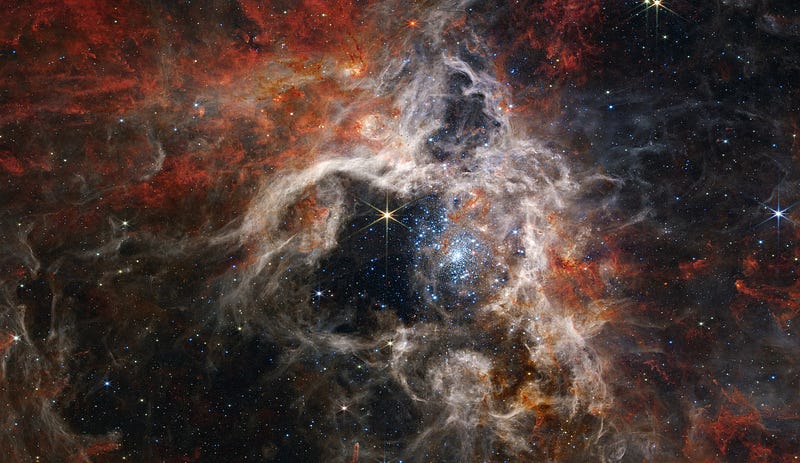
Tarantula nebula — [Photo: NASA, ESA, CSA, STScI, Webb ERO Production Team, Public domain, via Wikimedia Commons]

Where do stellar black holes come from? Most often, they are remnants of supernova explosions, supermassive stars that end their lives by exploding. But is such an end of life always accompanied by a spectacular explosion? Or are there also silent deaths, the collapse of a star without a clear ejection of matter?

The study of VFTS 243, a double star system from the Large Magellanic Cloud, may help answer this key question for understanding stellar evolution.
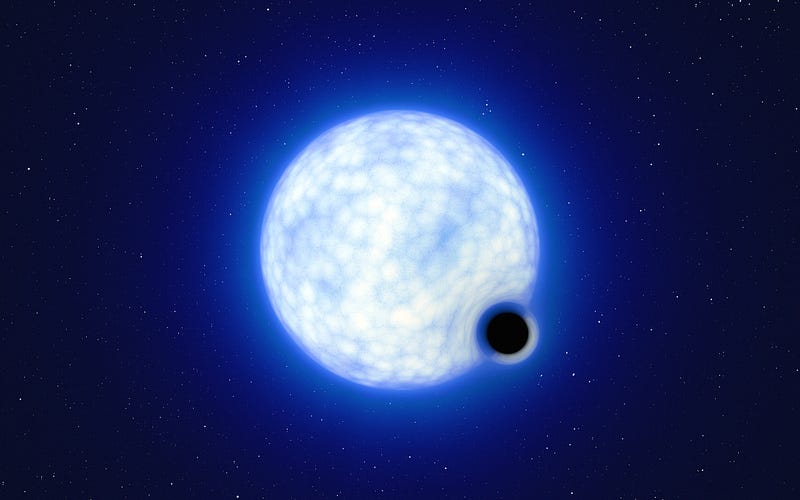
Artist’s impression of VTS243 — [Photo: ESO/L. Calçada, CC BY 4.0, via Wikimedia Commons]

Mysterious space couple

VFTS 243 is located in the Tarantula Nebula, visible in the southern sky. Thanks to observations from the European VLT telescope, it has been determined that in this binary system a young massive star with a mass of 25 Suns has an invisible companion with a mass of at least 9 Suns. What is this companion? A six-year study of the system has led astronomers to conclude that the only acceptable explanation is that there is a relatively massive stellar black hole in the binary system.

Analyses have been difficult because the two bodies are separated by a relatively large distance, and the black hole is not capable of absorbing the matter of its companion. With such devouring, strong X-rays are easily detected, and here we are dealing with an ascetic black hole. But this is why the discovery is important. There is no mass flow in the system, which usually leads to tightening and circularization of the stars’ orbits.

So it can be assumed that the current orbits of both components are close to those existing just after the birth of the black hole. And the shape of the current orbit suggests that the star from which the black hole formed exploded quietly — there was no large mass ejection, nor did the kickback — the recoil of the star caused by its asymmetric explosion, which is common in such explosions — happen.
VFTS 243 — [Photo: Pelligton and Aladin Sky Atlas in HST color, CC BY-SA 4.0, via Wikimedia Commons]

Tip of the iceberg

Silent supernovae, therefore, do exist. There may be more of them than we previously thought. As the researchers write, it seems that the few known ordinary X-ray binary systems with a black hole and a massive visible star represent only the tip of the iceberg. Hundreds of quiescent counterparts to X-ray-visible systems are predicted to exist in the Milky Way and Magellanic Clouds. Yet so far we remain virtually blind to these elusive fascinating systems…

Cool that you made it to the end of this article. I will be very pleased if you appreciate the effort of creating it and leave some claps here, or maybe even start following me. It would be nice if you also left a tip! Thank you!

Black Holes
Science
Research
Life Lessons
Space
Recommended from ReadMedium