
The multiverse: once a speculation, now a hypothesis based on a mathematical foundation
“Personally, I would prefer to derive the values of the physical constants based on some deeper mathematical structure, but as long as we don’t know it, it is worthwhile to clarify the constraints imposed by the anthropic principle. If such a structure is not found, and the anthropic constraints on the constants turn out to be very strong, that would be a reason to take the concept of a world ensemble seriously, even if it were to displease someone.” — said Brandon Carter in 1973. Is the multiworld concept still a speculation?
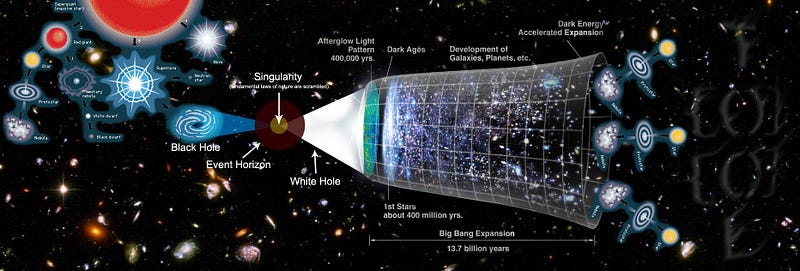
It has been 13.8 billion years since the Big Bang. That’s how long the light sent by the most distant objects we can observe today ran to us. But because cosmic space has continually expanded during that time, they are now 46.5 billion light years away from Earth. The observable universe, a sphere 93 billion light-years in diameter with our planet at its center, contains hundreds of billions of galaxies. Each has an average of a hundred billion stars, accompanied by an average of several planets each. If each planet were turned into a grain of sand, they would weigh a total of several hundred trillion tons.
Compared to Earth, the cosmos is so disproportionately large that the question is directly imposed: couldn’t it be smaller? — Naive, but only on the surface. Yes, all these galaxies could be much closer to us if, for example, the constant of gravity had a correspondingly larger value. But even a slight increase in it would have caused the universe to stop expanding and collapse to the state from which it emerged in the Big Bang before the Sun and Earth were formed. The consequences of reducing the constant of gravity would have been equally unhappy: neither galaxies, stars nor planets would have formed. Conclusion: a significantly different value of this physical parameter could not have been observed, because we would not have existed.

Amazing fine-tuning
About half a century ago, it was found that similar reasoning about many other parameters leads to the same conclusion. An example: a fraction of a second after the Big Bang, there were no atoms or even atomic nuclei in the universe — it was filled with elementary particles. The reactions taking place between them caused the cyclic transformation of protons into neutrons and neutrons into protons, with the number of neutrons per proton decreasing as the universe expanded and its temperature decreased.
When it dropped below eight billion kelvins, the transformation reactions stopped completely. This occurred when there was now only one neutron for every six protons. If a proton were lighter than a neutron not by one, but by half a per mille of its mass, there would be almost as many neutrons as protons left at the same moment. And this means that the most widespread element in the universe would not be hydrogen, but helium. In place of Sun-like hydrogen stars, which shine long and steadily, thus creating the possibility for life to develop on the planets around them, short-lived helium stars would appear, and the water necessary for life would become a cosmic rarity.
Another example: The Sun is not the first or even one of the first stars formed in the universe. Along with the planets orbiting around it, it formed from matter that had been digested by previous stellar generations, enriching it in the process with the element carbon, which is essential for the development of life. The nucleus of a carbon atom is formed from three nuclei of helium atoms. Their simultaneous contact is very unlikely, so the synthesis of carbon takes place in two stages. At the first stage, two helium nuclei fuse to form a beryllium nucleus, which must “capture” a third helium nucleus at the second stage. However, it has little time to do so, since it is impermanent and decays in a fraction of a second. If the physical constants that determine the magnitudes of the forces acting inside atomic nuclei had slightly different values, it would be virtually impossible to pass through the second stage. There would be no carbon or oxygen in the Solar System and no living organisms would appear on Earth.
The growing belief that the physical constants are “tuned” in such a way that life could appear in the universe led to the formulation of the so-called anthropic principle. It was presented in 1973 by Brandon Carter, a physicist and cosmologist working at the University of Cambridge at the time. Various versions of it have appeared over the past half-century (Carter himself gave a “weak” and a “strong” version). The crux of each, however, is the same and boils down to the statement: “we can observe only that which meets the conditions necessary for our existence as observers.” In other words — the answer to the question “why do the parameters of the universe have such and not other values?” is: because the fact of our existence significantly limits them (makes it impossible to choose them arbitrarily).

A necessary clarification
Carter’s idea turned out to be so interesting and fertile that to this day it is still being dealt with not only by physicists and cosmologists, but also by philosophers and even theologians. Unfortunately, from the point of view of science, it has a fundamental flaw: it does not allow to draw conclusions that can be verified in some way. When I write “science,” I mean those natural sciences that owe all their success to the application of the so-called scientific method.
The foundation of knowledge gained through this method is experiments and observations, by means of which we try to detect regularities occurring in the external world. Having detected them, we set about describing them in such a way as to make it possible to forecast the results of subsequent experiments or observations. If the prediction is accurate, we consider the description correct.
Successful verification of multiple independent predictions elevates the description to the status of a theory, while observations that, like the anthropic principle, do not enable prediction become worthless from the point of view of science. (Incidentally, contrary to its colloquial connotation, “theory” is a top-shelf product in science, which can be relied upon and which we more or less consciously use in everyday life; for example — the general theory of relativity is not only black holes, but also smartphones with a GPS app).
Since the anthropic principle is unscientific, the question of the reasons for its enduring popularity becomes legitimate. A significant role must undoubtedly have been played here by the final passage of Carter’s paper, in which he stated:
“Personally, I would prefer to derive the values of the physical constants based on some deeper mathematical structure, but as long as we do not know it, it is worthwhile to clarify the limitations imposed by the anthropic principle. If such a structure is not found, and the anthropic constraints on the constants turn out to be very strong, this would be a reason to take the concept of world ensemble seriously, even if it were to displease someone.”
Chaotic turmoil
“A world ensemble,” commonly referred to today as a multiverse, is a collection of universes that differ in the values of physical constants and/or the laws of physics. By definition, they exist outside our universe as real as possible, although any contact with them may be impossible. In this concept, the fine-tuning of the parameters of our universe is explained in the same way as the fact that we evolved on Earth and not on any of the trillions of planets where the conditions were not right. Life simply appears in those universes where it is possible. Others remain dead.
Carter’s idea lacked a theoretical underpinning, but he didn’t wait long for it. In 1980, Alan Guth, then working at the Stanford Linear Accelerator Center, presented the hypothesis of so-called inflation, according to which, at a very early stage of evolution, the cosmos rapidly accelerated its expansion and instantly “swelled up” (this solved the problem of certain features of our universe that the Big Bang theory could not cope with).
A very simplified analogy of this phenomenon is the rapid boiling of water, with steam bubbles corresponding to separate universes. During chaotic inflation, the entire space-time “boils” while expanding so rapidly that the “bubbling” universes move away from each other at superluminal speeds.
The inflation hypothesis was received enthusiastically, but after a few years critical voices were heard. Some pointed out that there are arbitrary parameters in it, which have to be tuned very carefully if the post-inflation universe is to look like ours, so that the problem of tuning is not solved, but only transferred elsewhere. Others — that the conditions necessary to initiate inflation are very unlikely. Even one of its “fathers” — Paul Steinhardt — felt disappointed with inflation. He completely turned his back on it and presented a radically different approach to the problem originally attacked by Guth.
Multidimensional tremor
Despite this criticism — supporters and promoters of inflation are still not in short supply. Probably in part because for the last twenty years or so the concept of chaotic inflation has been receiving strong support from string theory. It should be noted at this point that string theory has not been tested observationally or experimentally — so it should rather be referred to as a hypothesis. However, the term has become so widespread that there is nothing to do but follow the scientists and popularizers who apply it.
According to string theory, the foundation of physical reality is made up of microscopic filaments (“strings”) that exist in a space of ten or eleven dimensions (that’s how many are needed to make the theory mathematically consistent). We perceive only four “ordinary” ones (three spatial and a temporal one), because the others are “compacted.” That is, they relate to the ordinary ones more or less like the circumference of a thin optical fiber to its length.
The strings are constantly vibrating in different ways, with each type of vibration manifesting itself as one of the elementary particles (such as an electron or photon). Compactification turns dimensionless points of classical space-time into extremely complex creations of finite, though very small, size, whose shapes determine what types of vibrations are allowed. It can be done in at least 10500 ways, each of which generates a different set of elementary particles and the interactions between them. Different particles and different interactions define a different physical reality, or a differently arranged universe.
10500 is one with five hundred zeros — string theory therefore allows for the existence of a truly enormous number of universes. Moreover, it is able to describe how they evolve in a multiverse composed of them. This process is in principle not qualitatively different from chaotic inflation.

A biting term
Despite its lack of experimental or observational support, string theory continues to be held in high regard by many cosmologists and particle specialists, including such scientific notables as Nobel laureates David Gross of the University of California and Gerard ‘t Hooft of Universiteit Utrecht. Its critics are also numerous, including the famous late Nobel laureate Richard Feynman.
Particularly fierce attacks are being levied against those who demand the recognition that string theory is so mathematically elegant and explains so much that it does not require experimental verification.
“From here, it is only a step to abandoning the scientific method as a tool for acquiring solid knowledge and to relegating theoretical physics to a no-man’s land between mathematics and philosophy, where it will not meet the requirements of either discipline,” warn cosmologists George Ellis of the University of Cape Town and Joseph Silk of the University of Oxford in the pages of the prestigious science weekly Nature. And they add: “Before you put forward a new idea, ask yourself: what experiments or observations would make you abandon it? If you can’t answer, abandon it immediately. The imprimatur of science is due only to those concepts that can be tested.”
Probably not all physicists will agree with such a sharply outlined position, but willy-nilly they must admit that mathematics is much richer than physics. An excess of mathematics with a paucity of data is accused by particle physics practitioner Sabine Hossenfelder of the Frankfurt Institute for Advanced Studies, otherwise known as the cutthroat owner of a scientific YouTube channel. “Some people confuse mathematics with reality,” she says bluntly in one of her clips. She seems to be the origin of the grating term for string theory as “fact-free physics”.
Methodological confusion
The concept of the multiverse was born as pure speculation derived from the anthropic principle. Today it has become a decent hypothesis based on chaotic inflation and string theory, which gave it a rich mathematical foundation. However, this is not enough to assume that other universes really exist, because neither inflation nor string theory has been successfully tested. Key tests of string theory would have to be carried out at practically impossible energies of elementary particles, and previous attempts to test it at lower energies have proved inconclusive.
A realistic chance to test it, however, is inflation, which predicts the possibility of indirect detection of gravitational waves excited during the “swell” epoch of the universe. Detectors capable of recording them should appear later this decade. However, the detection of the signal alone may not be enough to determine how the inflation took place and whether it could generate other universes. Most likely, further technically challenging research will be needed, requiring increased sensitivity and resolution of the apparatus.
Meanwhile, the effect of fine-tuning is blurring. Fred Adams of the University of Michigan has written an extensive paper on the subject, recently published in the world-renowned journal Physics Reports. In almost all of the cases it describes, the anthropic principle allows, in the author’s words, a “pretty wide” range of parameters. According to him, a common cause of overestimation of the fine-tuning accuracy is methodological errors.
For example — the consequences of changes in a single parameter were usually studied, while simultaneous changes in at least two parameters generally expand the acceptable range of each parameter, i.e. weaken the effect of fine-tuning. It may eventually turn out to be so inaccurate that the need to explain it disappears. Other universes would then simply become redundant.
Cool that you made it to the end of this article. I will be very pleased if you appreciate the effort of creating it and leave some claps here, or maybe even start following me. It would be nice if you also left a tip! Thank you!