
An Introduction to Python Dictionary
Let’s dive deeper and know about the python dictionary.

Python Dictionary
Dictionaries can be created by placing a comma-separated list of key: value pairs within braces{} or by using dict() constructor. An empty dictionary is represented by {}. The dictionary contains key-value pairs. Keys are unique and can be of any immutable datatype like string, tuples, or numbers. The values of a dictionary can be of any datatype. We can access the items in the dictionary by using a key. Dictionary is unordered.
Topics covered in this story
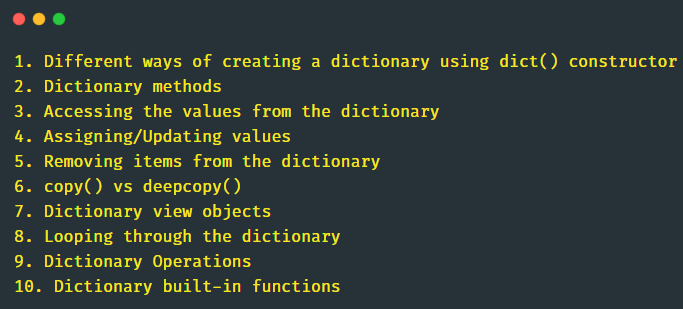
Different ways of creating a dictionary using dict() constructor
dict(**kwarg)
dict(mapping, **kwarg)
dict(iterable, **kwarg)
**kwarg-arbitary number of keyword arguments
- Creating a dictionary from keyword arguments:
dict(**kwarg)
2. Creating a dictionary using mapping:
dict(mapping,**kwarg)
3.Creating dictionary using iterable.
dict(iterable,**kwarg)
Dictionary methods.
- keys() Return a new view of dictionary’s keys.
- values() Return a new view of the dictionary’s values.
- items() Return a new view of dictionary’s items (key,value)pairs.
Accessing the values from the dictionary
We can access the values by using the get method and also by indexing. If the key doesn’t exist in the dictionary means, get method returns None. But when we use indexing, it will raise KeyError.
- get()
get(key,default)
Returns the value of that specified key. If the key doesn’t exist in the dictionary means returns None. If the default is specified, it will return the default value if the key doesn’t exist.
Using indexing
d[key]
Returns the value of the key. If the key doesn’t exist in the dictionary means it will raise KeyError.
Assigning /Updating values
d[key]=value
Set d[key] to value. If the key already exists in the dictionary means, it will update the value. If the key doesn’t exist in the dictionary means, it will add that key, value pair.
- iter()
iter(d)
Return an iterator over the keys in the dictionary.
- fromkeys() Create a new dictionary with keys from iterable and values set to value. fromkeys() is a class method that returns a new dictionary. value defaults to None.
fromkeys(iterable,value)
- setdefault() setdefault() method returns the value of a key (if the key is in the dictionary). If not, it inserts a key with a value to the dictionary. If the key is only mentioned, it will insert key with value as None.
setdefault(key,default)
Updating the items in the dictionary
- update() update() method is used to merge the second dictionary into the first dictionary. It will update the value of the first dictionary. It won’t create a new dictionary. It is used for merging two dictionaries. Update() method adds elements to the dictionary if the key is not in that dictionary. If the key is in the dictionary means, it will update the new value.Update() function won’t return any value.
update(other)
other argument can be another dictionary object or an iterable of key/value pairs (as tuples or other iterables of length two). If keyword arguments are specified, the dictionary is then updated with those key/value pairs.
Removing items from the dictionary
popitem() Remove and return a (key, value) pair from the dictionary. Pairs are returned in LIFO order. If the dictionary is empty, calling popitem() raises a KeyError. — python docs
- pop() If the key is in the dictionary, remove it and return its value, else return default. If the default is not given and the key is not in the dictionary, a KeyError is raised.
pop(key,default)
- clear()
clear() will empty the dictionary.Its return value is None.
delkeyword is used to delete the dictionary itself. We can also delete the key from the dictionary by usingdelkeyword. If the key is not in the dictionary means, then it will raise KeyError.
copy() vs deepcopy()
copy() method returns the shallow copy of the existing dictionary. A shallow copy means a new dictionary value is updated with references to objects in the existing dictionary. If we change the value of immutable data types in the original dictionary means, it is not reflected in the copied dictionary. But if we change the value of mutable datatypes like list means changes are reflected in the copied dictionary also. To avoid this, we can use a deep copy(). In deepcopy(), if we change either mutable or immutable data types of the original dictionary, changes are not reflected in a deep copied dictionary.
Dictionary view objects
The objects returned by dict.keys(), dict.values() and dict.items() are view objects. They provide a dynamic view of the dictionary’s entries, which means that when the dictionary changes, the view reflects these changes.-python docs
Dictionary views can be iterated over to yield their respective data and support membership tests.
iter(dictview)
Return an iterator over the keys, values, or items in the dictionary
reversed(dictview)
Return a reverse iterator over the keys, values, or items of the dictionary. The view will be iterated in reverse order of the insertion.-python docs
Looping through the dictionary
Dictionary Operations
Membership Test in, not in
in — Returns True if the key is present in the dictionary. Checks only key and not values.
Dictionary built-in functions
- len() — Returns the length (no of items) of the dictionary.
- list()-Returns the list of all keys in the dictionary
- sorted()-Returns the sorted list of keys in the dictionary.
- reversed()-Return a reversed iterator over the keys of the dictionary.
4. all(): Returns True if all keys(not values) in the dictionary is True or if the dictionary is empty.
5. any():Returns True if any key(not values) in the dictionary is True.If dictionary is empty returns False
Conclusion
- Return type is view object keys() values() items()
- Return type is List list(d),sorted(d)
- Return type is iterator iter(d),reversed(d),iter(dictview)
- Return type is dictionary copy(),deepcopy(),fromkeys()
- Return type is tuple popitem()
- Return type is None clear()- Doesn’t return anything.It will clear the original dictionary. update()-Doesn’t return anything.It will update the original dictionary.
- Return type is integer len()
- Return type is Boolean any(),all()
- reversed(d)- supported from Python version 3.8
My other blogs on Python data structures
An Introduction to Python List
An Introduction to Python Tuple


