An Informative Take on Arthurian Legend
A review of ‘The Strife of Camlann’ by Sean Poage
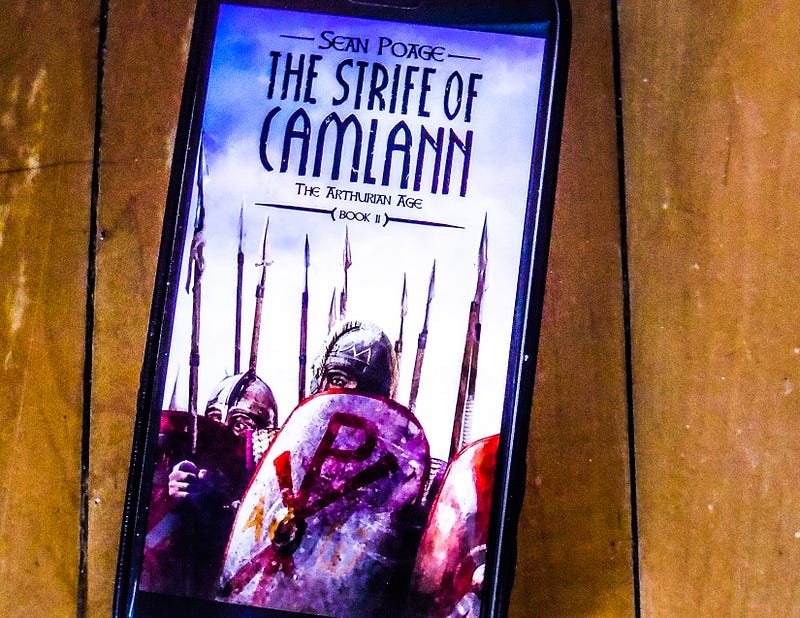
I took an independent study on Arthurian legend when I was in college. My reading material included The Once and Future King, Le Morte d’Arthur, Idylls of the King, The Acts of King Arthur and His Noble Knights, and others.
I’ve seen just about every King Arthur movie as well, that includes Excalibur, Camelot, and the Clive Owen King Arthur from 2004. I’ll get back to that film in a moment.
The thing I’ve always liked about Arthurian legend is how it balances the mystical element. Even when the mystical element is present, Arthurian legend never quite feels like fantasy. Merlin almost never comes across like Gandalf, he more often has power the way you think of Rasputin having power. The character is hypnotic, commands people, he seems to know things, but is he a wizard? Well…maybe.
It is a well known literary tradition for modern writers to try their hand at Arthurian legend. The collective nature of the stories is largely what gives Arthurian legend its power. There is no ‘canon,’ although subsequent works are judged by how well they are true to what feels like the ‘correct’ impression.
Yes, it’s vague. That’s what makes it awesome.
For the purposes of this review, the Clive Owen film from 2004 stands out because it attempted to bring more realism to the legend of King Arthur. In a similar fashion, Sean Poage places a focus on the history of Arthur’s time. As far as I’m concerned, Poage suceeds better than the 2004 film.
The Strife of Camlann is the sequel to The Retreat to Avalon which was published in 2018. Gawain is the protagonist in both of the books, which is a good narrative choice. It’s often easier to present other characters with appropriate awe when you invoke the perspective of a secondary character.
Anyone who is a fan of Arthurian Legend will find something of interest in this series. Poage’s writing is well-researched and deliberate. There is an extreme attention to historical detail. This is the kind of book that will bring greater understanding to other famous tales of Arthur and his knights.
I was chatting with Poage on Facebook as I prepared for this review, and he asked me to offer some criticisms. The main thing that jumped to mind was the inherent difficulty of including the traditional Arthurian mysticism in a historically based retelling.
Even in modern times, it’s possible to see how manipulative messaging can apparently “hypnotize” large masses of individuals. I found myself struggling with the idea of including that kind of social commentary in a King Arthur book. I also lamented the fact that removing the mysticism removes much of the power of Arthurian legend.
Poage quickly pointed out a scene that comes late in the book when Gwenhwyfar (Poage chose this of many spelling options) threatens Mordred with a Queen’s curse, and of course I felt foolish that it didn’t immediately come to mind.
It’s believable that a respected queen could bluff her way out of a moment of aggression by threatening a curse. The superstitions of those attacking her would be sufficient to deter any intended violence, particularly if the queen was authoritative enough in her declaration.
This is exactly the form of mysticism a King Arthur book grounded in history needs to emphasize. It’s the kind of thing that makes you reflect that all the elements of Arthurian legend are grounded in reality. A nice comparison would be to understand how people could find dinosaur bones and imagine that the world must have once been populated with flying dragons.
There’s a kind of beautiful and essentially human truth that floats through the pages of Arthurian legend. Poage’s iteration grounds the legend to some extent, but all of the elements, including the mystical elements, are still present.
There might be slightly less flash in The Strife of Camlann than you’ll find in say… The Sword and the Stone, but there is a truth that resonates as essentially Arthurian.
This is a worthwhile series.
Support the author of this review:
Find your next read here: