
BOOK REVIEW
Well, What Are Writers For?
Uschi Gatward’s English Magic “bears witness, offers commentary and critique, and adds to the conversation”
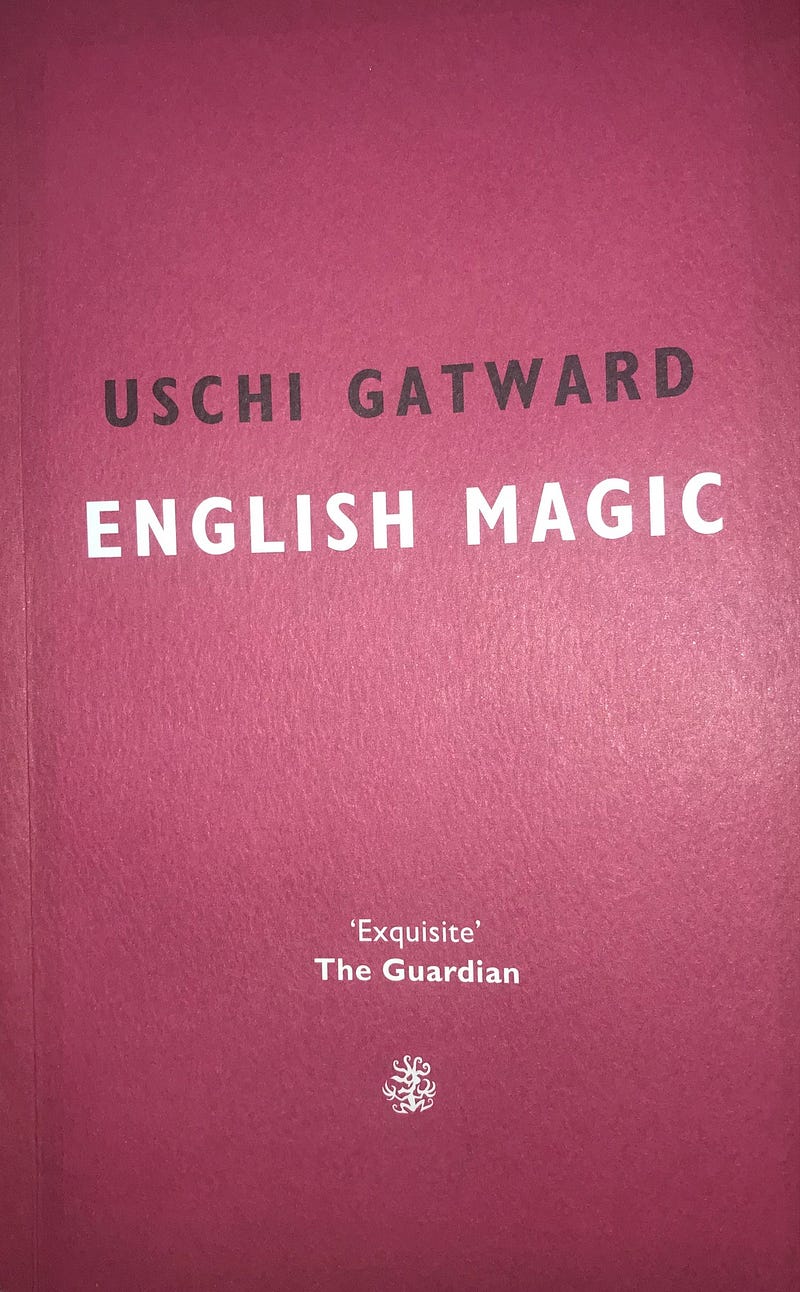
On the 4th of January 2022, Gatward’s publisher sent readers news of her passing. The subject line caught my eye: Uschi Gatward 1971–2021.
It was sobering to note: Uschi Gatward was just a few years older than me.
While I read the publisher’s tribute, my heart decided English Magic would jump the queue of short story collections to be read, and insert itself as priority, ahead of various readings in progress.
It lay exactly where I’d placed it months ago: on top a pile of books to be read, wrapped in charcoal-grey kitepaper.
I felt saddened to think Gatward would never now read any review I might write. But even so, here it is. Maybe she would have liked it.
A Glimpse of English Magic’s 12 Short Stories
The Clinic
The setting is a dystopian future. A mother, desperate to protect her precocious child from the State, plots a secret escape for her family.
Is her child at risk of being studied, trained, brainwashed or eliminated? Or all four? How long can her family live in hiding in the forest? For how long do they need to? The reader is free to speculate on the nature of this future world but the mother’s fear and its sinister nature is palpable.
This piece speaks to me of fears which have a constant lurking presence for many of us — and yet we speak of them less than we feel them.
- can we trust the State to act in our interest?
- what if our individual interests are not compatible with the State’s “greater good”?
- does the idea of the “greater good” provide cover for the State to cause us harm?
- could we survive away from the concrete and high-tech world we’ve grown dependent on?
- could we remove ourselves from state surveillance effectively and safely?
My Brother Is Back
Inspired by the true story of Talha Ahsan, a British Muslim detained for seven years in the US without charge, My Brother Is Back captures disregard and disrespect for the humanity of innocent but incarcerated detainees. With no apology, no compensation, no facilitation, no arrangements to ensure his well-being, Syed arrives in Heathrow with nothing but the clothes on his back and his passport in hand.
Oh Whistle And
Gatward opens with the John Le Carré quote: “God has very particular political opinions”.
This is a story sprinkled generously with humour, wide in scope and packed with so many social commentary threads that full essays could be written about it. It’s worthy of a full review of its own.
Again, the themes of distrust and surveillance re-surface, as Gatward whizzes us around an A-Z of characters, and what they’re up to.
Here we find Edward Snowden, surveillance, the urge to avoid surveillance, the extremes people go to in avoiding surveillance; workers organising, workers distrusting management; hackers planning cyber attacks on Tory party HQ, algorithms linking unconnected people together and imputing bad intent; teachers acting to seek out would-be terrorists in the classroom under the UK’s PREVENT strategy … and whistleblowers who might end up dead.
Gatward reminds us towards the end of Oh Whistle And, that the word ‘algorithm’ is derived from the name of Muhammad ibn Musa al-Khwarizmi.
She writes of him:
a mathematician-astronomer during the Abbasid Caliphate in ninth-century Baghdad, whose achievements include popularizing the use of algebra and introducing positional notation to the West. Every day a school day, huh?
Beltane*
I re-read the first page many times before I got into this one. But when I fell in with the story I loved it.
Beltane has created for me an interest in the old English ritual of May Day. I wondered to what extent Gatward described traditional May Day celebrations? Where in England could I attend such a ritual to see for myself the Queen of May and the ritual dancing, celebrating and blessing the fertility of women? Might there really be a traditional game of jumping over burning hay bales?
Reading Beltane reminded me of the scene of Kathakali dancing in Arundhati Roy’s The God of Small Things. As with Beltane, reading about the tradition shifted it from an unknown in my mind, to something of value and importance in our human tradition.*
Four stories in, Beltane solidified my enthusiasm for the collection.

The Bird
A newly married couple save a gull trapped in their chimney. At first they think it’s a pigeon. For me this story triggered thoughts about activism. Who do we choose to save and who do we allow to die? How do we decide what causes are worth our effort? How do we decide to turn a blind-eye, even while the cause is tapping away at our consciousness?
On Margate Sands
A woman is visiting a seaside town. She remembers another visit there with a friend, back in her university days when music was played on records, and cigarettes in English hands were as ubiquitous as smart phones are now. Reading On Margate Sands, we feel nostalgia, and grief for memories lost or misremembered. We’re reminded of the attachments we form as children, so often painfully shattered by future realisations of what these attachments look like under the glare of our adult perspective.

The Creche
A story full of small details and little people. Mums and toddlers are on an excursion — a day trip to the seaside coast, from Essex via London. This is a story which could strike you in so many ways. The English weather! The diverse origins of the modern English population! What really matters in life! And when you’re a parent of a toddler, the little things matter a lot!
Lurve
Young Londoners, young artists — seeking pairings, rejecting suitors, brushing off heartbreak. I enjoyed the reading of Lurve particularly, though it seemed to end rather flatly…

But wait! I’ve just discovered that vernissage, midissage and finissage are not playfully made-up words, but references to stages of an art exhibition! I am now prompted to re-read Lurve to see what I’ve missed!
I think I get it now! Vernissage, midissage and finissage are stages in Ollie’s study of Jeanie’s potential to go past platonic!
(I apologise. I get overexcited sometimes. No more spoilers).
Gatward winds a few political commentary threads through Lurve:
Shadows falling across the frosted glass, and voices in Banglish outside. Then distinctly: Fuck off back to Shoreditch.
The window shatters in front of his eyes.
***
Ollie sits in the kitchen of the woman two doors down as she cleans up his forehead. I wouldn’t mind, he says, but I was actually born here. Y’know? I was born up the road from here.
Course you were, says the woman. They weren’t, were they?
That’s not what I meant, says Ollie.
And Lurve is rich with a sense of history and the passing of time:
He runs into Max Levitas in the upstairs café and gets him a cup of tea. Tell me about the whole thing all over again, Max, says Ollie, and the Cable Street veteran obliges.
Join the Young Communists, young man! shouts Max as Ollie leaves him.
I will do, Max, I will do, says Ollie.
It’s the only way to defeat the fascists.
And
Back in its heyday, at the turn of the century, the Victorian pub was frequented by Hirst, Emin and Lucas. Now it’s frequented by Ollie, Jeanie and Lottie. Half the private view is on the pavement, puffing at e-cigs through beards.

Muslim Londoners are everywhere in Lurve, rightly represented as the non-homogeneous grouping they are. From artists to council estate thugs, from those feeling threatened to those creating threat, with George Galloway and Crusader jokes deftly slipped in.
Lammas
This was my favourite. Lammas spans decades beginning in 1892 with active resistance against the laying of rails through community property.

Lammas reminded me of a book on my TBR List which I hope to get onto this year, Plunder of the Commons by Guy Standing.
These lines in Lammas brought tears to my eyes:
I exhaled heavily. Will the young people carry on our work, do you think?
One never knows. It’s all an act of faith, isn’t it? Ironically. Perhaps they’ll come up with something of their own that we haven’t had the wit to think of yet.
Samhain*
It’s Hallows’ Eve for a woman and her daughter — less the highly commercialised Halloween and more the ancient connection with nature, with which all our rituals were once infused.
What’s For You Won’t Go By You
Addiction and drugs, success and despair, aromatherapy, herbs and Tarot cards. Another Ollie and an ending on a hopeful note.
Backgammon
A fragile male ego in a fragile partnership. What a dismal note to end on.
English Magic devotes itself faithfully to the English people — the many, not the few; the common folk, not the elite and powerful — making an exception for Lammas’ Musgrave, who shows solidarity:
He was a decent fellow, Musgrave, I said. He was well-to-do — he had a professional standing. And property, plenty of it. Didn’t have to throw his lot in with us. What was it to him whether the commoners kept their land?
What would it do for our race relations in the UK if we taught more of the history of the grassroots of the United Kingdom, and less of the history of the UK’s rulers? And as for the offshore history of the UK, how about more of what happened during the days of the British Empire and less of the glorification of Empire; let’s have history, as the children’s educational brand Horrible Histories cleverly puts it, “with the nasty bits left in!”
In English Magic, Uschi Gatward has given us a glimpse of what is needed.
I’ll end with Gatward’s own thoughts on the question of “what are writers for?”
I think they’re also there to help make sense of things, to keep notes, to bear witness, to offer a commentary and a critique, to add to the conversation, and to contribute to the permanent record — Uschi Gatward (1972–2021)
Quotation source: full Q&A interview with Uschi here.
*Curious about Beltane and Samhain as I was? Read more here and here.
English Magic is published by small independent publisher Galley Beggar Press and is available from their website, as well as from Amazon on both their US and UK sites.
It’s been a pleasure sharing English Magic with you. Please note, there are no affilate links for this book, nor commissions associated with this review.
What does it mean to be English?
If you aren’t English yourself, it might surprise you to know that Englishness, what it is and isn’t, is discussed on contemporary English talk radio these days. Was Uschi Gatward trying to address the question of Englishness, or prompting us to ask the right questions in the first place?
What’s included and what’s excluded in this story of Englishness? What does Englishness bring to mind for you?


