
Inspiration and Life
An Important Skill You Need Now
What asking powerful questions can do for your life

Imagine having the power to change your life or anyone else’s by asking a simple yet powerful question. Is it possible? Absolutely! Look at your life. You are where you are today because of your answer to either a standard or powerful question posed by yourself or someone else.
Practically everything in life starts with a question. If you wish to live the best possible life, there is no better place to start than with the right questions — the more power in the questions, the more potential in your life. But what makes a question more or less powerful? Let’s find the answer to that question!
The power of questions
“Change your questions, change your life!” Merilee Adams, Ph.D. (1944-present)
To make the best use of your mind and life, you must ask the right questions. Your ability to ask powerful questions is one of the most crucial skills you can develop. It will change your life and the lives of those around you.
The wisest people of all time became wise by asking and answering the right questions. If you never take the time to ask yourself the right questions, how can you expect to progress and grow?
“The wise man doesn’t give the right answers, he poses the right questions.” Claude Levi-Strauss (1908–2009)
Think about this: The quality of a question determines the quality of your thinking. Likewise, the quality of your thoughts determines the quality of your learning.
You can also state it thus: The better and more powerful the question, the greater the potential to expand your knowledge and understanding.
What exactly is a powerful question? Let’s look at a simple way to understand and immediately use powerful questions in your life. We will start by contrasting low-power questions with more powerful questions.
Low-power questions
Low-power questions start with where, which, when, who, do, will, or can and provide limited information. Such questions are often closed-ended, resulting in a short and simple answer.
Low-power questions lead the person to react or respond with an answer requiring little thought. These questions are great for narrowing and eliciting succinct responses. However, you can lose a good deal of information by using them.
To give you examples of low-power questions, notice how you can answer each of the following questions with only a word or two.
- When did you graduate?
- Where were you born?
- Which team do you like?
- What do you earn?
- Who did that?
- Do you know what you want to eat?
- Can you do this for me?
Powerful questions
Powerful questions often begin with how or what. Answering a powerful question requires more thought than a low-power question. Powerful questions lead to more profound insight and reflection, bringing flavor and richness to answers.
Powerful questions get a person to look inside themselves for answers. This is why professional coaches are usually good at asking such questions. A big part of their job is to help their client look inside themselves to come up with their own answers to situations.
To form a powerful question requires more thought, but the effort can pay huge dividends. Powerful questions help you gain new perspectives, furthering learning and subsequent growth.
“Asking questions is one of the best ways to grow as a human being.” Michael Hyatt (1955)
Examples of powerful questions can include:
- How can I help you?
- How can I know which is right?
- How do you explain that to someone?
- What do you want in your life?
- What countries do you want to visit?
- What may I do for you?
- What should I say to them?
While answering some of these questions with one or two words is possible, they are unlikely to result in such a short answer.
Most powerful questions
“Judge a man by his questions rather than his answers.” Voltaire (1694–1778)
Use of these most potent questions must be done with caution as they ask “why.” Why questions can be powerful when used correctly yet must be used carefully because of their potentially judgemental nature. When asking someone a why question, you ask for a motive or underlying reason. This can seem harsh to many people.
To understand their power, ask yourself, “Why did you do that?” It can help you deeply probe your underlying assumptions when used on yourself. But ask the same question to someone else, and you’re likely putting them on the spot in a way that can be most uncomfortable!
You can almost always rephrase a why question to a what or how question to remove any potential sting. Instead of asking:
- Why did you do that?
Rephrase it to:
- What happened? or
- How did you come to that decision?
Instead of shutting the person down, these rephrased questions will elicit a more open and honest answer.
Anytime you ask a why question to someone, pay attention to your intent. Ask yourself:
- Why am I asking this question?
- What do I need to know?
- Can I ask this question to get information without being judgmental?”
Let’s make it practical
Try this exercise to understand yourself better. Ask yourself the same why question multiple times. For example, “Why did I do that?” or perhaps “Why haven’t I done it yet?” After your first answer to the question, ask the same question to yourself again. After you have a couple of responses, ask the same question over and over until you have mined all that can be said.
With each answer, you will uncover a new or different perspective. The more perspectives you discover, the more you develop understanding and knowledge. I try to ask the same why question to myself at least six times. You may find you can come up with even more perspectives, but six is a good target for most of us. It will astound you how much deeper you can go when doing this and how many layers you can uncover.
Reference chart
Following is a drawing showing questions and their relative strength.
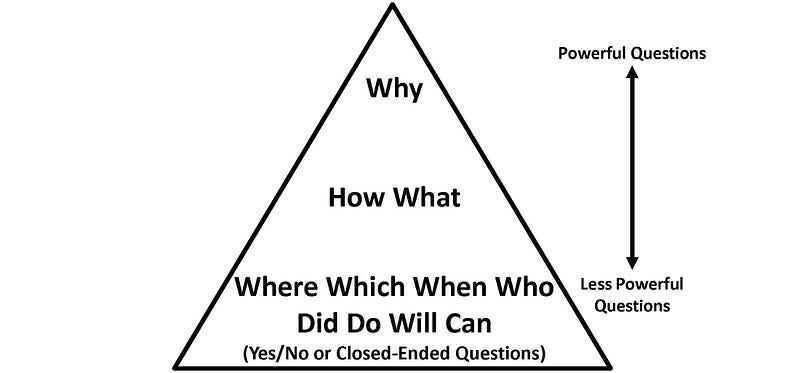
You can use this chart as a quick reference when formulating questions until you firmly learn it.
Final thoughts
“Learn from yesterday, live for today, hope for tomorrow. The important thing is not to stop questioning.” Albert Einstein (1879–1955)
As you develop the skill of asking powerful questions, you will find it easier to learn and achieve more. You can also use this skill to help others improve their lives. As you improve in this skill, it will undoubtedly lead to great rewards!
In summary, the right questions lead to the right answers, which lead to the right actions creating the right results for you and others. Practically everything good to come in your life begins with asking the right questions. What questions do you need to ask to create the best life possible?
I challenge you to become more conscious of and deliberate with the questions you ask! What greater gift could you give to yourself and those you love?
LinkedIn |Twitter| Medium| UncommonSense| AmazonAuthorPage | Parlor
Bill Abbate Leadership Writer and Editor in ILLUMINATION
Thank you for reading this article! If you enjoyed it, please check out the others below!