
An Explosion of Stillness
A Meditation
Stillness settled over me like a shroud of sun-warmed blue sky draping over soft red Sedona slick rock. My skin soaked in the heat of the spring afternoon. Towering spires of soft stone and striated canyon walls cradled me in their eternal wisdom.
And all around me, life happened. A tiny lizard scurried across the plateau. A yellow butterfly floated on the breeze.
Stillness is not the same as silence.
The longer you sit with stillness, the more you hear and see, but it is like you are seeing and hearing with different eyes and ears — eyes and ears which don’t need the mind to label everything.
Stillness holds space for the flap of a butterfly’s wings, or for the rustle of moldering leaves where a tiny bird roots for its next meal. Stillness includes the rhythmic battering of the pinon tree by the woodpecker who had flitted from branch to branch, just ahead of us, during our hike up to Vultee Arch.
In stillness, when I soften my gaze, I can see the “energy specks” in the air. And an amorphous buzzing fills my ears. When I hear it, that “buzz,” I know that I am present with the Universe.
Sitting cross-legged on a ledge of rock, that early spring day in Sedona, Arizona, I noticed it all. I let it all move through me. An explosion of stillness filled me completely, to overflowing, to the point where my heartbeat felt like it pulsed with the current of “being.”
Stillness can be found not only in seated meditation, but also when the body is in motion, and the mind softens to a certain point of receptivity. In that place of intense awareness, we are able to truly observe, without any attachment to our preconceptions about the world around us.
Most of the most profound moments of stillness that I can recall have been found in nature.
I remember the first time I went snorkeling in Maui, years ago. The dulling of the normal air-bound senses seemed to amplify the sound of my own heartbeat and transformed the streaming fingers of light, reaching down through the waters, into a grand cathedral.
And I remember coming face-to-face with a deer once, here in Sedona, on an early morning winter run. We startled each other so much that neither of us moved for what seemed like an endless second. In those black eyes, I saw eternity.
I opened my eyes, that afternoon on the ridge, to the sight of a fat black bee humming in mid-air about three inches from my face. I think that she sensed it — the momentary human immersion into the world she occupies all of the time, the world of “this moment.” I think that she wanted to understand me, just a little bit.
And when she flew off, I let my eyes remain open, taking in the striations of iron-rich sandstone and white lime which marked time in the looming cliff-faces all around me.
And the variations of “green” — from the bluish-haze of the one-seeded juniper to the dusty olive pines — boggle the mind.
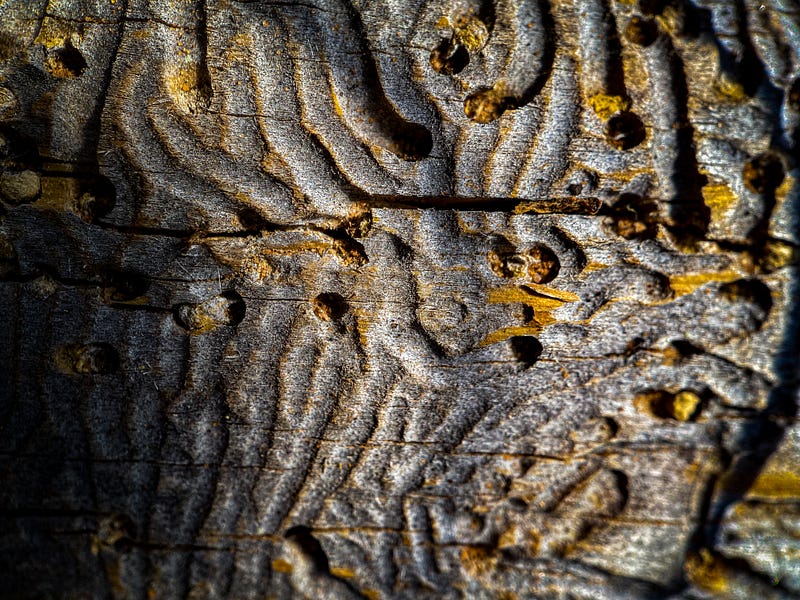
My husband and I had four-wheeled 4.4 miles in from the main road to the trailhead of Vultee Arch, and then had hiked in near-silence through the forest. We’d marveled at the peeling red bark of the mesquite trees and at the “petroglyphs” the insects had bored into a fallen log. And we’d been soothed by the peculiar hush of our footsteps, absorbed by the soft sand and clay under our feet.
A woodpecker had taunted us, allowing us a glimpse of his crested head and blue back, but never staying still long enough for me to photograph him.
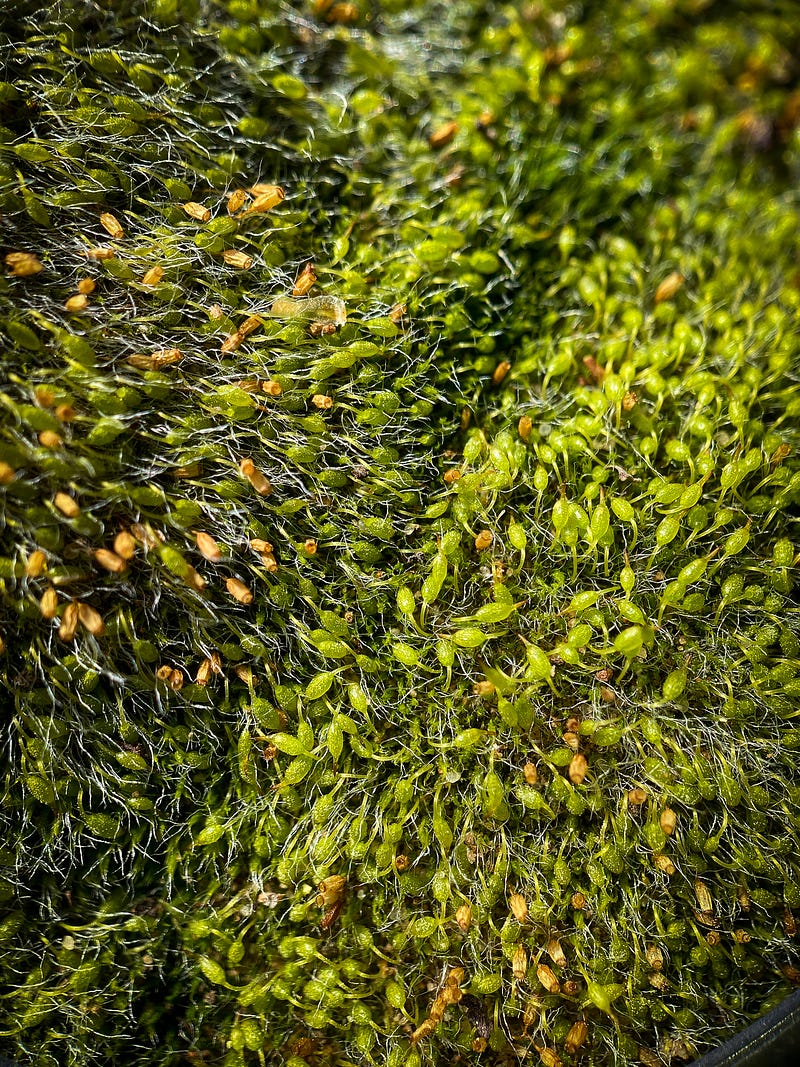
I had peered into the microscopic world of the fungi and lichen which painted the rocks. When viewed through my macro lens, a whole other universe yawned open in front of me. That universe is always there, although we don’t normally take the time to look for it.
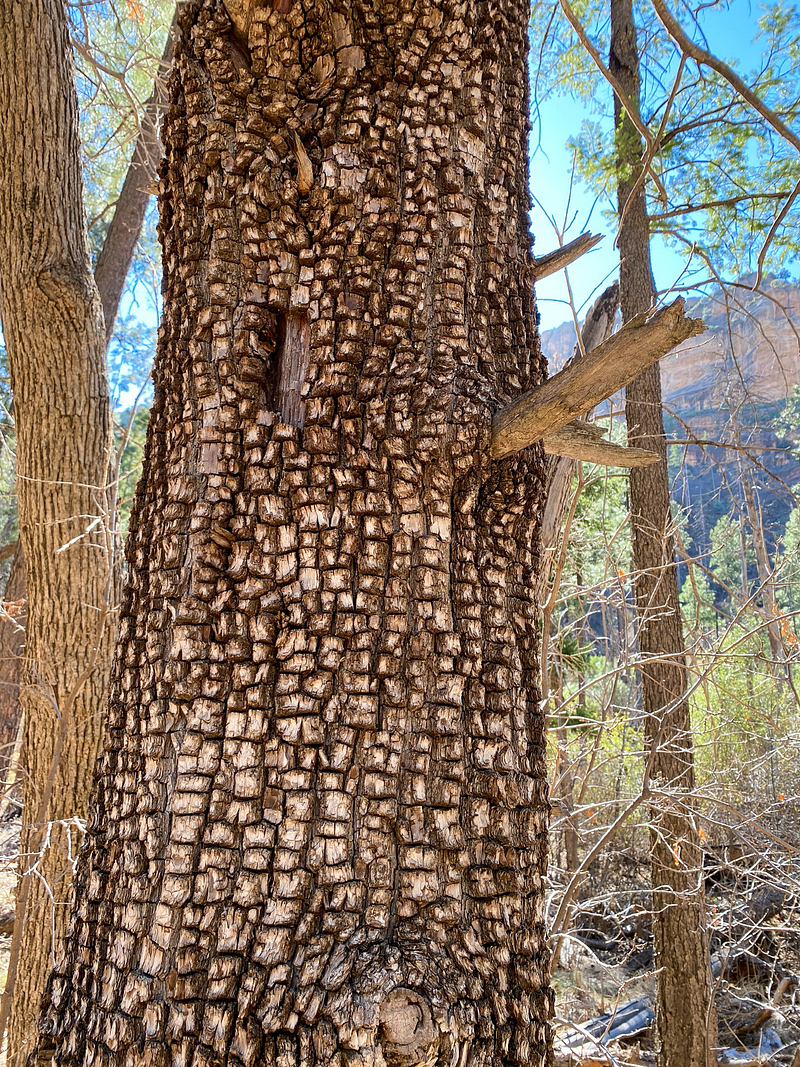
I couldn’t help but place my hands on the skin of an “alligator” juniper — feeling wisdom seep from between its rough scales of bark and into my palms.
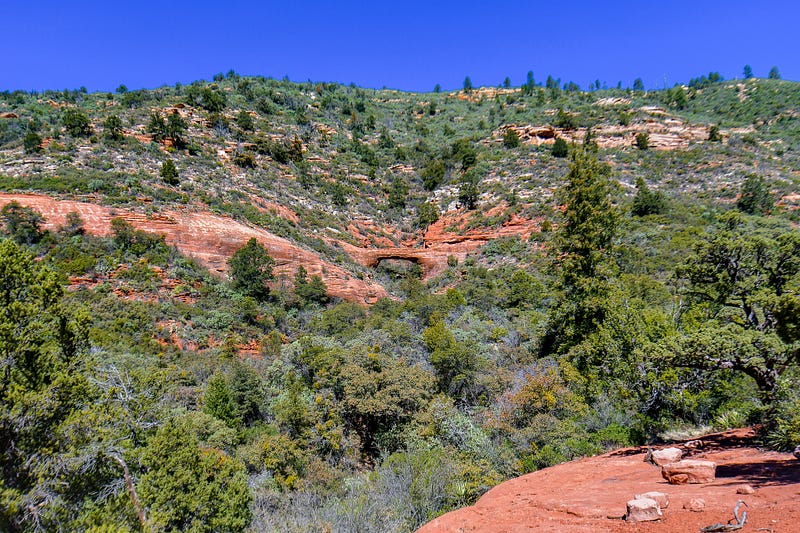
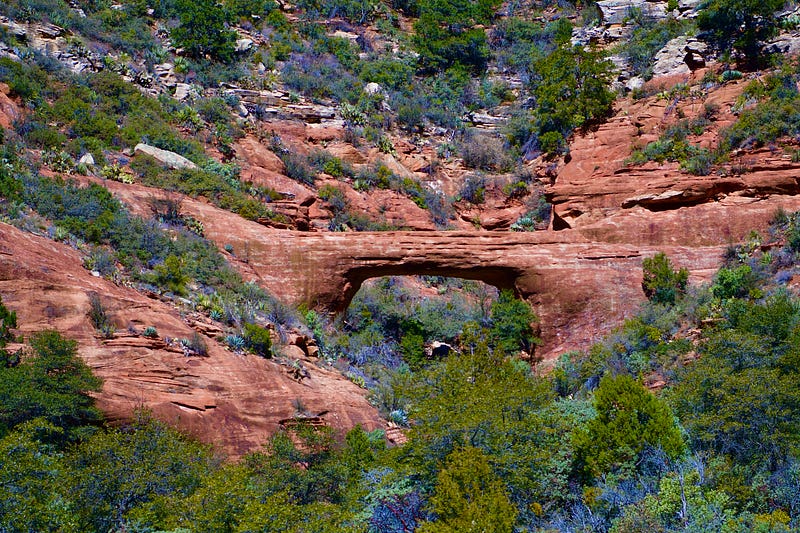
After an hour or so of walking, we reached a small plateau. We had reached the “mile-marker” for the viewpoint over Vultee Arch, but we didn’t see it.
Then, all of a sudden, it manifested before our very eyes — a delicate band of rock, thin in the middle, like a wedding band worn for many years, emerging from the surrounding cliffside.
How many eons had it been there?
Had it felt the soft padding of Sinaguan feet across its arching bridge? Had it once sheltered a family of javelina, those scruffy, nearly-blind wild desert pigs?
And what about the century plant — the spiky agave which shoots up a grand asparagus-like stalk which flowers only once in its hundred-year lifespan before the entire plant withers away? Perhaps this one, to the left of the arch, was the great, great, infinitesimally-great granddaughter of the one who witnessed the birth of the arch, the one who saw the slow erosion of soil and rock, the sculpting forces of the rain, the re-shaping of the sands and the soil by the wind.
I closed my eyes again, absorbed once more in the buzz of existence, the hum of the universe.
All around me, the world was in constant motion. But, inside, I was still.
Meditational exercise:
I suggest reading (or listening to this) outside, or near an open window where you can feel the warmth of the sun on your skin and you can hear some of the sounds of nature. You might also want to have a journal and pen handy.
If you are listening, just close your eyes and absorb the words for a few minutes. All of the following instructions are also on the recording.
From your own “place of stillness,” I invite you to begin to notice the small details of the world around you (either with your eyes opened or closed). What do you hear? Are there birds nearby? Are there leaves rustling in the trees? Can you hear any insects?
Listen closely. Can you hear the subtle “buzz” of nature?
What do you smell?
Can you feel the sun warming your skin, or the breeze raising the fine hairs on your arms?
Open your eyes, if they aren’t open already. If you soften your gaze just a little, and look at the sky, can you see those little particles of light in the air? Can you feel how their energy is dancing all around you, and is also in you?
Can you allow yourself to just sit with this stillness for a few minutes, while all around you the world is humming with life?
If you enjoyed this, you might also like:
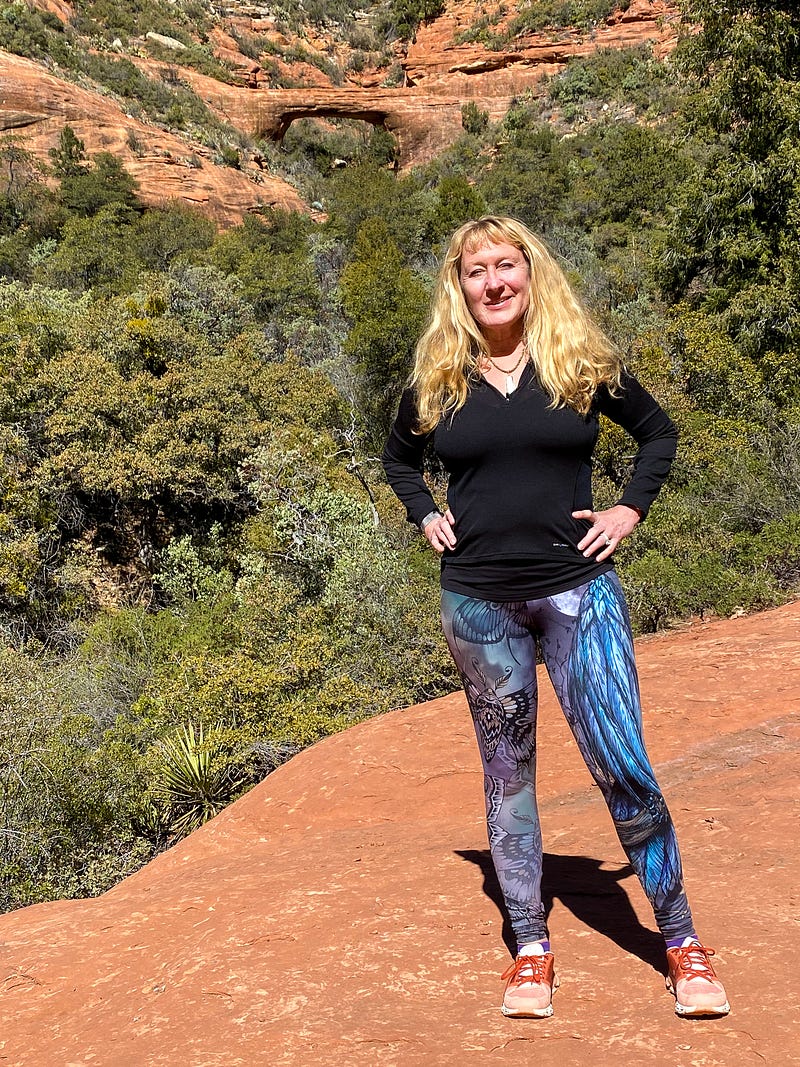
Erika Burkhalter is a yogi, neurophilosopher, cat-mom, photographer, and lover of travel and nature, spreading her love and amazement for Mother Earth’s glories, one photo, poem or story at a time. (MS Neuropsychology, MA Yoga Studies). Erika is also an editor for Dharma Talk.
Meditation and photo ©Erika Burkhalter
© Erika Burkhalter 2020


