
An Excursion into Ukrainian
Learning two languages at once can be challenging
“Hello, how are you?” “My name is Alison.” “What is your name?”
And so starts every language course, just like when I learned the first few words of French at primary school, many years ago.
I am taking an introductory course in Ukrainian, designed for people who already know some Russian. In our first lesson, our teacher spoke Russian to explain the principles and translate vocabulary. I thought that would be difficult, like having to cope with two new languages at once. Instead, it made me realise how far I have come with my Russian and that Ukrainian is going to be a whole new challenge. From the second lesson, though, Russian was banished. We spoke almost entirely in Ukrainian, practising and using our simple knowledge. We will only have five lessons, just enough to give us an overview, so we are progressing fast.
I can’t get over how different Ukrainian sounds from Russian. Of course, every language has its own distinctive melody and rhythm, that blur of sounds you hear background conversation, but you can’t quite pick out the words. Somehow, because there are so many similar words, I would expect the two languages to sound similar. But Ukrainian has something of a sing-song metre, more of a central European feel, perhaps more like folk music. In contrast, Russian has a more even intonation, with longer vowel sounds.
I listen and am fascinated by the music of the two languages. Listening without trying to understand, just picking out the rise and fall of conversations, they sound completely different. At the risk of overthinking this, I posit that in Ukrainian there are more words ending in vowels, where in Russian the same words tend to end in consonants. It is a bit like comparing the sound of Italian to that of French.
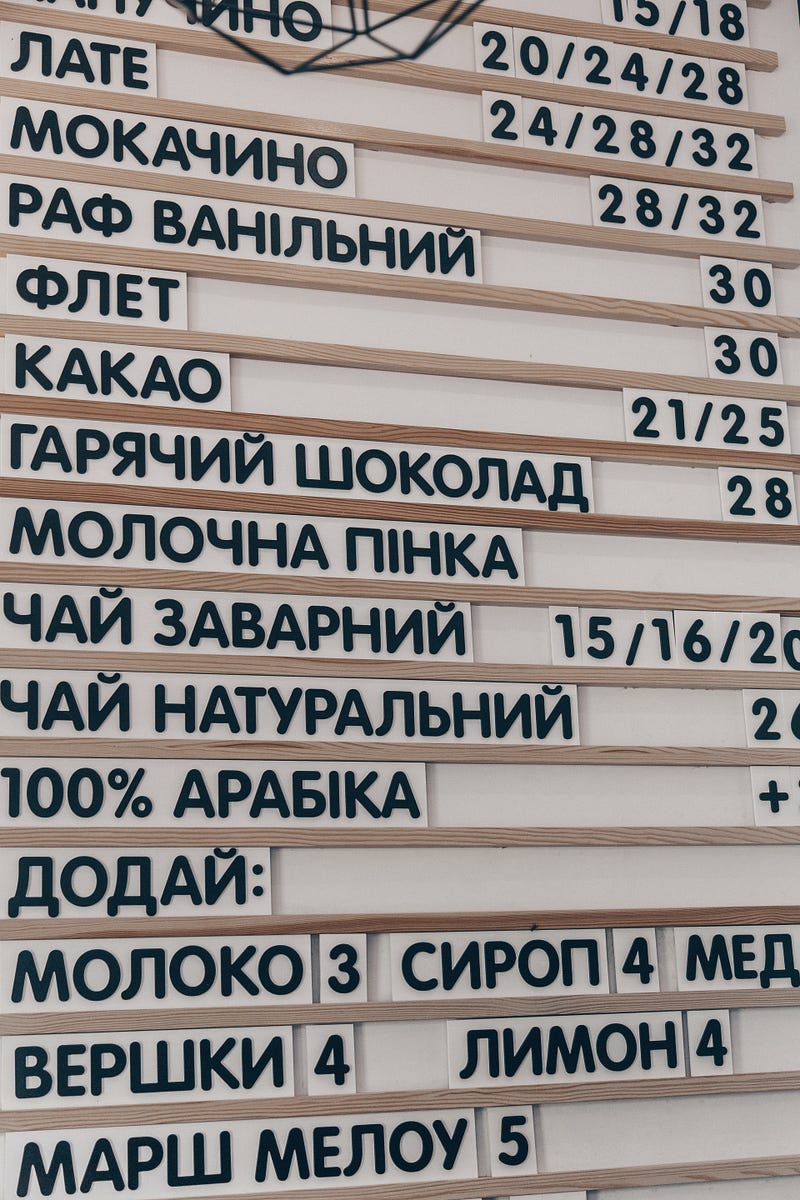
I want to learn the basics of Ukrainian for my planned travel later this year (hopefully). I spent three months in Kyiv, the country’s capital, last autumn. During that trip, I concentrated on learning Russian. In Ukraine, there are many Russian speakers, particularly on the eastern side of the country, although that is changing fast. Ukrainian has been the official language for some time now and is used in schools, universities and government communications. Food labels in shops and menus in restaurants are in Ukrainian. I never had any problem speaking to people in Russian — and indeed heard it spoken widely around me — but sometimes struggled with reading signage and labels.
I had originally chosen Russian to learn because it is spoken in many countries across eastern Europe and seemed a more generally useful language. It worked fine in Kyiv, where people all seemed to speak Russian. However, my next plan — coronavirus permitting — is to travel around Ukraine, to other cities and to smaller towns too. Somehow it seems only polite to learn some Ukrainian.
Because Ukrainian and Russian are quite similar grammatically, we are able to make progress on the course quite quickly. A large proportion of the words are very similar, although some are completely different. This means I can often work out the meaning of a Ukrainian word, but that it can be risky to take a wild guess when translating from English. One of the hardest things is the alphabet. Although both languages use the Cyrillic alphabet, they are slightly different. Ukrainian has a few extra letters not used in Russian and vice versa. The Ukrainian alphabet has a whole raft of extra vowels, which I find deeply confusing, too similar for my untutored ear to pick out the differences from listening. I have to painstakingly learn the spelling of each word.
Another irritating difference between the two languages is the availability of the keyboard. I have downloaded both the Russian and the Ukrainian keyboards onto my phone and my laptop. However, the Ukrainian keyboard on my phone is of no value, because none of apps seem to be compatible with it. Google Translate and several online sites offer an audio option for Russian — you click on the little speaker icon and a voice reads the word out. This is invaluable for learning how to pronounce a new word. Unfortunately, this feature is not available for Ukrainian. It is obviously a much more minority language.
I don’t know how far I will go with Ukrainian. At the moment I am taking classes in both Ukrainian and Russian language, but really I am the stage where I just need lots of conversation practice. I wonder what it will be like when I am back in Ukraine: how will I choose which language to speak? Or maybe I will start out trying Ukrainian and offer Russian if I get into difficulties. At the very least, I am looking forward to being able to order my coffee in the local language.
For now, still locked down and unable to travel, I am spending time learning both of these lovely languages. It is certainly interesting and enjoyable in itself. I hope, too, that having at least a smattering of the language will open more doors to me.
You may like to read about my previous visit to Kyiv and my experiences of learning Russian.