
After the Immersion
My next steps in learning to speak Russian
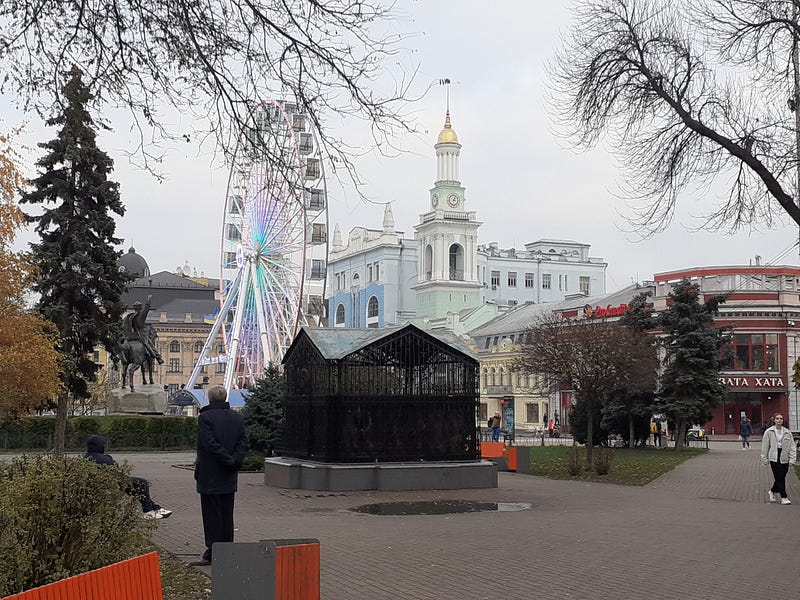
I recently returned from three months in Kyiv, Ukraine. I went there to learn Russian (while also working remotely part-time, exploring, and writing). This was immersion learning. I had lessons every day, a big wodge of homework to do every evening, and was exposed to speaking Russian in shops, restaurants and anywhere else I went.
All my lessons were conducted in Russian, with only occasional concessions to translate single words. The main explanations of grammatic rules were in Russian. The exercises were in Russian. If I had a question, I had to try to ask it in, Russian. Although I found this challenging, it really did help me with my spoken Russian, as well as with listening.
In terms of speaking, communicating in real-life situations, I feel like I broke through a barrier during my three months visit. At the start, I would be so worried about saying things correctly, I just wouldn’t open my mouth. If this was in a shop, a railway station, or a café, then usually the other person did not wait patiently. They would either start to speak English to me or just wave me away, annoyed that I was wasting their time.
Having to speak Russian in classes gave me that ‘safe space’ to get going. Everyone — the teachers, my ‘peer coach’ Russian conversation tutor, the other students — were amazingly patient and supportive while I hunted for a word. Of course, this is normal: everyone is in the same position. It is better to have a go than not to try.
I remember exclaiming in frustration to my Russian tutor about how challenging it was. Many words change their endings or their form, depending on the context. For example, adjectives or pronouns must match the case, the gender of the following nouns. In particular, the Russian way to say ‘I have…’ is effective ‘to me is…’. So many times I would embark on a sentence, starting with ‘I…’ then realize I should have started it ‘to me…’.
The problem was not that I did not know this, but that when I opened my mouth to start talking I hadn’t really planned out the whole sentence. My tutor just laughed. And pointed out that English is illogical too.
Anyway, at least I got talking and could get across what I wanted to say.
I would say I went through three phases. My first month in Kyiv I found it really hard to speak Russian and was frustrated constantly that all the shop and café staff would just sweep aside my attempts and go into English.
Then in the second month, I got braver and started talking. Both at the language school and in the wider city, I spoke shockingly badly, making mistakes, mixing up words, and often having to supplement my speech with some pointing or miming. But I persevered, and when people tried to reply in English, I steadfastly kept to Russian. At this stage, I could make myself understood but must have made people wince at my terrible grammar.
Then in month three, it started to fall into place. The case endings, some of the most common phrases, all began to come to me naturally. I could speak grammatically most of the time. In lessons, I even got quite ambitious, constructing complex sentences with sub-clauses and using the odd idiom. Of course, I never remembered things like this when — in the heat of the moment — in a shop, I needed to say something like “I’d like a smaller piece of cheese, but not the end piece, please”.
But I felt like I was airborne. On my way. Off the ground, if not quite flying yet.
So this has been the main achievement of my three months immersion in the Russian language: I can now confidently make conversation.
Now I am back at home, I have a different regime. I am taking two online lessons per week and will probably also take an online peer coaching conversation session once I get organized.
I feel a bit like I’ve been through a whirlwind of a constant bombardment of new words. As far as my learning trajectory goes, I had got to a kind of plateau where I needed to really expand my vocabulary significantly. When I was in Kyiv, I was constantly writing down new words in my notebooks in lessons or looking things up on my phone when I was out and about. It was hard to keep up. I did not have enough time to learn all these words, and it seemed that I forgot them as soon as I learned them.
It is as if I have learned how to use the tools to build a wall, but I keep running out of bricks.
Now that I am home, I am trying to spend a little time each day just learning vocab. I use Quizlet, a vocab app, which allows me to set up lists of words to learn, practice, test myself. I am investing a lot of time, at the moment, in doing this.
I am really trying to consolidate all the learning from my three months in Kyiv. I am fortunate that in my online group we are all at a similar stage. Mostly, we spend the lesson using new vocab that we had been set to learn, talking about texts we had been given to read, or sometimes watching video clips and talking about what we have understood.
Back at home, we currently have a fairly restrictive lockdown. I will not be able to travel again for some months, but learning Russian is something that I can usefully do. If I can continue to spend a couple of hours a day on it, I should be able to communicate well when I can travel again.
I hope to go back to Ukraine and to travel around, see more of the country, including the countryside and smaller towns. Most people in Ukraine speak good Russian, although Ukrainian is the official language, and speaking Russian means I can confidently travel to other countries too. However, I hope to also learn a bit of Ukrainian before I go back again. That will be my next big challenge!
If you would like to read more about my trip to Kyiv, what I did and saw there, you may enjoy my Letters from Kyiv.