
America’s Shooting Spree Continues
What’s COVID Got To Do With It?

Introduction
In March, I began a series of stories focused on some of America’s fastest-growing and fastest-shrinking cities. It evolved into crime after focusing on race, with 13 American Cities Plagued With Murder And Death.
My theory on the latter was, with America in quarantine for much of 2020, the number of murders in some of the most crime-ridden cities would decrease.
Boy, was I wrong.
Background
There are two ways to look at this: one is the murder rate (per 100,000 residents), and the other is the raw number of murders.
Let’s take my own city of Albuquerque (an apt example, as we have plenty to work with). On 8/16/2021, we reached 81 homicides, two more than in 2020, with four months to go. However, based on the murder rate, we didn’t even fall into the top 20 of American cities.
Do you know which cities are among the top 20 in the murder rate? The five fastest-shrinking cities: 1) St. Louis, 2) Baltimore, 4) Detroit, 5) Cleveland, and 15) Pittsburgh.
The other city in the top 5 in the murder rate is 3) New Orleans. Missouri is the only state with two cities in the top 20: St. Louis and Kansas City.
Population goes down, and homicides go up. It makes no sense until you consider the demographic makeup of each city. In all, approximately 55% of murder victims are Black, and 42% are White. Those remaining in the shrinking cities are, for the most part, not of means. Redlining in housing forced minorities into certain sections of these cities. White flight to the suburbs made the cities contract even more.
I looked at whether these murders were happening more in red states or blue states. The results showed no difference.
The United States is the 128th safest country in the world, according to the Global Peace Index.
Doesn’t that make you feel comfortable?
If you live in the Phoenix suburb of Glendale, consider yourself lucky. It is the only one of 185 cities over 250,000 in population reporting no homicides thus far in 2021, according to Datalytics. But, as you’ll see below, other Phoenix suburbs are not as lucky.
The five cities having the largest increase in homicides in 2021 compared to 2020 are: 1) Mesa, AZ, 2) Gilbert, AZ, 3) Portland, OR, 4) Fresno, and 5) Austin.
Referring back to my own city, Albuquerque is at number eight on this list. Recently the Governor deployed the State Police to assist the local police department in high crime areas. An extreme measure, but Trump ordered federal agents to come to the city last year to beef up patrols.
So far, it doesn’t look as if much of anything has helped.
2020
Overall, crime fell, but violent crimes and murders were up 25%. In addition, gun violence is on the rise. “We’ve never seen a year-over-year increase even approaching this magnitude,” says John Roman, a criminal justice expert at NORC at the University of Chicago. Others think it’s an anomaly starting from a low base, with “relative” peace between 1994 and 2014, otherwise known as the “Great Crime Decline.” Last year, there was no real trend between big and small cities, metropolitan and nonmetropolitan counties, and regions of the country.
Mass shootings (defined as four or more people injured) were up 46%, but there were fewer high profile, public mass shootings.
One might point to COVID-19 because it exacerbated economic conditions in high-poverty neighborhoods. Criminologists say isolation and idleness are likely to get more people into trouble. Domestic violence has spiraled upward in the era of COVID.
2020 was a whacked year for policing as a result of the George Floyd killing. There was a breakdown in police-community relations.
And guns, Guns, GUNS! A record number of guns were purchased in 2020. More guns equal more violence.
But what really caused the surge? Probably a combination of these factors.
2021
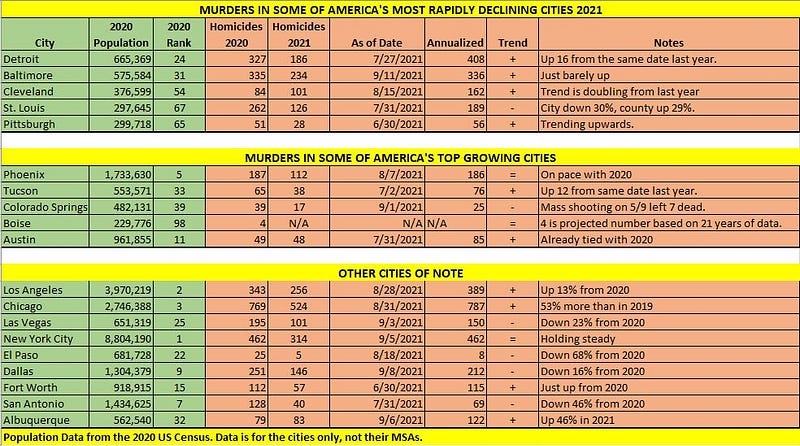
If current trends continue, there will be more murders in more cities in 2021. Unfortunately, among the cities in decline, mainly made up of people of color, St. Louis is the only one to show any real progress.
Where numbers are down (see “Trend”), the easing of lockdowns and the absence of large, widespread protests have contributed to lower numbers. As a result, police are more able to be proactive and keep ahead of crime.
In some majority Latino/Hispanic communities, such as El Paso and San Antonio, homicide is down. But then you look at Albuquerque, and that hypothesis goes down the drain. No matter how you slice and dice it, there is not one clear trend.
Texas contains four of the ten largest cities in the U.S. While numbers have slowed in Dallas and San Antonio, Austin has already had more murders in 2021 than they had in all of 2020. Austin is the fastest-growing city in the country. Could the increase be due to sheer numbers? Could it be the housing situation? Growth has forced minorities out of the city to the point where it is now only 8% Black.
On September 1, a new and very controversial law began in the Lone Star State. Texans can now carry handguns without a permit or training. We should be paying very close attention to the effects of this law.
We’re just concerned because anytime there’s more guns, there’s a problem”. ~Ray Hunt, executive director, Houston Police Officers’ Union.
And then there’s Chicago. Oh, Chicago. Currently, at 524, this is their worst year for murders to date since 1996. “Young men feel in fear of their lives,” said Lance Williams, a professor at Northeastern Illinois University. “They’re getting guns to try to protect themselves.”
Conclusion
Rosanna Ander, executive director of the University of Chicago Crime Lab, stated that the best programs to prevent gun violence are more mental health support, youth opportunities, jobs, and outreach to at-risk members of the community.
These are exactly the kinds of programs that get cut first, especially in a city like Chicago, which has a budget gap of $1.2 billion in the coming fiscal year.
While there are several reasons for the increase in gun violence, money is the main obstacle to solving the problem at its roots. If Texas leads by example (and it does) and helps create new pro-gun laws in other states, given the current environment, it does not bode well for any improvement. We’ve just handed the whack jobs of January 6, and others like them, more guns. We’re on the road to creating a country of vigilanteism.
“When will they ever learn?” ~ Pete Seeger, “Where Have all the Flowers Gone?”
Sources for homicide statistics obtained from the following: KOB4NBC (Albuquerque), The Baltimore Sun, abcNews5Cleveland, St. Louis Post-Dispatch, Pittsburgh Post-Gazette, 90.5WESA/NPR (Pittsburgh), 12NewsNBC (Phoenix), KGUN9abc (Tucson), fox21news.com (Colorado Springs), cityrating.com (Boise), Austin American-Statesman, LexisNexis (El Paso).
Other sources include the U.S. Census Bureau, AHDatalytics, The Texas Tribune (8/16/2021), WBEZ/NPR-Chicago (9/1/2021), World Population Review, and The Santa Fe New Mexican.