
American Crisis 2.0: these are the times that try our souls!
Here’s another great prompt from Ruby Noir 😈: The world, and each individual life on it, is full of harsh truths. Things we know but wish we didn’t. *Examples: climate change, starving children exist all over the world, Trump has not been assassinated {😂}, police have, can, and do murder People of Color, Nazis are still a very real part of the world we live in, hatred and bigotry are everywhere, etc. — these are harsh truths in the world, how you define them in your own life is up to you to determine. What harsh truths do you IGNORE? — Answer both about the world (or country) and about your own life. Why do you ignore them? Does it help you to ignore them? Is it actually possible to truly ignore them? Explain.

In December 1776, Thomas Paine wrote these famous words in his first American Crisis paper:
THESE are the times that try men’s souls. The summer soldier and the sunshine patriot will, in this crisis, shrink from the service of their country; but he that stands by it now, deserves the love and thanks of man and woman.
The threats to the thirteen colonies in 1776 took the form of the British Parliament and the Redcoats, but those today are arguably much worse. Today, we face numerous problems, such as starving children, climate change, systemic racism, and the rise of the Far Right — to name only a few. This is our new American Crisis, 21st-century style.
Let me begin by saying that as a POC–Person of Color–and as someone only several degrees removed from down-and-out destitution, none of these issues are ever very far from my mind. In fact, they are constantly there, simmering just beneath the surface, waiting only for a situation to implode. It takes just one credit card to be declined while paying for groceries, one reduced credit score, one tree to fall in my backyard, and one more news report about the KKK handing out leaflets in my local area to realize my life is more precarious than it should be. Land of the free and the brave? More like we need to brave it out to live in an unfree land!
The fact is in our post-Civil Rights Act days, our country remains as divided as ever: the election of Donald Trump in 2016 was just one more glaring instance of the fractured state of our nation. For those of you familiar with the famous Twilight Zone episode, “Nightmare at 20,000 ft,” Donald Trump is the gremlin of racism in America: the evidence that racism really does exist — but which so many (white) people once brushed aside as ramblings of paranoid minorities.
So let’s start with that — the systemic effects of racism which percolate all the way down to our livelihoods and lifestyles. You see, when you’re POC, you are still regarded as lesser than, regardless of claims to equality, equity, democracy and all that good stuff that Americans are supposed to enjoy. You are still underappreciated, underpromoted, and underpaid. For instance, consider that the poverty rates for Blacks is much higher than for whites at 27.7 % vs. 5.1% while other statistics also show that poverty rates for Asians are also higher than for whites at 12.3% vs. 9.8%. And now, with the overturning of affirmative action, underrepresented minorities may not only be adversely affected in college admissions but also in the corporate world as diversity and inclusion initiatives are being quickly dismantled.
Ultimately, this prevents many POC from attaining a middle-class, let alone upper-middle class lifestyle — and that’s just for those with at least a college degree.
Not that POC are alone in facing such challenges. Regardless of race, many are constantly aware of the dangers of a layoff in these uncertain times — especially with inflation remaining high as food and other basic necessities cost considerably more than they used to. (Some of you may recall, for instance, that just last week, I mentioned the escalating costs of pet food and veterinary bills which rack up to $3,374.96.) Combine all that with a shrinking retirement portfolio this past year for those over 60. Let’s not forget either that anywhere between 40% and 60% of Americans cannot afford a $400 emergency. No wonder so many are angry!
The problem of starvation, in other words, is not as remote as we assume it to be in a wealthy, developed nation. Just one medical crisis, even if not combined with job loss, can lead to bankruptcy. In fact, medical issues are the number one cause of bankruptcy in this wealthy nation.
That’s why the issues wrought by climate change are very real for those far from comfortably well-off. Those like me who cannot afford to spend $8000 on an air-conditioner compressor (and definitely not after those pet expenses!) must suffer weeks of blistering 90+ temperatures. Those like me who worry that the next downpour or blizzard will damage our houses, knowing we cannot afford to or even borrow $30,000+ to fix our roofs and/or drain out a flooded basement. Or more simply, just deal with the exacerbated costs of electricity as temperatures climb when we run a fan all day.
Nor are house damage, electric costs, and raised insurance costs the only worries. There’s the problem of power and Wi-Fi outages. Many of us in the relatively calm Northeast know this firsthand from the ravages of a thunder blizzard in late October 2011 and Hurricane Sandy a year later when certain areas suffered a power and gas shortage that lasted over several weeks in certain places (not to mention damaged houses and roads). If you lived in at least a plush, upper-middle class area and were fortunate enough to have several generators costing more than $7000 apiece, you weren’t too badly off. But if otherwise, you suffered for weeks. This is an even worse problem for those who work remotely and have no easy access to Wi-Fi.
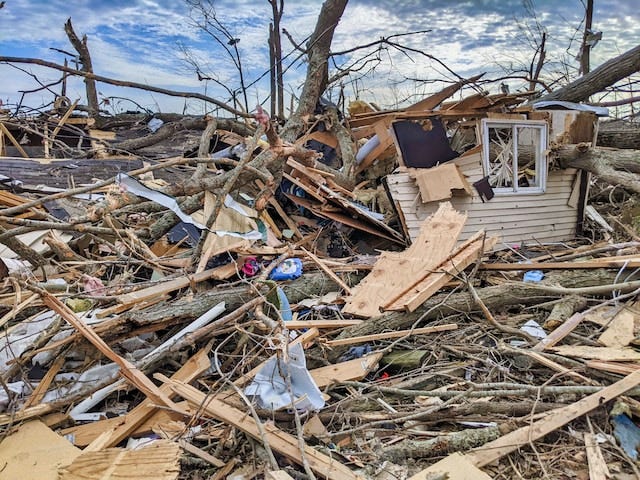
Let’s not forget all the physical toll of these stresses on the human body either. Extreme heat can cause cramps, heat exhaustion, heatstroke, and hypothermia while worsening cardiovascular, respiratory, and cerebrovascular conditions — not to mention the psychological effects of extreme heat: increased irritability, aggression, depression, all of which can lead to domestic violence, substance abuse, and suicide. Heat can also cause problems with memory, attention, and reaction time while difficulties falling asleep can further aggravate mental health issues.
So while the problems of starvation, climate change, and nascent fascism may seem distant to those at least upper middle class, they are not for this particular Asian adjunct professor and editor— and I dare say any person not in the upper 20% subset. Too many of us feel that the threat is only barely behind us, like a mountain lion that seems to close the gap rapidly as we try to escape from our neoliberal forest of corporatized profits.
This is why it behooves us to VOTE OUT our millionaire and billionaire politicians who refuse to adequately address climate change. Those who refuse to address inflation, whether food or utility, because they are barely aware of such problems as they sit pretty in their 8,000 sq ft mansions, eating $13 a pint ice cream while dressed in their $3000 suits. (Here’s looking at you, Nancy Pelosi, denying that inflation is a problem!) Those who refuse to tackle hate crimes and profiling against POC or take action against domestic terrorism. Those seeking to reduce taxes even more on the wealthiest. (Here’s looking at the Republicans!) And yes, the upper 10% who leave a disproportionately large carbon footprint on the earth because they are barely affected by the ravages of climate change and inflation: yes, those people with the multiple mansions, giant SUVs, private jets and yachts.
We need to NAME THEM and SHAME THEM if we are to fix our new American crisis!
© Frances A. Chiu, August 29, 2023. All rights reserved.


