
3 Crypto Core Trends That Could Shape The Future of The Decentralized World
Where the industry goes from here
If you know me, you must be aware of how I hate it to predict crypto trends or narratives. My reluctance is often derived from how ‘too hyped’ something is, or how short-term a narrative would be.
Not this time, though. This time I am actually excited about my findings.
As the market continues to move boringly, the crypto community now is left with people who are actually ‘in it for the tech’ — or simply are stubborn like me. As a result, with the absence of bull market grifters and loud people, discussions right now tend to get heavily focused on the tech. Meaningful gigabrains conversations everywhere, and with them, I begin to see the direction where the industry could go from here.
These trends feel different than typical crypto because in most cases, not only it is barely investable unless you’re a VC, but also they probably are only materialized in 2, 5, or even 10 years. We’re going to be in for a long haul, my friends. Regardless, they contain so much alpha, and additionally, by knowing them you can be as cool as those crypto thinkboys and thinkgirls.

The Modular Future
There’s a theory circulating around the community about how the blockchain people use in the future, would be completely different from the blockchain and smart contract platform we know today. That could be true with how modular blockchain design is on the rise.
Today’s popular public blockchains use a design that’s called a monolithic design. Bitcoin is monolithic, and so does Ethereum, Solana, and Avalanche. Even the ones that aim for modularity, like Cosmos, are not pure modular — but rather, take a hybrid approach. Fun fact, layer 2 won’t make Ethereum fully modular either. So does Avalanche subnets, which essentially are monolithic chains on top of another monolithic chain.
In a monolithic design, all types of transactions are handled by one ‘layer’. For example, the Ethereum mainnet is where execution, data availability, settlement, and consensus are being done. As a result, it’s easy for Ethereum to get congested when activities are high. Users experience gas fees spiking, the network gets slow, and transactions don’t get through. All these aren’t ideal if a public blockchain hopes for mass and global adoption.
Conversely, a modular smart contract network consists of different chains each handling a specific task. Layers are separated into:
- Data availability, where the chain store and handle all data related to transactions and make sure the data is always updated and accessible by users.
- Consensus layer. Where the decentralization happens. The security layer.
- Execution layer. Where transactions are received and executed.
Modular blockchain is the answer to the notorious blockchain trilemma. By delegating specific tasks to specific chains, a network can achieve scalability while still maintaining security and being decentralized.
However, the modular future is still a long road ahead. It’s like building puzzle pieces by pieces. Each ‘layer’ or stack must be thoughtfully designed to compose one big, fully functional system. Currently, a prominent project in this category is Celestia, which claims to be the first fully modular in the space.
Further reading regarding this topic:
The glue that is the middleware
Imagine crypto middleware as the glue that sticks chains and dapps together. Some people would say, middleware is the dapps for dapps. In fact, in a modular future, middleware could be just another layer in the stack. They are the crucial crypto infrastructure.
I’ve highlighted middleware/infrastructure play in my Q2 article and this sector is getting stronger every day, judging by the number of builders working specifically on this, the projects launched, and how much VC money is getting thrown at them.
Middleware is a vast categorization. Projects included here range from decentralized cloud storage solutions, multichain bridges, developer kits, smart contract automation, node infrastructure, and many more. There’s a good article if you want to dig deep into crypto infrastructure by Jump Crypto titled Peeking Under The Hood: Key Pillars of Crypto Infrastructure.
The infrastructure sub-sector of crypto has great potential. Web3 nowadays still heavily depends on web2 incumbent (i.e. Amazon’s AWS.) We are in a dire need of web3 solutions for a lot of things, all while maintaining the economic incentives for decentralization. The Total Addressable Market for a middleware project could be infinite. (After all, AWS is what makes Amazon profitable, not the marketplace.) Now it makes sense why VCs throwing a lot of money at this sector.
However, middleware, albeit crucial, is boring as heck. That’s one of the weaknesses of infrastructure play in the eyes of investors, especially retailers. In terms of hype and narratives, this sector gives nothing much. Infra play needs a deep technical understanding too for average people to invest.
On top of that, a middleware project heavily depends on the network it runs on. For example, an Ethereum-focused project would need to rely on the success of Ethereum itself for the project to succeed. Assessing middleware and investing in it is tricky. There is a lot of uncertainty on which project going to be the tech giant of web3. It also explains why this sector is seemingly reserved for VC at the moment.
At least, as a regular pleb, now you know where the smart money is betting in. This knowledge can help you spot opportunities that get overlooked by the general public because it doesn't look as attractive as a picture of monkeys.
Fat applications > Fat protocols thesis
The Fat Protocols thesis was made popular in a 2016 article simply titled Fat Protocols. In the space where the protocols are fat and the applications are thin, values are mostly concentrated at the base layer. Investing in the base layer is more profitable than investing in apps.
In many ways, the crypto space right now is still protocol-centric. Ethereum is the largest revenue maker. The fact that non-L1s altcoin got battered hard relative to Layer 1s is another indicator. It’s still cliche wisdom how people going to tell you that you’re better off holding BTC or ETH than investing in app tokens.
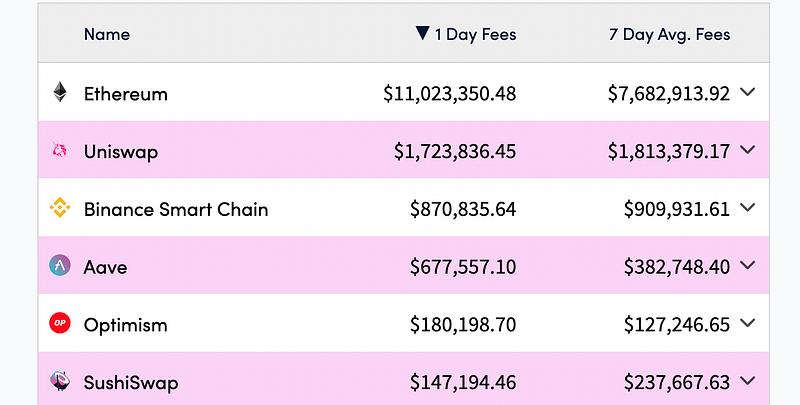
Whether or not the inverse — where the protocol is thin and apps are fat — is good remains a debate. The internet nowadays is very app-centric and it doesn’t look attractive either. Power and values are concentrated in what we now call “The big tech,” not something we want in the decentralized world.
However, we do need values to trickle down more to the application level in the crypto space. A glimmer of hope, perhaps in the decentralized world business model and profit-sharing are much more egalitarian than in the legacy tech. Lately, a prominent crypto researcher Hasu sparked a discussion on his post where he said we’re too invested in layer 1s. He is not wrong.
The ideal crypto world I envision involves users using a dapp without caring much which chain he is connected to. The app would seamlessly direct users to the most optimal network based on specific conditions (best yield, least congested, best fee, etc.) A ‘fat’ app would look like that on the UX level. On the backend side, the apps would be multichain, perhaps having their own chain — a stack chain in a modular system rather than an entirely sovereign layer 1. If it’s a DeFi, their liquidity is deep everywhere. The protocol generates revenues from every corner of web3 and is the ‘big tech’ of the crypto space.
Some nowadays DeFi protocols, like AVEE above, are working on this path. They plant their root in many chains, constantly innovate various aspects of their products, build credibility by surviving various market turmoils and/or security-related incidents, and accrue profit consistently. They aim to become a household name.
The fat application flippening possibility has tempted retails to look back into the temporarily forgotten DeFi boomer apps like AAVE, UniSwap, or Curve. Largely ignored during the height of the euphoria phase, DeFi 1.0 protocols slowly gaining attention again. This trend isn’t limited to old dapps though, as some of the newer projects are similarly ambitious and have great potential to build a moat around themselves.
If the apps-layer 1s flippening does happen, what we will see is a growth stall in layer 1s in terms of investment return — not the tech or innovation — while at the same time, capital flocks heavily in the app layer. This might need a while to play out. But like everything in the crypto space, it could be unimaginably faster.
Reading about these trends, you can feel how early crypto is as there are so many puzzles to solve. Or tech solutions that are not even born yet. The industry has a long way to go before reaching the mass adoption we all envision. It’s going to be an exciting journey. Whether you are a builder or investor in the space, opportunities are available for both.
As I stated earlier, investing in these trends remains vague in most cases. No need to hurry. Just let the space organically evolves while you keep an eye on things, all while using these trends as a framework for your due diligence. When a good opportunity pops up, you will recognize it.