
Crypto Trend Predictions for Q2 2022
What’s the next narrative?
I am personally not a fan of giving predictions on which crypto to invest in next. Narratives in crypto are often short-lived, so writing a quarterly prediction is too long of a time frame for anyone to be able to predict. Here, three months is equal to a year. The nature of the crypto industry is that it moves fast. Hence it’s not unheard of for you to spot a highly-talked project that becomes irrelevant after several months after.
But let me try. There are some narratives I’d like to keep an eye on for the second quarter of 2022.
The first three months of the year were brutal. In between market drawdown, several internal incidents (hacks, wonderland), and global crisis — i.e. wars, recession — it was hard to see where exactly crypto would go for the rest of the year.
However, as always the market surprises. As people succumb to desperation and start accepting the bear, the sentiment reversed. With it, some promising projects floating to the surface, and where the industry heading becomes a bit clearer.
The highest demand in the crypto industry: Blockspace
During the recent market drawdown, we’ve seen L1 are the most resilient crypto tokens to have. Ignore x% from all-time high — ATH prices are poor anchors. Instead, look at how the chain perform over the past year. Most of them are still overperforming, shown by the unbroken uptrend chart even BTC couldn’t maintain.
It’s not without reason. Many analysts are still really underestimating the demand for block space.
As more people use decentralized platforms for trading, generating passive incomes, and buying NFTs, the demands for blockspace would be nothing but increasing. Users queuing up for their transactions to be added to the next block of the blockchain. It’s not going to stop anytime soon.
With the increasing threat to privacy, sovereignty, and there’s a fear of (over)regulations, there’s an urgency to move assets on chains like never before. That’s just one retail-related situation, I haven’t mentioned the demand coming from institutions. Especially since crypto is practically the only free-market left nowadays.
Citing Token Terminal, it’s not surprising Ethereum remain surpassing dApps in term of revenue.
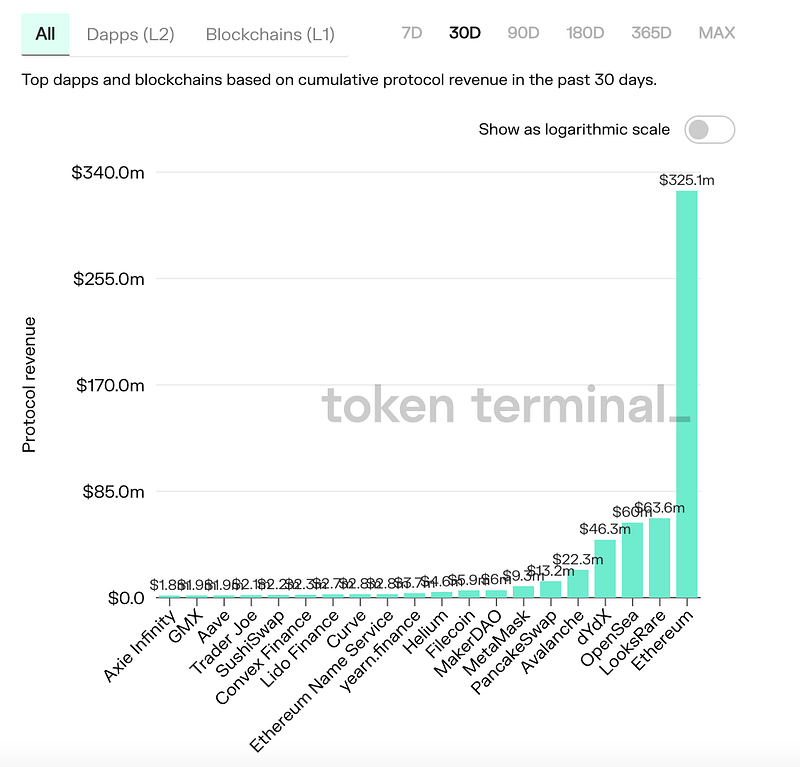
Combined with the resiliency layer 1 cryptos during the past 3 months, it convinced me that the Layer 1s narrative is here to stay.
The next month we could see the rise of Layer 1s, old and new. Incumbents winners like AVAX, FTM, and Luna may continue rising — Heck even the CT’s least favorite Polygon, Solana, and BSC. At the same time, people are also enticed with opportunities in new lands. Newer blockchains and ecosystems like Near/Aurora, Ethereum L2s, Polkadot’s parachain, and Cosmos ecosystem. To the extension of it, keep an eye on staking protocols. The demand for blockspace is also aligned with the demands for validators — to validate transactions and securing the network.
I’ve always thought becoming a particular chain maxi is a time and energy-wasting endeavor. By maxi, I mean the religious zealot who would campaign one chain and denounce the others. Because regardless of your choice is, there’s always a market share for even the most niche of chains. Everyone’s numba most likely gonna go up, albeit at a different pace. There’s always a demand for vacant blockspace.
Bridges, because the future is not only multichain, but also cross-chain
A lot of debates around bridges currently. After the latest ronin hack, then wormhole before that, some people increasingly agree with Vitalik’s view about multichain. That the future will be comprised of a lot of chains but each is not going to exchange goods — assets — with the others.
I completely disagree.
The future is very much cross-chain.
My reasoning is simple yet solid. I like to view blockchains from a nation-state perspective in this matter. In the history of humanity, there’s no sort of adversity that would stop humans from seeking riches in the foreign, faraway land. People cross desserts and raging oceans to get something that’s today so “normies” and common, like spices. In 2022, I expect not much difference between us and our ancestors. If anything, the degens have it much easier since they can do all these explorations from the comfort of their desk.
Despite the many bridge-related hacks crypto suffered lately, it doesn’t discourage people from moving their assets cross-chain. The recent launch of the metaverse project DeFi Kingdom DeFi expansion, CrystalVale, saw $470 million worth of assets bridge over Synapse in less than 24 hours. And this launch happened only a day after the Ronin hack. You think people would be more risk-averse, as it turned out they didn’t.
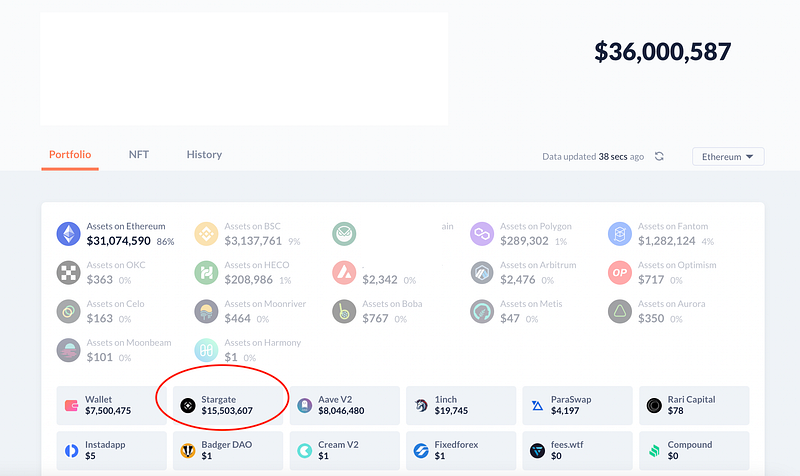
Stargate, the star of the current cross-chain narratives, managed to amass $4 Billion in liquidity. After Wormhole's $320 million hack, you’d think whales would be reluctant to put their money on bridges. But even to my surprise, what I saw from wallet activities is DeFi whales putting a large portion of their capital to Stargate. That indicates an immense trust in the platform.
Which bridges would be the winner?
This may sound boring but it’s better to not think too much about it. Just like The L1s trend, most decent major bridges out there will have their own market shares and users. There are plenty of reasons a user may consider a bridge out of another. Just like the layer ones — and honestly, all crypto projects in general — is that the best tech doesn’t always win. UX, reputation, features, low fees, and additional incentives, are some other factors influencing a user’s decision-making before choosing a bridge.
From the investing perspective, it means “ape whichever, all gonna go up.” Stargate may have the best price action currently. But other bridge tokens are catching up too.
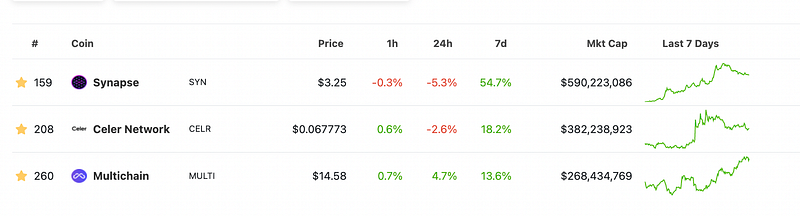
The best (most rational) bet would be the one that is undervalued. You can calculate this by comparing transaction volume vs the market cap. But often, fundamental isn’t enough. Just like with Stargate, which has 3 Billion market cap despite transaction volume still below projects launched before them, the “pumpamentals” — narrative, VC backing —and other tidbits need to be taken into consideration.
*Personally, I simply invest in the project I am vibing with.*
Appchains
With the success of DeFi Kingdom’s Crystalvale launch, there’s a trend toward app-specific chains. Crystalvale was a DFK’s expansion on other chains Avalanche. But instead of deploying into mainnet, the team deployed into something called a subnet.
Having a chain on its own is a great solution for projects expecting a lot of transactions at the same time, such as a play-to-earn project. Instead of clogging the mainnet traffic, you got your own chain with your own validators. This approach does have some risks, as the Axie Infinity’s Ronin hack has shown us. But I believe moving forward improvements will be made. The appchain paradigm is still very early.
The need for appchain is an extension of the need for block space I wrote in the previous point. Layer 1s alone will not enough to cater to users' demands. Some types of apps are better to build their own chain to extract maximum performance and give the best user experience.
As it is very early, there’s not a solid answer yet to the question, “how do I invest with this.” Appchain narratives in my opinion would be project-specific than chain-specific. As long as the project is attractive and checks all the fundamental and pumpamental boxes, who cares which tech it uses or which chain it deployed into.
As for the base tech, I have my eyes on the zk-rollups solution. The concern with the app-specific chain is that it lacks decentralization and security. Ethereum layer two solutions like zk-rollup could be the answer for that. Other Layer 1/layer 0 projects offer developers to have their own chain including Cosmos and Near Protocol.
Mature protocols
As the crypto space matures, I sense the increasing demand for mature projects.
Instead of a short-term pump and dump or unsustainable high APR yield farming, people begin to yearn for the following.
- Sustainable yield for passive income
- Security
- Resilience (Independent to market condition, narrative-less)
- Stability
- Innovation
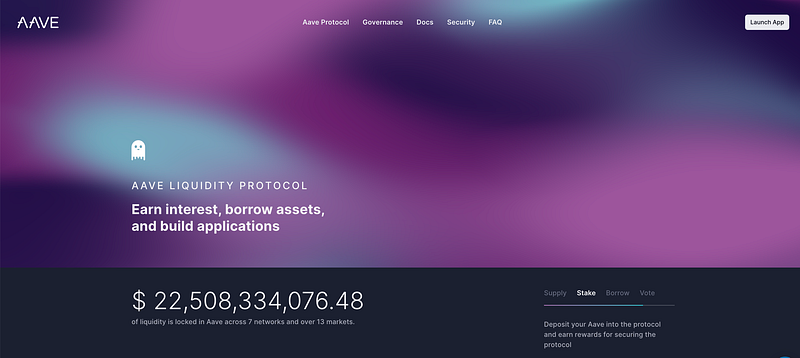
We are starting to see the resurgence of DeFi 1.0 protocols like AVEE and Balancer lately, and I’m seeing this won’t stop anytime soon. It’s not just DeFi 1.0 dApps, but both old and newer protocols will gain loyal users and investors as long as they are able to provide the points above. Investing in this sector would not be just about the token price.
In crypto, it seems that everything is short-lived. Narratives. The flavor of the weeks. But beyond all that noise, lies the true “trend” that’s brewing quietly and continues to grow despite what the sentiment is. It’s our job to figure out what is it. What I do is usually take a step back and try to see things in the bigger picture.


