
AN UNSUNG HEROINE
All Quiet On The Ukrainian Front
A remarkable new book tells how scrappy residents of a small town made a big difference when Russia invaded
At first glance, Andrew Harding’s A Small, Stubborn Town appears to have nothing in common with Erich Maria Remarque’s great novel of World War I, All Quiet on the Western Front.
Harding draws on his reporting for BBC News in a new nonfiction account of how a scrappy small town rebuffed Russian invaders in an early battle for the soul of Ukraine. Remarque turned the dross of his German military service into the gold of a classic of war fiction.
But A Small, Stubborn Town has more in common with All Quiet on the Western Front than it does with any of nonfiction books I’ve read about Ukraine, including Luke Harding’s Invasion and Serhiy Zhadan’s Sky Above Kharkiv. It shows the “murderous absurdity” of Vladimir Putin’s war as plainly as Remarque’s novel lays bare the disillusionment of young soldiers who went into battle dreaming of fighting for noble ideals propagated by Imperial Germany.
If you didn’t know Harding had written a work of journalism, you might imagine you were reading the first stellar novel to come out of the war in Ukraine. With just 150 pages, Harding’s book is an appealingly slim volume that focuses tightly on an ensemble cast of residents who startled the invaders by putting up more of a fight than Putin had led them to expect.
Like Remarque, Harding has an elegant control of his swift pace and his measured tone, which reflects a mastery of the power of understatement in describing war. His book is ideal for anyone looking for a great story, not for a history of Ukraine or the politics of its fraught ties to Russia.
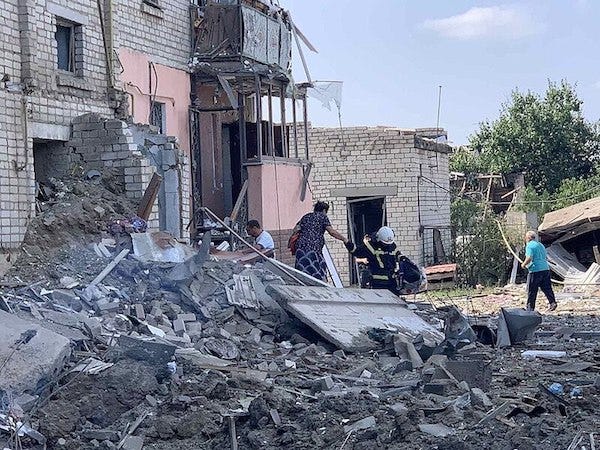
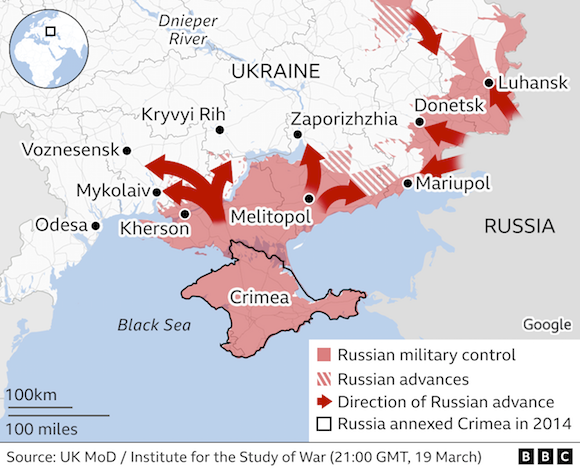
Harding brings a you-are-there immediacy to his report on the fierce two-day battle for Voznesensk, a pretty rural town in the Mykolaiv region with a tactically key bridge. He summed up its significance for the BBC:
“Victory would have enabled Russian forces to sweep further west along the Black Sea coast towards the huge port of Odesa and a major nuclear power plant.
“Instead, Ukrainian troops, supported by an eclectic army of local volunteers, delivered a crushing blow to Russian plans, first by blowing up the bridge and then by driving the invading army back, up to 100km, to the east.”
The gallant two-day battle for Voznesensk in early March 2022 became emblematic of later conflicts across Ukraine. Yet it’s been overshadowed in America by the larger-scale dramas in places like Mariupol, Kherson, and Kharkiv.
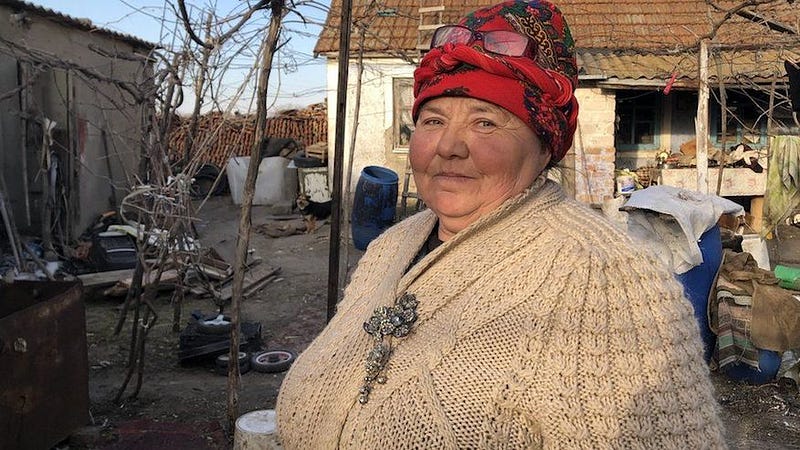
That’s part of what makes A Small, Stubborn Town important. Another part is that it’s the rare book with a heroine who shows the role of women in the war: an impoverished wife and mother in a village on the outskirts of Voznesensk, the scene of heavy fighting.
.jpg)
On the first page, the arthritic 59-year-old Svetlana Martsynkovska keeps her cool as a Russian soldier points an AK-47 at her stomach. She scoffs at his idea that he’s liberating Ukraine from Nazis. She and her family had found shelter in a nearby cellar after the Russians commandeered her tumbledown cottage for a field hospital, and when they left, she had blood stains on her door and tank tracks in her garden.
Around Svetlana a ragtag group move in and out of the story. Among them: her husband, Petya, and son, Misha, both lazy and often drunk; Yevhenii Velychko, the 32-year-old mayor; Andrii Zhukov, his deputy; Valentyn , a lawyer; and a man nicknamed “Ghost,” who had fought the Russians after they invaded Crimea.
Before the war, the authorities been warning Ukrainians to fortify their home guards. Russian troops were massing on the border. But in Voznesensk, people didn’t believe war would come to their town:
“Russia was obviously bluffing, whatever the Americans said.”
Once the invasion was certain, 30 members of the home guard set frantically to work: “A shabby parade of pot bellies, grey beards, baseball caps, trainers and tracksuits.” They hoped to repel the Russians with weapons like guns, knives, sandbags, Molotov cocktails, and their own indignation.
Some residents of one neighborhood fled. Other people stayed in “a mood of profound stubbornness.”
Svetlana worried about what she’d do for money if the fighting destroyed her cottage. Born in Russia, she’d worked in a slaughterhouse there and settled in Ukraine after the fall of the Soviet Union. Neither she nor her husband could cut through the red tape needed to claim their Soviet-era pensions.
The defenders of Voznesensk faced setbacks. They blew up the bridge too soon. And some suffered terrible losses. In one scene, a Ukrainian mother scrapes bits of her dead son off a gate, telling herself: “This is him. That’s his flesh.” Then she begins to sob.
But the residents prevailed with the aid of Ukrainian troops and British-made rocket-launchers. Invaders who had believed Putin’s lies were shocked not to be welcomed as liberators. One Ukrainian was disgusted by the Russians’ lack of honor, “the way they left their wounded on the field.”
Svetlana never received her pension for her Soviet-era work in a slaughterhouse, and the war deepened her rift with relatives who had stayed in Russia. But she resisted family pressures to return. She kept a collection of teddy bears on a windowsill, hoping her grandchildren someday would visit her again.
Harding makes clear that women like Svetlana, not just male soldiers, have helped Ukraine resist Russian savagery. All Quiet on the Western Front shows the vast gap between those who start wars and those who fight in them, and in A Small, Stubborn Town, Svetlana’s life personifies that gap.
The traditional Ukrainian response to the rallying cry “Glory to Ukraine!” (“Slava Ukraini!”) is “Glory to the heroes!” (“Heroiam slava!”). Maybe it’s time to add, “And to the heroines!”
@Jan is an award-winning journalist who has written for many major media. She has been the book columnist for Glamour, the book critic for a large newspaper, and a vice president of the National Book Critics Circle.
Listen to BBC Radio 4 dramatization based on Harding’s book.
You might like another of my stories about the defense of Ukraine: