2019 NBA Awards Season
Who would make 4th Team All-NBA? Or 10th Team or 15th Team?
Why stop with just three All-NBA teams? Let’s rank them all!
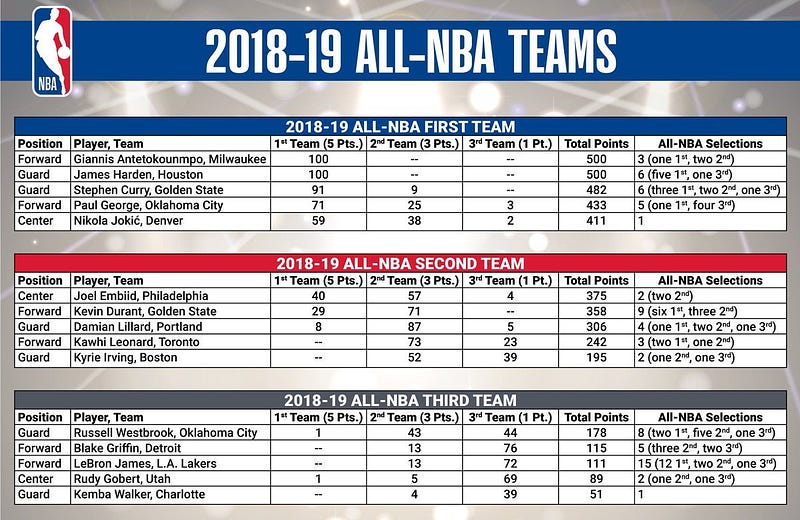
THE NBA RELEASED ITS FIRST, SECOND, AND THIRD TEAM All-NBA selections this week, and the results were about as expected. James Harden and Giannis Antetokounmpo were unanimous First Team choices, joined by Stephen Curry, Paul George, and Nikola Jokic. No huge surprises, other than a stray vote missing here or there — seriously, who left Paul George and Nikola Jokic off the ballot entirely?
The full All-NBA teams were just as I chose them, with a few guys up or down a team. Some fans were surprised by the inclusion of names like Rudy Gobert or Kemba Walker; others raised an eyebrow when Karl-Anthony Towns and Klay Thompson missed out on some big financial incentives. Devin Booker, Lou Williams, Dwyane Wade, Andre Drummond, and Marvin Bagley received a vote. Marvin Bagley got a vote!! The usual shenanigans.
But why stop with just three All-NBA teams? Why not name a 4th Team All-NBA and a 5th and 6th? What about a replacement-level 15th Team All-NBA or the league-worst 30th Team? Everyone in the league deserves to be ranked and judged equally, so I went about the yeoman’s work of doing it for you. Without further ado, your complete 2018–19 All-NBA teams…
4th Team All-NBA — The Snubs
Bradley Beal, Washington Mike Conley, Memphis Pascal Siakam, Toronto Danilo Gallinari, LA Clippers Karl-Anthony Towns, Minnesota
Just so we’re clear, these aren’t actually “snubs.” I thought they got the 15 All-NBA players exactly right. Even if you just pick the actual 15 best players this season regardless of position as Rachel Nichols suggested on ESPN’s The Jump, I still think they got the 15 players right. Maybe Towns makes the list in that scenario, but the process is working.
Still, it’s pretty tough to put up 24 points and 12 boards on 56/40/84 shooting and miss All-NBA. Only 56 seasons in NBA history saw a 24/12/3 season like Towns, and KAT posted the fourth best true shooting percentage among them. This was a historically brilliant offensive season, and Towns got even better down the stretch, posting a ridiculous 31/15/4 on 56/50/79 shooting in 13 games after returning from a life-threatening car accident. If Towns plays like that next year, he’ll make First Team with an exclamation mark. For now, voters think those numbers are empty. Towns led the league in fouls a second straight year and had 68 offensive fouls, most of his career. He needs to curb that problem and keep playing better D. For now, his miss costs him $32 million — but saves the Timberwolves a ton of precious cap room.
Beal is another player that could’ve gotten a super-max offer if he’d made All-NBA. He joined Harden, Giannis, KD, Steph, and LeBron in posting a 25/5/5 season this year, one of 90 such seasons in NBA history. He also ranked 86th among those seasons in win shares and dead last in defensive rating. Conley had the same season he always does, which puts him squarely in the snub section of whatever award was just given out. Please, can we get Conley on a real team next year?
Pascal Siakam and Danilo Gallinari round out the 4th Team. I’ve written about Siakam a few times already. He is the league’s Most Improved Player by a mile, and he just posted an age-24 season similar to James Worthy, Larry Nance Sr., and Shawn Kemp! Among forwards he ranked 10th in OBPM, 6th in DBPM, 7th in VORP, 5th in win shares, and 4th in true shooting. He might be the true snub on this list. Gallinari posted the best season of his career. After the Clippers traded Tobias Harris, Gallo put up 22ppg on 49/40/90 shooting over the final 25 games. Wowza.
6th Team All-NBA — The Not Quite Top-25 Players
Chris Paul, Houston Marcus Smart, Boston Luka Doncic, Dallas Thaddeus Young, Indiana Nikola Vucevic, Orlando
Smart was the best guard defender in the league and just made First Team All-Defense, but he was already that good on D. The big leap was on offense. Smart jumped from 29.3% career to a perfectly useful 36% on 346 threes. His twos are up from 42 to 53% too and his turnovers have dropped, the benefits of playing in a lower-usage starting role and taking smarter shots. Smart jumped from 100 to 113 offensive rating and from 48 to 57% true shooting. Chris Paul missed 24 games, played like a declining 33-year-old in another 26… and closed the season in a flurry, playing like a top-5 guard over his final 32 games. This is the compromise for a player that’s still elite when healthy.
The NBA counts Doncic as a forward, so he makes the cut here. Doncic had a heck of a rookie season, averaging 21 points, 8 rebounds, and 6 assists a game with the league’s second deadliest step-back jumper. He also took a bit of a step back after the All-Star Break, so he needs to improve his efficiency on what should be a much better Dallas team next year. Perhaps he’ll be playing next to Thad Young. Young is an intriguing under-the-radar free agent coming off a career year at age 30. He was worthy of an All-Defense selection and is something like 85% of Paul Millsap and a little younger and a lot cheaper.
Nik Vucevic is a free agent too, but it’s hard to see Orlando letting him go anywhere. Vooch posted numbers not far from KAT and might’ve made All-NBA another season. He broke out with more points, assists, and rebounds per minute and nearly doubled his career three pointers total, hitting 84 this year at a 36% clip. He finished the season with 21 points, 12 boards, and 4 dimes a game and could get a max offer this summer.
Could you win an NBA title without a top-25 player? This team would be nasty defensively, with plenty of playmaking and shooting. They might not beat you, but you would not want to face them for a 7-game playoff series.
10th Team All-NBA — These Were Not the Droids You Were Looking For
Danny Green, Toronto Buddy Hield, Sacramento Jerami Grant, Oklahoma City Nemanja Bjelica, Sacramento Brook Lopez, Milwaukee
Let’s show the Kings a little love! Did Sacramento actually win the Cousins trade? New Orleans got 65 games of Boogie — none of them in the playoffs — while the Kings now have one of the league’s elite shooters. Don’t believe me? Buddy Hield just made the seventh most threes in an NBA season ever. Only Curry, Harden, and PG have made more in a season. And it’s not just volume. Buddy shot 43% from deep and 89% at the line. Between him and De’Aaron Fox, the Kings have their backcourt of the future. They also got great production from Bjelica. For a team that badly needed spacing, Bjelica led Sacto in on-court and on/off plus-minus rating, and he was the only King with positive OBPM and DBPM. Remember when Bjelica signed with Philly, then backed out for Europe and ended up joining Vlade Divac in Cali? Turns out the Sixers could’ve really used exactly this player.
Danny Green should have made All-Defense for Toronto, not Kawhi. He’s the best transition defender in the league and also saw career-best shooting numbers, including 46% from downtown and 63% true shooting, even if he’s regressed hard back to the mean these playoffs. Green was +14 per 100 possession on the court and +18 on/off per 100, both leading the Raptors by a mile. Toronto would not be on the brink of the NBA Finals without him.
So too Milwaukee and Brook Lopez. Giannis is the system in Milwaukee, but BroLo is next in line. He became the first player in NBA history to post 130 blocks and threes in the same season… and he had 187 threes and 179 blocks! Lopez was the captain of my 2019 Tim Duncan All-Stars, the best bargain in the entire league. His gravity pulls everyone away on offense and sucks everyone in on the other end. He warps the entire game.
Jerami Grant was top ten among forwards in win shares and true shooting. Grant is one of very few players in the NBA that can guard all five positions and increased his outstanding defense from 20 to 32 minutes a game, largely because he finally learned how to shoot. Coming into the season, Grant had hit 159 career threes at 30%, which pretty much means Russ should’ve just shot it himself. This year, Grant hit 115 threes at 39%, turning himself into the 3-and-D player OKC badly needed. If that shot is real going forward, he’s the perfect fit between PG and Adams.
Would the 10th Team make the playoffs? You look at that roster and it sure doesn’t seem like it, without a true point guard or enough scoring. Swap in near misses like De’Aaron Fox and Josh Richardson and now we’re talking. Still, this team would’ve gotten swept into oblivion by the Warriors or Bucks.
15th Team All-NBA — Replacement Level Starters
Jamal Murray, Denver Patrick Beverley, LA Clippers Al-Farouq Aminu, Portland P.J. Tucker, Houston Andre Drummond, Detroit
You’re mad about Jamal Murray, I know. The playoff breakout doesn’t count. In the regular season, Murray ranked 30th among guards in win shares, 32nd in VORP, and 40th in OBPM. By true shooting, he ranked 60th. Remember when Jamal Murray was a supposed All-Star snub? Nah. Not even close. Murray’s metrics are still moving in the wrong direction. His three-point and free-throw rates are dropping instead of increasing. We need more Murray off-ball movement and more cuts to the basket off Jokic. Maybe that playoff breakout propels him forward next season — but he has a long way to go.
Patrick Beverley and P.J. Tucker showed just how valuable they were in these playoffs. Both of them should have made All-Defense over the guys who got there on reputation. Beverley drew 42 offensive fouls, most in his career, and added 40% on threes. Tucker hit 38% from deep. These guys can’t score from anywhere else on the court but have maximized their impact by only taking open threes and otherwise using all their energy on defense. Tucker has become an ironman for Houston. He played by far his most minutes ever without slowing down and has missed only one game in four years despite his physical style of play. He single handedly kept Houston’s defense afloat. Aminu had a similar role for Portland. He was their most reliable forward on a team desperate for forward play. He had a career shooting season and played positive defense, an effective role player.
And then there’s Andre Drummond. As I ranked and re-ranked the centers — yes, I actually ranked all the positions to make these teams — no matter how I shuffled the big men around, I kept ending up with Drummond right at 15th. I had no interest in writing about Dre or the Pistons, maybe the least interesting team in the NBA, but here we are.
What exactly is Andre Drummond? He’s good at defense; that much we know. Drummond posted his fifth straight season of 100 or better defensive rating, third best among centers. He had his most PPG ever and led the league in rebounding for the third time in four seasons, and he had the 11th most win shares in the NBA. That’s not among centers. That’s the entire NBA, like, right ahead of Steph, Brow, and Kawhi Only 14 players have ever posted multiple seasons averaging 15 points and 15 rebounds a game. It’s happened seven times in 35 years since Moses Malone retired. Drummond has done it three of the last four years. What??
So why does Andre Drummond feel… so very replaceable? For one thing, the elite rebounding isn’t elite. Drummond racks up big rebounding numbers, but the team is consistently worse at rebounding with him on the court. The offensive rebounds lead the league for six straight seasons, but he contributes nothing else on that end, and by nothing I mean Drummond is somehow 5-for-49 on threes the last two years. Which of those numbers is worse? Hint: it’s the 49. Stop shooting, dude.
Drummond is a nothing burger on offense, but maybe it’s because he has no guard help. Get Conley on this team, and could Drummond be DeAndre Jordan? DJ consistently averaged 250 dunks with 75% of his buckets assisted playing with CP3. Drummond had only 167 dunks and saw barely half his makes assisted. He’s not getting any help… but maybe his huge contract is the reason he can’t get any help. Is modern-day Nate Thurmond really worth $56 million the next two seasons? Just how valuable can a 2019 center be if he’s good-not-great at defense and useless on the other end? Andre Drummond is a riddle wrapped in an enigma shrouded by a forgettable roster. And in the end, isn’t that really the essence of replacement level?
30th Team All-NBA — Worst Starters in the League
Rajon Rondo, LA Lakers Avery Bradley, LA Clippers Andrew Wiggins, Minnesota Jabari Parker, Chicago & Washington Marcin Gortat, LA Clippers
I already wrote full pieces about the 30th and 31st Teams, so let’s just throw the choices in here and link the articles for you to save some time.
31st Team All-NBA — First Team All Bench
Monte Morris, Denver Lou Williams, LA Clippers Andre Iguodala, Golden State Domantas Sabonis, Indiana Montrezl Harrell, LA Clippers
60th Team All-NBA — The End of the Line
Jamal Crawford, Phoenix Josh Jackson, Phoenix Jonathon Simmons, Philadelphia Kevin Knox, New York Bismack Biyombo, Charlotte
These are the five worst guys playing regular minutes (at least 1000, 750 for centers) across the NBA.
Jamal Crawford struggled to find a team at age 38 and now we know why. He’s like Russell Westbrook if you took away everything else Russ does and left only the jumper. Teammate Josh Jackson was even worse as a sophomore than his terrible rookie season. I’m not sure if his 91 offensive rating or 114 defensive rating is more damning. Jackson was arrested recently; at least now he has an excuse.
Kevin Knox had one of the worst volume seasons in NBA history but he was also a rookie, and a young one. We’ll see. Jon Simmons paid his way to a G-League tryout in 2013 ($150!) and held his own against an MVP candidate in the Western Semis a couple years ago. Philly wishes they’d traded for anything like that version of Simmons. Instead, he was just another unplayable bench player.
How many guesses would it have taken you to remember Bismack Biyombo was on Charlotte this season — over or under 17? Cuz that’s one guess for every million dollars Biyombo made this year. And he’ll make it again next season, too.
But hey, Biyombo and the others are still in the NBA. That still makes them 1-in-14-million — and a heck of a lot better at basketball than me or you!
Follow Brandon on Medium or @wheatonbrando for more sports, television, humor, and culture. Visit the rest of Brandon’s writing archives here. Thanks to Basketball Reference and Sports Reference as always.