
Algorithms, Part 1 Course from Princeton — Stack, Queue, and Week 2 Assignment Deques and Randomized Queues
Introduction
Algorithms, Part 1 is a solid course for IT or software engineers to learn algorithms which are provided by Princeton. Of course, we still have to take time to clarify the concepts after completing the class.
Stack and queue are fundamental data structure for storing data in the practice. In this article, we will focus on APIs and different ways for implementations.
About this Series
This series aims to wrap up contents of Algorithms, Part 1.
- week 1: Union-find and Week 1 assignment Percolation
- week 2: this article
- week 3: Sorting and Week 3 assignment Collinear Points
- week 4: Binary Tree, Binary Heaps, and Week 4 Assignment 8 puzzle
- week 5: Hash table and Week 5 Assignment KD-Tree
Agenda
It includes the following topics in this article.
- Separate interface and implementation
- Introduction to Stack
- Stack implementation in Linked-list
- Stack implementation in Array (Resizing array)
- Introduction to Queue
- Queue implementation in Linked-list
- Queue implementation in Array (Resizing array)
- Priority queue implementation in Array
- Week 2 Programming Assignment: Deques and Randomized Queues
1. Separate interface and implementation
What we want to do is to completely separate the details of the implementation from the client
e.g., stack, queue, bag, priority queue, symbol table, union-find, etc.
Roles
client: program using operations defined in an interfaceimplementation: actual code implementing operationsinterface: the description of data type, basic operations
Benefits
Clienthas manyimplementationfrom which to choose but the client code should only perform the basic operations- Many clients can re-use the same
implementation
2. Introduction to Stack
Last in First out (LIFO): remove and return the item most recently added
APIs
APIs we have to implement for the stack.
Resizing array implementation vs linked list implementation
Stack can be implemented with either resizing array or linked list. client can use interchangeably.
Related LeetCode questions
- 150. Evaluate Reverse Polish Notation (medium)
- 155. Min Stack (medium)
- 46. Permutations (medium)
- 77. Combinations (medium)
- 1381. Design a Stack With Increment Operation (medium)
- 1441. Build an Array With Stack Operations (medium)
- 232. Implement Queue using Stacks (easy)
- 225. Implement Stack using Queues (easy)
3. Stack implementation in Linked-list
Description
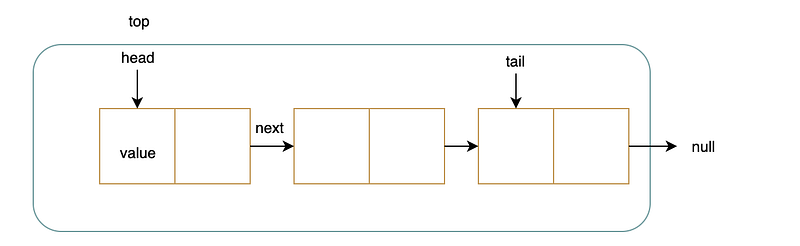
- Maintain pointer to first node in a linked list
- Insert and remove the front
Propositions
Every operations takes constant time in the worst case
Implementation in Java (from the official video)
4. Stack implementation in Array (Resizing array)
Description
- Use array
s[]to storeNitems on stack push: add new item ats[N]pop: remove new item ats[N — 1]
Considerations
- underflow: throw exception if pop from an empty stack
- overflow: use resizing array for array implementation
Resizing array
- If the array is full, create a new array of twice the size, and copy items
- consequence: inserting first
Nitems takes time proportional toN(notN ^ 2) - If the array is full, having size of array
s[]
Too expensive in worst case for resizing array
- consider
push-pop-push-pop…sequence when array is full - each operation takes time proportional to
N
Proposition
Implementation in Java (from the official video)
Related LeetCode questions
5. Introduction to Queue
First in first out (FIFO): remove and return the item least recently added
APIs
APIs we have to implement for the queue.
6. Queue implementation in linked-list
Description
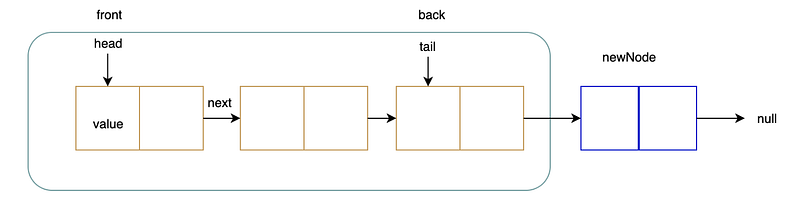
- Maintain pointer to first and last nodes in a linked list
- Insert the front
- Remove from the end
Implementation in Java (from the official video)
7. Queue implementation in Array (Resizing array)
Description
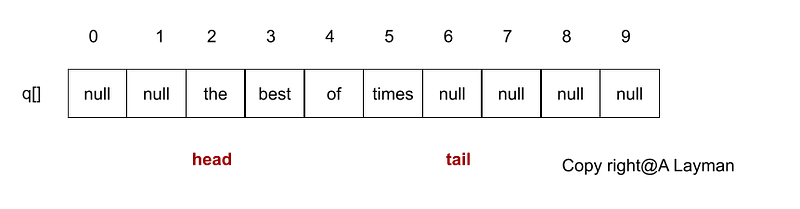
- Use array
q[]to store items in queue enqueue: add new item atq[tail]dequeue: remove item fromq[head]- Update
headandtailmodulo the capacity
Implementation in Java (completed by myself, from the official video)
8. Priority queue implementation in array
Description
- Queue: remove the item most recently added
- Stack: remove the item least recently added
- Randomized queue: remove a random item
- Priority queue: remove the largest (or smallest) item
APIs
Implementation in Java (from the official video)
- Unordered array implementation
Challenge
- Implement all operations efficiently
9. Completed code in JavaScript
- completed by myself, not from the official video
Week 2 Programming Assignment: Deques and Randomized Queues
There are two requirements.
- deque: double-ended queue that supports adding and removing items from either the front or the back of the data structute
- randomized queue: the item removed is chosen uniformly at random among items in the data structure
- client program: read a sequence of string and print exactly k of item, uniformly at random
Requirements in detail
Solutions
- Deque.java
- RandomizedQueue.java
- Permutation.java
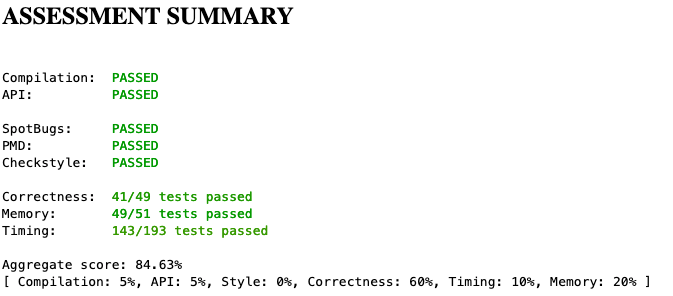
Grades
Summary
Thanks for your patient. I am Sean. I work as a software engineer.
This article is my note. Please feel free to give me advice if any mistakes. I am looking forward to your feedback.
- Subscribe me
- The Facebook page for articles
- The latest side project: Daily Learning


