Free AI web copilot to create summaries, insights and extended knowledge, download it at here
6627
Abstract
s="gist-iframe" src="/gist/JenHsuan/075a959ee274f0051fd0cbe496244eba.js" allowfullscreen="" frameborder="0" height="undefined" width="undefined">
</div>
</div>
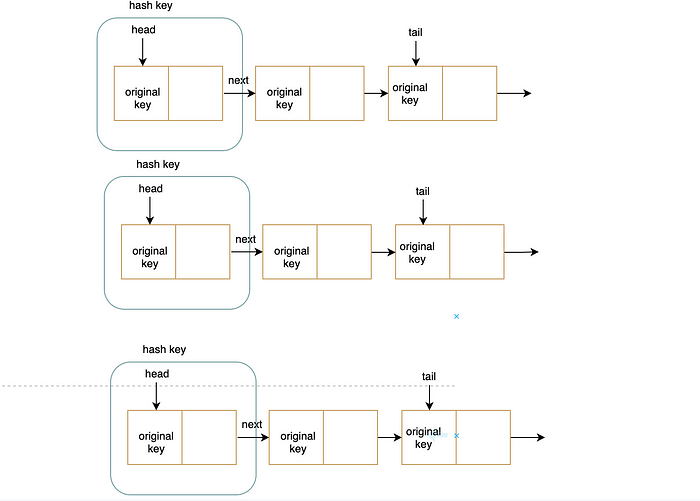
</figure></iframe></div></div></figure><h1 id="4a3d">3. Separate chaining table</h1><h2 id="0e6e">Collision</h2><ul><li>Two distinct keys hashing to same index</li></ul><h2 id="aee8">Collision resolution</h2><ul><li>Algorithm and data structure to handle two keys that hash to the same array index</li></ul><h2 id="b92b">Separate chaining table</h2><ul><li>To solve the collision issues efficiently</li><li>Use an array of <code>M < N</code> linked lists</li></ul><figure id="7151"><img src="https://cdn-images-1.readmedium.com/v2/resize:fit:800/0*CTkSY_QcNN4yIsYh.png"><figcaption>source: <a href="https://readmedium.com/learning-data-structure-in-javascript-for-beginners-f5752363a4e1#8804">https://readmedium.com/learning-data-structure-in-javascript-for-beginners-f5752363a4e1#8804</a></figcaption></figure><h2 id="747f">Implementation</h2><ul><li>Number of probes for search/insert is proportional to <code>N/M</code> (<code>M</code> time faster than sequenced search)</li><li><code>M</code> too large => too many empty chains</li><li><code>M</code> too small => chains too long</li><li>Typical choice: <code>M ~ N/5</code> -> constant-time operations</li></ul>
<figure id="96f9">
<div>
<div>
            <iframe class="gist-iframe" src="/gist/JenHsuan/c0aaca5b2c07b0865aaf09351030f05f.js" allowfullscreen="" frameborder="0" height="undefined" width="undefined">
          </div>
        </div>
    </figure></iframe></div></div></figure><h1 id="905d">4. Linear probing</h1><ul><li>Map key to integer i between 0 and M — 1</li><li>Array size M must be greater than number of key-value pairs N</li><li>Search table index <code>i</code>; if occupied but no match, try <code>i + 1</code>, <code>i + 2</code>, etc</li></ul><h2 id="36a8">Implementation</h2>
    <figure id="eb3a">
        <div>
          <div>

            <iframe class="gist-iframe" src="/gist/JenHsuan/90564ce134b0fb16089674cb8f35e388.js" allowfullscreen="" frameborder="0" height="undefined" width="undefined">
          </div>
        </div>
    </figure></iframe></div></div></figure><h1 id="acc2">5. Separate chaining table vs. Linear probing</h1><h2 id="5817">Separate chaining table</h2><ul><li>Easier to implement delete</li><li>Performance degrades gracefully</li><li>Clustering lass sensitive to poorly-designed hash function</li></ul><h2 id="c0fc">Linear probing</h2><ul><li>Less wasted space</li><li>Better cache performance</li></ul><h1 id="3607">6. Hash tables vs. balanced search trees</h1><h2 id="d4ad">Hash tables</h2><ul><li>Simpler to code</li><li>No effective alternative for unordered keys</li><li>Faster for simple keys (a few arithmetic operations verses log N compares)</li><li>Better system support in Java for strings (e.g., cached hash code)</li></ul><h2 id="f06b">Balanced search trees</h2><ul><li>Stronger performance guarantee</li><li>Support for ordered ST operations</li><li>Easier to implement <code>compareTo()</code> correctly than <code>equals()</code> and <code>hashCode()</code></li></ul><h2 id="d955">Java system includes both</h2><ul><li>Red-black BSTs: <code>java.util.TreeMap</code>, <code>java.util.TreeSet</code></li><li>Hash tables: <code>java.util.HashMap</code>,<code>java.util.IdentityHashMap</code></li></ul><h1 id="644f">7. Completed code in JavaScript</h1><ul><li>completed by myself, not from the official video</li></ul><div id="ae7f" class="link-block">
      <a href="https://readmedium.com/learning-data-structure-in-javascript-for-beginners-f5752363a4e1">
        <div>
          <div>
            <h2>Learning data structure in JavaScript for beginners</h2>
            <div><h3>It’s the note for learning data structure in JavaScript. I studied the source code form trekhleb’s Github repository…</h3></div>
            <div><p>medium.com</p></div>
          </div>
          <div>
            <div style="background-image: url(https://miro.readmedium.com/v2/resize:fit:320/1*MSRVgtaB1NSWFnrP13x-jQ.png)"></div>
          </div>
        </div>
      </a>
    </div><h1 id="ff6a">Week 5 Programming Assignment: KD-Tree</h1><p id="b336">Give a bunch of points and draw a rectangle by the mouse, calculate the points inside the rectangle.</p><p id="8463">Implement in two ways.</p><ol><li>brute-force implementation (PointSET.java)</li><li>KD-tree implementation (KdTree.java)</li></ol><h2 id="40ba">Requirements in detail</h2><div id="7a68" class="link-block">
      <a href="https://coursera.cs.princeton.edu/algs4/assignments/kdtree/specification.php">
        <div>
          <div>
            <h2>Programming Assignment 5: Kd-Trees</h2>
            <div><h3>x- and y-coordinates between 0 and 1) using a2d-tree to support efficientrange search (find all of the points contained…</h3></div>
            <div><p>coursera.cs.princeton.edu</p></div>
          </div>
          <div>
            <div style="background-image: url(https://miro.readmedium.com/v2/resize:fit:320/0*0wq5sV-JkACcJeeQ)"></div>
          </div>
        </div>
      </a>
    </div><h2 id="c5f5">Solutions</h2><ul><li>PointSET.java</li></ul>
    <figure id="d8e1">
        <div>
          <div>

            <iframe class="gist-iframe" src="/gist/JenHsuan/56c71530e76ff42c1cb468fac8672358.js" allowfullscreen="" frameborder="0" height="undefined" width="undefined">
          </div>
        </div>
    </figure></iframe></div></div></figure><ul><li>KdTree.java</li></ul>
    <figure id="b0f9">
        <div>
          <div>

            <iframe class="gist-iframe" src="/gist/JenHsuan/b9ec58d563a3b392cc9efd79ed1cf912.js" allowfullscreen="" frameborder="0" height="undefined" width="undefined">
          </div>
        </div>
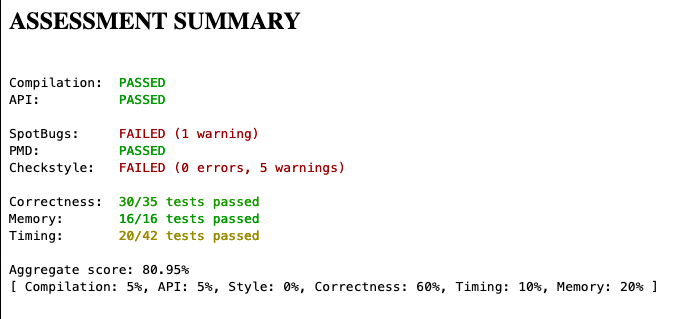
    </figure></iframe></div></div></figure><h2 id="4e73">Grades</h2><figure id="a63d"><img src="https://cdn-images-1.readmedium.com/v2/resize:fit:800/1*8xZ-02kUeZs-gVWpfvd0uw.png"><figcaption></figcaption></figure><h1 id="2ad6">Summary</h1><p id="67b1"><i>Thanks for your patient. I am <a href="https://www.linkedin.com/in/jen-hsuan-hsieh-6a13347a/">Sean</a>. I work as a software engineer.</i></p><p id="95c5"><i>This article is my note. Please feel free to give me advice if any mistakes. I
Options
am looking forward to your feedback.</i></p><ul><li>Subscribe me</li></ul><div id="00b7" class="link-block">
<a href="https://medium.com/@seanhsieh_63050/membership">
<div>
<div>
<h2>Join Medium with my referral link — Jen-Hsuan Hsieh (Sean)</h2>
<div><h3>As a Medium member, a portion of your membership fee goes to writers you read, and you get full access to every story…</h3></div>
<div><p>medium.com</p></div>
</div>
<div>
<div style="background-image: url(https://miro.readmedium.com/v2/resize:fit:320/0*HotGzJ9QwFkeUJCo)"></div>
</div>
</div>
</a>
</div><ul><li>The Facebook page for articles</li></ul><div id="633c" class="link-block">
<a href="https://www.facebook.com/imalayman">
<div>
<div>
<h2>A Layman</h2>
<div><h3>A Layman. 81 likes. The page sharing the information about programming languages, algorithm, databases, devops and…</h3></div>
<div><p>www.facebook.com</p></div>
</div>
<div>
<div style="background-image: url(https://miro.readmedium.com/v2/resize:fit:320/0*7t8weBH0eq-il9Lq)"></div>
</div>
</div>
</a>
</div><ul><li>The latest side project: Daily Learning</li></ul><div id="af2a" class="link-block">
<a href="https://daily-learning.herokuapp.com/">
<div>
<div>
<h2>ALayman Daily Learning</h2>
<div><h3>Daily learning provides articles, challenges, or videos to people who are also self-learner for programming.</h3></div>
<div><p>daily-learning.herokuapp.com</p></div>
</div>
<div>
<div style="background-image: url(https://miro.readmedium.com/v2/resize:fit:320/0*7820hJWu4Uq6b1eH)"></div>
</div>
</div>
</a>
</div><h1 id="e3cf">Related topics</h1><p id="0421">How to use the two-way binding in Knout.js and ReactJS?</p><div id="bb06" class="link-block">
<a href="https://readmedium.com/how-to-use-the-two-way-binding-in-knout-js-and-reactjs-afea126d0236">
<div>
<div>
<h2>How to use the two-way binding in Knout.js and ReactJS?</h2>
<div><h3>Components built by different frameworks must have the same action in one website. What we have to realize is how to…</h3></div>
<div><p>medium.com</p></div>
</div>
<div>
<div style="background-image: url(https://miro.readmedium.com/v2/resize:fit:320/1*SK9-uglh85Hl4wAh3OHQ_g.png)"></div>
</div>
</div>
</a>
</div><p id="7d15">Learn how to use SignalR to build a chatroom application</p><div id="ebac" class="link-block">
<a href="https://readmedium.com/learn-how-to-use-signalr-to-build-a-chatroom-application-63e8bb8049ff">
<div>
<div>
<h2>Learn how to use SignalR to build a chatroom application</h2>
<div><h3>The Introduction of SignalR</h3></div>
<div><p>medium.com</p></div>
</div>
<div>
<div style="background-image: url(https://miro.readmedium.com/v2/resize:fit:320/1*j6m4jnkuRKkQ6rrkqLFeGA.png)"></div>
</div>
</div>
</a>
</div><p id="6252">My reflection of <effective sql="">:</effective></p><div id="a401" class="link-block">
<a href="https://readmedium.com/how-to-design-the-data-model-my-reflection-of-effective-sql-adba6376588a">
<div>
<div>
<h2>How To Design The Data Model? — My reflection of <effective sql=""></effective></h2>
<div><h3><effective 61="" sql:="" specific="" ways="" to="" write="" better="" sql=""> gave me many tips for using the database.</effective></h3></div>
<div><p>medium.com</p></div>
</div>
<div>
<div style="background-image: url(https://miro.readmedium.com/v2/resize:fit:320/1*trYud-lAkP2-bXo82U9bQA.png)"></div>
</div>
</div>
</a>
</div><div id="249d" class="link-block">
<a href="https://readmedium.com/how-to-design-the-index-my-reflection-of-effective-sql-b23d24212974">
<div>
<div>
<h2>How To Design The Index? — My reflection of <effective sql=""></effective></h2>
<div><h3><effective 61="" sql:="" specific="" ways="" to="" write="" better="" sql=""> gave me many tips for using the database.</effective></h3></div>
<div><p>medium.com</p></div>
</div>
<div>
<div style="background-image: url(https://miro.readmedium.com/v2/resize:fit:320/1*l4nVJqhrI1_sFMy2zQ8N0w.png)"></div>
</div>
</div>
</a>
</div><div id="6af9" class="link-block">
<a href="https://readmedium.com/whats-if-we-can-t-change-the-design-my-reflection-of-effective-sql-3704b87c49b5">
<div>
<div>
<h2>What if we can’t change the design? — My reflection of <effective sql=""> Part 3</effective></h2>
<div><h3><effective 61="" sql:="" specific="" ways="" to="" write="" better="" sql=""> gave me many tips for using the database.</effective></h3></div>
<div><p>medium.com</p></div>
</div>
<div>
<div style="background-image: url(https://miro.readmedium.com/v2/resize:fit:320/1*jqUMxB_afM-552DjqBo3gA.png)"></div>
</div>
</div>
</a>
</div><p id="75de">IT & Network:</p><div id="79e8" class="link-block">
<a href="https://readmedium.com/back-to-the-basic-introduction-to-dns-f63aebe7bee7">
<div>
<div>
<h2>Back to the basic: Introduction to DNS</h2>
<div><h3>I decided to back to the basic and enhance these bits of knowledge. I also expect that this article can help someone…</h3></div>
<div><p>medium.com</p></div>
</div>
<div>
<div style="background-image: url(https://miro.readmedium.com/v2/resize:fit:320/1*m4nxtUjDkrX9lClzHnnboA.png)"></div>
</div>
</div>
</a>
</div></article></body>