
Algo-Trading NVIDIA with Donchian Channels

- NVIDIA (NASDAQ: NVDA) has come to dominate the market for chips used in AI-powered platforms, bringing its market capitalization to more than $2.28 trillion, an increase of over $1 trillion from its value at the beginning of the year.
- TradingView: Nvidia’s earnings for the current year have risen by 3.1% over the past month to $23.84. Furthermore, Nvidia is projected to experience a significant EPS growth of 84% this year.
- Indeed, NVDA stock smashed through earnings expectations, sending its shares — and the shares of adjacent AI stocks — rocketing higher. But bull runs don’t last forever. Therefore, it’s always wise to keep an eye on the exit strategy.
- The objective of this post is further validate the current NVDA technicals, trading ideas and analyst recommendations using Donchian channels.
- Donchian Channels (DC) are a technical indicator that seeks to identify bullish and bearish extremes that favor reversals, higher and lower breakouts, breakdowns, and other emerging trends.
- Why DC: Combining SMA/EMA, volume indicators, and MACD with DC can lead to a more complete picture of the market for an asset.
- Method: We take on board the algo-trading algorithm in Python that consists of the following steps (cf. Strategy 1: Donchian Middle Value Cross-Over):
- Step 1: Reading the NVDA stock historical data using yfinance
- Step 2: Create a visualization of the Donchian Channel using matplotlib
- Step 3: Implementing the Donchian Middle Value Cross-Over Strategy 1
- Step 4: Compare the cumulative returns and relevant stock Risk/Return KPIs (total/annual ROI, annual volatility, Sortino/Sharpe ratio, max drawdowns, and max drawdown durations) of Strategy 1 vs Buy-and-Hold default.
- Let’s delve into the implementation details in Jupyter Notebook!
- Setting up the working directory YOURPATH
import os
os.chdir('YOURPATH')    # Set working directory
os. getcwd() - Basic import and installations
!pip install yfinance
import pandas as pd
import numpy as np
import matplotlib.pyplot as plt
import yfinance as yf- Invoking the DC functions that implement Strategy 1
def calcDonchianChannels(data: pd.DataFrame, period: int):
  data["upperDon"] = data["High"].rolling(period).max()
  data["lowerDon"] = data["Low"].rolling(period).min()
  data["midDon"] = (data["upperDon"] + data["lowerDon"]) / 2
  return data

def midDonCrossOver(data: pd.DataFrame, period: int=20, shorts: bool=True):
  data = calcDonchianChannels(data, period)

  data["position"] = np.nan
  data["position"] = np.where(data["Close"]>data["midDon"], 1,
                              data["position"])
  if shorts:
    data["position"] = np.where(data["Close"]<data["midDon"], -1,
                                data["position"])
  else:
    data["position"] = np.where(data["Close"]<data["midDon"], 0,
                                data["position"])
  data["position"] = data["position"].ffill().fillna(0)

  return calcReturns(data)

def calcReturns(df):
  df['returns'] = df['Close'] / df['Close'].shift(1)
  df['log_returns'] = np.log(df['returns'])
  df['strat_returns'] = df['position'].shift(1) * df['returns']
  df['strat_log_returns'] = df['position'].shift(1) * \
      df['log_returns']
  df['cum_returns'] = np.exp(df['log_returns'].cumsum()) - 1
  df['strat_cum_returns'] = np.exp(
      df['strat_log_returns'].cumsum()) - 1
  df['peak'] = df['cum_returns'].cummax()
  df['strat_peak'] = df['strat_cum_returns'].cummax()
  return df

def getStratStats(log_returns: pd.Series,
  risk_free_rate: float = 0.02):
  stats = {}  # Total Returns
  stats['tot_returns'] = np.exp(log_returns.sum()) - 1

  # Mean Annual Returns
  stats['annual_returns'] = np.exp(log_returns.mean() * 252) - 1

  # Annual Volatility
  stats['annual_volatility'] = log_returns.std() * np.sqrt(252)

  # Sortino Ratio
  annualized_downside = log_returns.loc[log_returns<0].std() * \
    np.sqrt(252)
  stats['sortino_ratio'] = (stats['annual_returns'] - \
    risk_free_rate) / annualized_downside

  # Sharpe Ratio
  stats['sharpe_ratio'] = (stats['annual_returns'] - \
    risk_free_rate) / stats['annual_volatility']

  # Max Drawdown
  cum_returns = log_returns.cumsum() - 1
  peak = cum_returns.cummax()
  drawdown = peak - cum_returns
  max_idx = drawdown.argmax()
  stats['max_drawdown'] = 1 - np.exp(cum_returns[max_idx]) \
    / np.exp(peak[max_idx])

  # Max Drawdown Duration
  strat_dd = drawdown[drawdown==0]
  strat_dd_diff = strat_dd.index[1:] - strat_dd.index[:-1]
  strat_dd_days = strat_dd_diff.map(lambda x: x.days).values
  strat_dd_days = np.hstack([strat_dd_days,
    (drawdown.index[-1] - strat_dd.index[-1]).days])
  stats['max_drawdown_duration'] = strat_dd_days.max()
  return {k: np.round(v, 4) if type(v) == np.float_ else v
for k, v in stats.items()}- Loading the NVDA historical data and calculating DC
ticker = "NVDA"
yfObj = yf.Ticker(ticker)
data = yfObj.history(start="2021-01-03", end="2024-04-03").drop(
    ["Volume", "Stock Splits"], axis=1)
data = calcDonchianChannels(data, 20)
data.tail()

                          Open        High        Low      Close Dividends upperDon lowerDon midDon
Date
2024-03-25 00:00:00-04:00 939.409973 967.659973 935.099976 950.020020 0.0 974.0 771.213814 872.606907
2024-03-26 00:00:00-04:00 958.510010 963.750000 925.020020 925.609985 0.0 974.0 771.213814 872.606907
2024-03-27 00:00:00-04:00 931.119995 932.400024 891.229980 902.500000 0.0 974.0 783.463248 878.731624
2024-03-28 00:00:00-04:00 900.000000 913.000000 891.929993 903.559998 0.0 974.0 794.312735 884.156367
2024-04-01 00:00:00-04:00 902.989990 922.250000 892.039978 903.630005 0.0 974.0 834.169983 904.084991- Plotting DC for NVDA
colors = plt.rcParams["axes.prop_cycle"].by_key()["color"]

plt.figure(figsize=(12, 8))
plt.plot(data["Close"], label="Close")
plt.plot(data["upperDon"], label="Upper", c=colors[1])
plt.plot(data["lowerDon"], label="Lower", c=colors[4])
plt.plot(data["midDon"], label="Mid", c=colors[2], linestyle=":")
plt.fill_between(data.index, data["upperDon"], data["lowerDon"], alpha=0.3,
                 color=colors[6])

plt.xlabel("Date")
plt.ylabel("Price in $")
plt.title(f"Donchian Channels for {ticker}")
plt.legend()
plt.grid()
plt.show()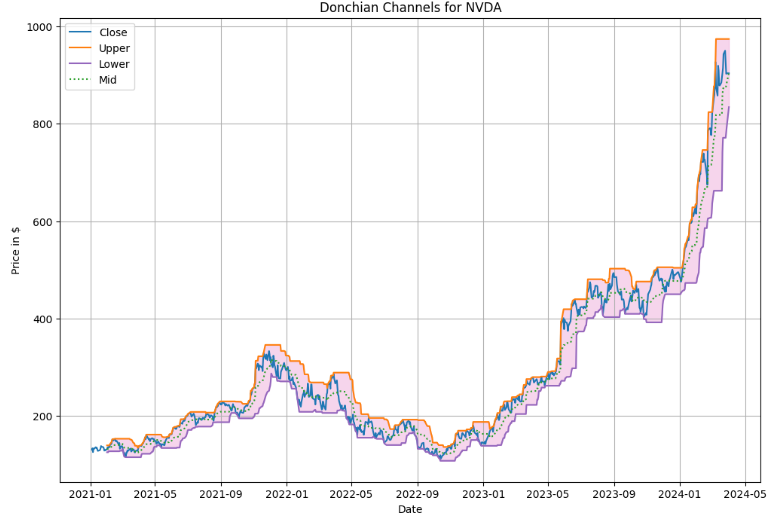
- Comparing Cumulative Returns for Mid Donchian Cross-Over Strategy vs Buy-and-Hold default
midDon = midDonCrossOver(data.copy(), 20, shorts=False)

plt.figure(figsize=(12, 4))
plt.plot(midDon["strat_cum_returns"] * 100, label="Mid Don X-Over")
plt.plot(midDon["cum_returns"] * 100, label="Buy and Hold")
plt.title("Cumulative Returns for Mid Donchian Cross-Over Strategy")
plt.xlabel("Date")
plt.ylabel("Returns (%)")
plt.xticks(rotation=45)
plt.legend()
plt.grid()
plt.show()

stats = pd.DataFrame(getStratStats(midDon["log_returns"]),
                     index=["Buy and Hold"])
stats = pd.concat([stats,
                   pd.DataFrame(getStratStats(midDon["strat_log_returns"]),
                               index=["MidDon X-Over"])])
stats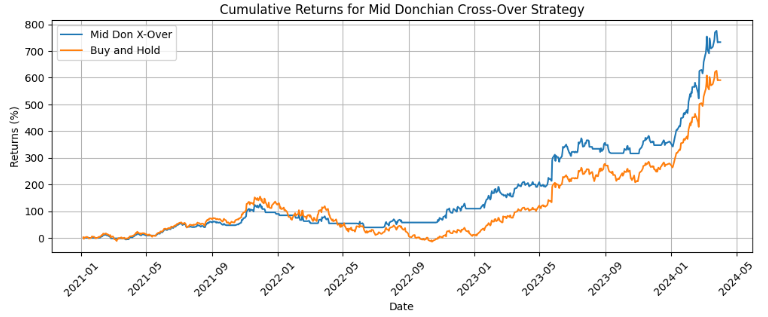

Conclusions
- In this study, we have performed the algo-trading technical analysis of NVDA using Donchian Channels (DC).
- Results have shown that DC can provide valuable insights into NVDA stock dynamics and offer potential opportunities for profit and exit strategies.
- It appears that NVDA Mid Donchian Cross-Over (Strategy 1) has outperformed the Buy-and-Hold default in terms of Cumulative Returns and popular Risk/Return KPIs for our selected timeframe.
Explore More
- Donchian Channel Trading Systems
- A Market-Neutral Strategy
- NVIDIA Returns-Drawdowns MVA & RNN Mean Reversal Trading
- NVIDIA Rolling Volatility: GARCH & XGBoost
- IQR-Based Log Price Volatility Ranking of Top 19 Blue Chips
- Multiple-Criteria Technical Analysis of Blue Chips in Python
References
- NVIDIA
- Building A Simple Breakout Trading System Using Python
- Nvidia Stock Buy Hold or Sell
- NVDA Technicals
- Nvidia’s $1 Trillion Market Cap Gain This Year Is Nearly Double Tesla’s Entire Market Cap
- Nothing Goes Up Forever. This Rule Will Tell You When To Sell Nvidia Stock.
- Donchian Channels
- Donchian Channels Formula, Calculations, and Uses
- DONCHIAN CHANNELS (DC)
- Donchian Channels — Overview, Mechanics, and Calculation
- Donchian Channel Strategy — What Is It
- What Everyone Should Know About the Donchian Channel Indicator


