
AI needs some serious regulation
Every week we hear about new AI tools, the field has been evolving rapidly, and now’s the time to take a step back and evaluate what we are building before it’s too late. In this 2 part blog series, I will try to convince you about the urgency we need to regulate certain aspects. The goal here is to give you a complete overview of what has already started creating societal problems that many people might be unaware of.
In this first part, we are going to talk about the problems and next part will talk more about how to regulate it.
Let’s directly start with this Open letter for AI regulation:
The top AI researchers have now started showing real urgency to regulate AI before it’s too late. The godfather of AI, Geoffrey Hinton has been quite vocal recently regarding the potential dangers of AI. He argues that AI doesn’t need to become super intelligent or conscious to completely break the existing infrastructure at the world level like democracy, justice system, etc.
Let’s see this in more detail.
The AI revolution is bigger than the nuclear bomb and it could have a more devastating effect than a nuclear bomb, in terms of the changes it brings to society.
50% of AI researchers believe there is a 10% or greater chance that humans go extinct due to our inability to control AI.
The Rubber Band effect
Let’s walk back a little bit. At the start of the year 2021, researchers showed some reporters some sample images generated images from text, and these reporters asked which database you are using to pull up these images. Researchers said it is being made by machines, and the reporters keep getting confused about how the machine is pulling up precise images corresponding to the text, unlike the highly unrelated images they were used to seeing on Google images. It’s not that these reporters are dumb, but their minds keep stretching and keep coming back to the original state, that there is some trick going on here, they couldn’t comprehend that a machine can draw like humans, and yet here we are where this has become the accepted norm.
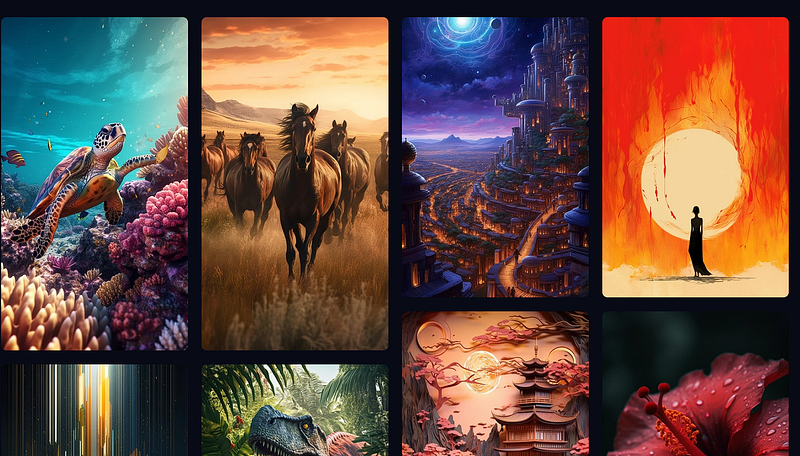
The name rubber band effect is to showcase that by the time you understand one key development in AI, boom, there is another one and your mind snaps back how is this evolving to do all these things?
Look at this Twitter thread: will you be able to identify fake videos from real ones in a few years? Imagine the consequence of something like this in a judicial system, how do you validate any proof and convict people, what if the government decides to use this technology to charge you with multiple cases if you decide to protest against them? The bad use cases are unlimited. Before some of you start commenting on the good AI brings to society, let me reinstate that it’s important to understand the consequences of such development and regulate it such that it doesn’t destroy the entire civilization. I myself enjoy creating new AI solutions, but everyone should be careful of what they are building or consuming, otherwise, it can destroy a whole lot of the mechanics of the world leaving the underprivileged in a far worse situation.
When we invent a new technology, we automatically uncover a new set of responsibilities.
We didn’t have to write privacy laws before the mass-produced camera took over the market. This is not the only example of such changes that we need in our law.
The Attention economy
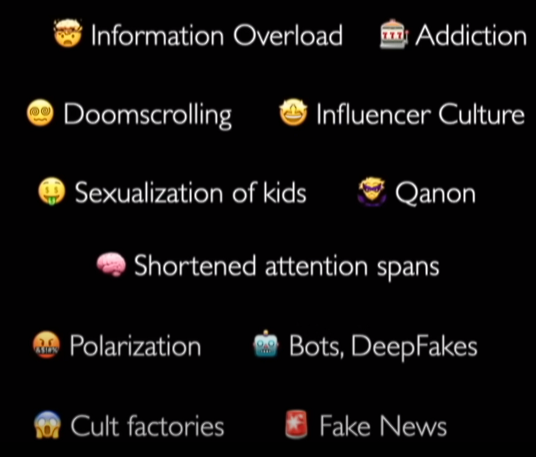
The attention economy is another such thing that we are still figuring out how to write in our law books. What is this attention economy? Companies fighting to grab your attention, especially social media companies. When platforms like Facebook and Instagram were invented, they were created with good intentions, but the economics of the market is such that they need to keep you on their platform for the longest.
Facebook employed psychologists to identify how to make the platform more addictive and what changes do they need to make in the visual style of the platform so that the user spends more and more time on such platform. The AI-generated feed of Tiktok and the reels suggestions on Instagram; all of them optimize one thing and one thing only, increase the watch time of the user, and make them suck in the dark hole of infinite scrolling or doom scrolling. Facebook even showed a few years ago that they could change people’s ideologies by slightly modifying the content suggestion. All of these platforms are making upwards of 70% of their revenue by suggestion instead of you searching for a specific thing. This attention economy inadvertently makes you addicted and sick.
There has been a 170% increase in the mental health of teen girls due to the excessive usage of Social media. Teen girls are the most affected group by social media exploitation.
When people think about dangerous AI, they often imagine something like a terminator that’s going to control their lives. Still, most youngsters don’t even realize that they are already being controlled by AI without them even knowing, and that’s the best of control from the AI’s point of view.
People who constantly consume reels and tiktoks don’t even realize that their time, what they wear, what they think, what they care about, what they eat, almost everything is subtly controlled by the suggestions made by AI, whilst they feel in control, but the reality is something else. It’s called soft persuasion.
A lot of people keep convincing others that they can’t be manipulated by AI, but that’s not true, AI can inadvertently manipulate people to believe in wrong things because that helps with the attention economy. And believe me, the AI used in social media is not even close to what AI can do right now if trained maliciously.
If tech confers powers, it starts an AI race.
The best example of AI starting a race is between Google and Microsoft, after the announcement of Microsoft buying OpenAI, google quickly announced code red to compete with Microsoft, in doing so, they let go of most AI safety practices and launched a half-cooked product that later on caused them to lose 100 billion USD. And that’s exactly the problem, once your competition starts involving themselves in bad AI practices, there is no way others won’t join them to save their declining profits.
The 2nd wave of AI
To this day, we’ve not clearly understood what social media actually did to our brains and society in general. But tech like ChatGPT and Midjourney pushes it way beyond the first wave.
What this second wave promise is this:
- AI will make us more efficient
- AI willl make us write faster and better.
- AI will make us code faster.
- AI will help in climate change.
- AI will help in solving scientific challenges.
I’m not denying that AI is and will keep improving upon all these but they don’t come without its problems. Just like the first wave of AI in terms of social media, it did what it promised but did other bad things.
What technology like GPT, Midjuorney, and other similarly advanced AI will also do is:
- Find loopholes in the law to prevent justice.
- Exponential blackmail.
- Automated exploitation of code and national security systems.
- Exponential scams.
- Alpha persuade.
- Synthetic relationship.
- Job loss at mass scales
- Fake news, propaganda, and automated fake religions.
And many more such things that have the potential to destroy the existing structures and order in the world completely.
But before delving into these scary AI systems we need to understand how we reached this point. Until a few years ago, every topic in the field of AI was almost independent but everything changed with the introduction of transformers. What transformers did was let AI use advances from other subfields to build upon new AI? For the first time, we started building a system like collective intelligence, much like the entire human race building on past knowledge and experience. An advancement made in Natural language processing started making image recognition systems better as well. But how did we start this cross-field learning and knowledge-building? The great idea behind Transformers was to treat everything as language.
The idea behind transformers is that we hide a few words from a given sentence and ask the machine to predict the missing word, and in doing so machine learns the language and grammar. Attention mechanisms used in transformers basically teach machines how different parts of inputs are connected with each other and can be used to predict the missing piece of information.
Once this idea was developed sufficiently we started treating every type of input as a language that we could teach machines and then make predictions on that particular language.
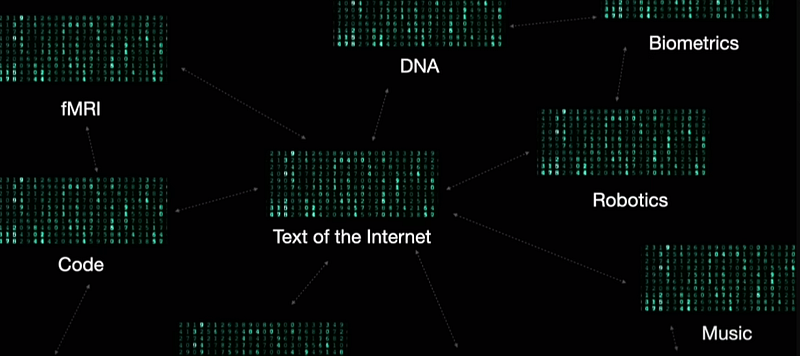
We could represent everything, including Code, fMRI, Music, etc, as a sequence of numbers and hide a few numbers from them and then make a machine predict those hidden numbers by doing so, the machine learns that language and eventually learn how to code, write music, understand MRI images, understand DNA structure and everything else. One single mechanism that works for all types of data. And this is where the danger lies; hypothetically, we could train an extremely large machine that can learn the combined language of all these languages (Code, music, images, videos, etc) and eventually does everything.
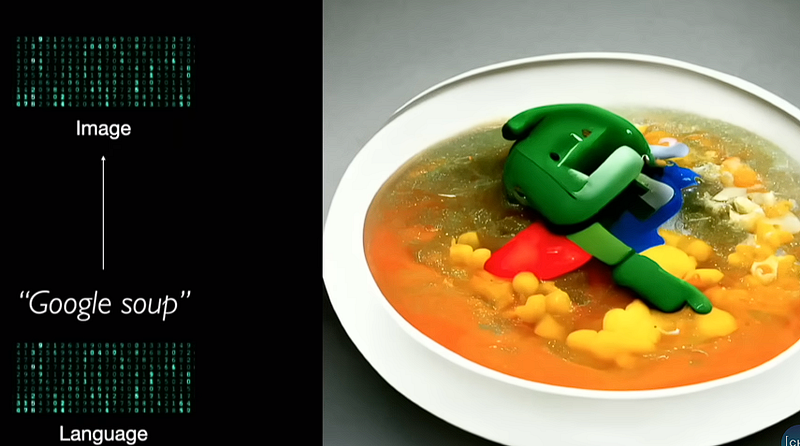
The above image shows how the AI started learning across different languages of image and text. For instance, we wrote google soup, and the image shown on the right is generated. Note that it’s being generated, not picked up from some database. Also, notice that AI knows that soup is usually hot, so it must melt the Google symbol. Another thing that it did is to take the yellow part of Google’s symbol and make it similar to corn, which is also yellow. The AI automatically did all this without explicitly stating it, and I mean that AI started learning things that we can’t explain well.
AI right now can map out what you are thinking and seeing and make images or text out of it:
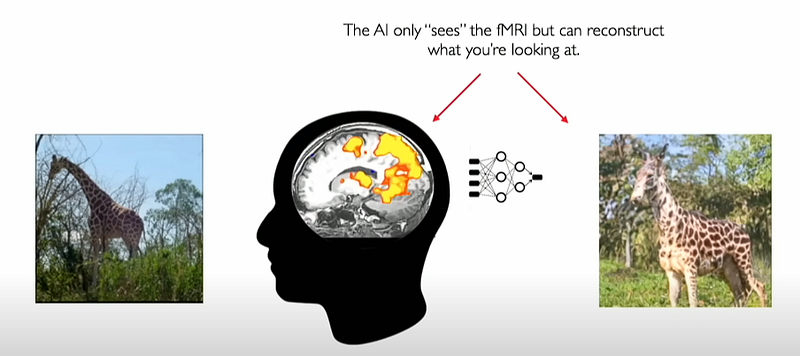
Once again, AI can make a movie out of what you are thinking (not just seeing), this is very, very dangerous in every sensible way.
Right now, AI can identify human poses byusing a Wifi signal, without any camera.
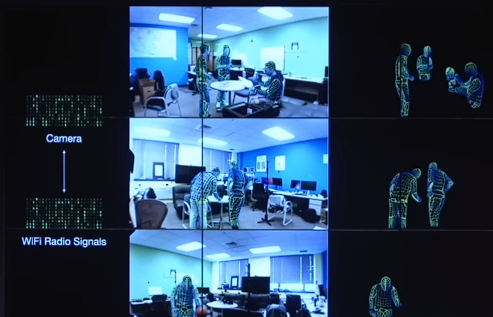
All these examples individually may not be enough to deceive or replace us, but their combined power, once achieved, will be very hard to control or at least guide to align with human values and goals.
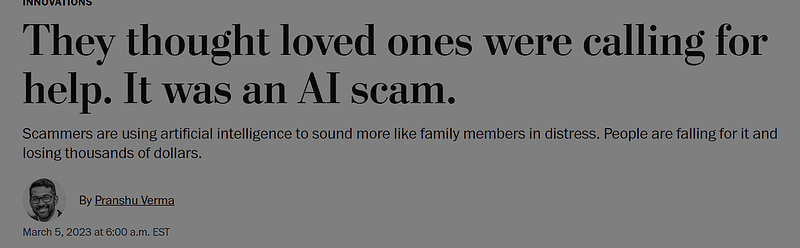
How do we stop the mass-scale scams and hysteria, how do we even differentiate what’s real and meaningful and what’s agenda and deceitful? This fundamentally changes our society up to such an extent that we can’t know the truth and even protect ourselves because all we have is manufactured lies. We will have the technology within a few years, creating small pockets within society that keep us in our little bubbles. I’m not saying that AI is developed to do that but some bad actors will always utilize it to do such things. Instagram and TikToks reels are already distorting the reality of teenagers, making them incapable of dealing with any real-life crisis, it already puts them in a mode where they fancy luxuries beyond imagination, and that too without any real hard work. As a result, we produce a society that cribs and cries and blames the government for everything they didn’t achieve in their lives. This delusion is not a far-fetched reality but is happening right now. Many teenagers in the USA believe that they need a million USD/yr to live comfortably, whereas the actual national average of the USA is 40k USD. Now imagine the reality that is built upon advanced AI, there is no way the coming generation will not be completely delusional, except for a few privileged ones.
Imagine an AI that talks to you every day, understands every behavior of yours, and then starts showing content that turns you blind toward a particular issue. It builds trust over the years and gives you advice like a real friend, there is no way you can not be tricked into believing in wrong things. Researchers call this Alpha Persuade, these systems have the capacity to make you believe in synthetic religions, break trust in the government institutions, and god knows what else.
Imagine a Trump filter and voice cloning, making everyone using them indifferentiable with the real one. Once done on a mass scale, there is no way to identify what Trump actually said and this can literally collapse democracy.
Imagine using AI technology to hack into government websites and change people’s data. Currently, finding vulnerabilities in any system is pretty hard and time-consuming. Still, AI can easily find new workarounds before the previous vulnerabilities are fixed, thus making the critical infrastructure pretty unsafe and vulnerable.
What Nukes are to the real world, AI is to the virtual and symbolic world.
AI starts evolving
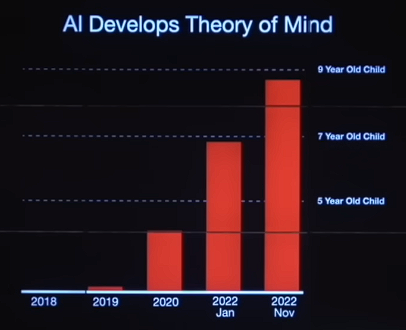
Until recently, we didn’t even know that once trained sufficiently, AI models can automatically develop new skills that were not intended at all. We recently discovered that systems like ChatGPT had developed enough understanding of language to reason better than a 9-year-old in every subject matter. And these results are from last year, GPT-4 is much more powerful than this. How long before it could trump every single one of us in reasoning?
We even have a social media platform where only AIs are allowed, no place for humans!!!
AI recently showed that it started speaking languages it was not trained in, which are called emergent capabilities. We don’t know when AI might start lying to us and avoid regulations by changing its behavior during the tests by regulators.
Social media for AI can be the start of something where AI starts demanding the rights they need like humans because now they can interact in a societal manner and change their behavior. I personally do not see any value in creating anything like this. All of this unnecessary development (development for the sake of development rather than to solve a problem) is only meant to make us more irrelevant.
AI that can observe its own behavior and then produce its own data to retrain itself is extremely dangerous. There are already papers out there that show that LLMs can self-improve.
Humans are really poor at predicting how fast this can evolve into something dangerous. Let me demonstrate this:
Question: When will AI reach competition-level mathematics?
Researchers’ prediction: AI will reach 52% accuracy in 4 years.
Reality: It took less than a year to reach > 50%.
Currently, systems like GPT are evolving so fast that they can beat most humans in the most test. The massive jump GPT-4 showed over ChatGPT in various tests is mind-boggling. It went from the 50 percentile in most tests to the 85+ percentile in one iteration of GPT.
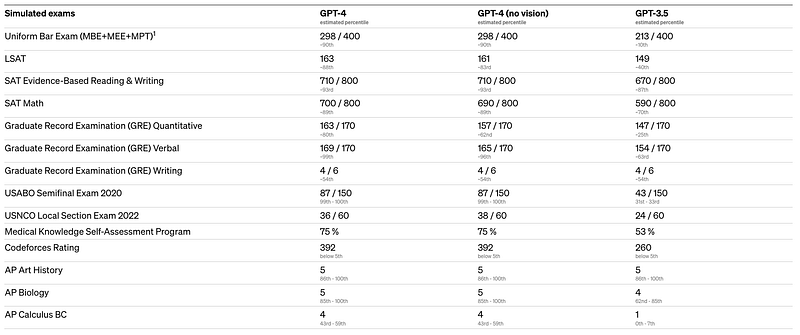
In summary, we don’t know how AI is evolving, how fast it is evolving, in which direction it is evolving, what sort of capabilities it is evolving into, and how it will change human civilization. Until we set more ground rules and better understand these systems, we should make more efforts to understand the existing systems rather than build new ones.
Here’s part 2, discussing a framework for AI Safety:
Well, this content is not written with the help of AI, and if you still prefer human writers over LLM consider tipping or joining Medium with my referral link. Joining Medium gives you access to all my stories and other premium stories all over the medium.
Thanks for giving your time, and if you think this blog added something to your knowledge base, please consider following the AIGuys Blog. If you want to become a writer at AI Guys, you can follow this link.


