avatarFabio Matricardi

Free AI web copilot to create summaries, insights and extended knowledge, download it at here

7206

Abstract

6fdb">While the researcher highlights the impressive abilities of In context Learning (ICL) they also noted that “When presented with tasks or functions which are out-of-domain of their pre-training data, we demonstrate various failure modes of transformers and degradation of their generalization for even simple extrapolation tasks…” .</p><p id="f369">This basically means, in plain English, that if you want a transformer model to do something, you need to train it on data related to that task. <b>Even if the task is simple, if the model hasn’t been trained on the right data, it might not be able to do it.</b></p><p id="27f3">I found only one honest article published on the AGI topic and on the limits of the current Transformers Architecture to produce an AGI: it is from <a href="https://sjbyrnes.com/agi.html">Steven Byrnes</a>. He goes through the Generative AI structure and identifies 3 main deficiencies in Transformers as AGIs:</p><ul><li>the <b>sample efficiency </b>is bound to be dramatically worse for training a Transformer versus training a real generative-model-centric system. And this makes it difficult or impossible for it to <b>learn or create concepts that humans are not already using</b>.</li><li><b>the finite number of Transformer layers puts a ceiling on the quality of the generative-model-search process, the time spent deliberating: </b>Humans can stretch their capabilities by thinking a little bit longer and harder. However, if you have a Transformer that more-or-less simulates the first 100 (or whatever) milliseconds of the neocortex’s generative-model-search process, then that’s all you can ever get.</li><li>because the Transformer is a kind of information processing imitating a <i>different </i>kind of information processing, I generally expect edge cases where the imitation breaks down, leading to <b>weird inductive biases, crazy out-of-distribution behavior, etc.</b> I’m not too sure about this one though.</li></ul><p id="ac95">The article is quite interesting: you can read it her for your enjoyment and critical thinking</p><div id="d1b4" class="link-block"> <a href="https://www.alignmentforum.org/posts/SkcM4hwgH3AP6iqjs/can-you-get-agi-from-a-transformer"> <div> <div> <h2>Can you get AGI from a Transformer? - AI Alignment Forum</h2> <div><h3>UPDATE IN 2023: I wrote this a long time ago and you should NOT assume that I still agree with all or even most of what…</h3></div> <div><p>www.alignmentforum.org</p></div> </div> <div> <div style="background-image: url(https://miro.readmedium.com/v2/resize:fit:320/0*9r6Rdea6jjBfqQNZ)"></div> </div> </div> </a> </div><p id="48fd">So at the status of the art, as of now, the Transformers architecture is only a foundation block for a General intelligence. And honestly all the algorithm are an attempt to reproduce the way the human mind thinks and process information, learns, abstracts and connects the dots.</p><h1 id="6a39">The Next Steps</h1><p id="1ebe">I believe that generally speaking the Open Source community and the universities are going in the right direction.</p><p id="e670">You can see the hints in the general trends and the new papers release on <a href="https://arxiv.org/search/advanced?advanced=&amp;terms-0-operator=AND&amp;terms-0-term=&amp;terms-0-field=title&amp;classification-computer_science=y&amp;classification-physics_archives=all&amp;classification-include_cross_list=include&amp;date-year=&amp;date-filter_by=date_range&amp;date-from_date=2023-11-01&amp;date-to_date=2023-11-18&amp;date-date_type=submitted_date&amp;abstracts=show&amp;size=50&amp;order=-announced_date_first">arxiv.org</a>. The main topics are related to:</p><ul><li>computer vision improvements</li><li>Data quality Vs Data quantity</li><li>RAG evaluation and new strategies</li><li>New quantization algorithms</li><li>Smaller models but with wider logic abilities</li><li>new generative AI architectures RCG (Retrieval Centric Generation)</li></ul><p id="08ae">Traditional generative AI models, known as RAG (Retrieval-Augmented Generation) systems, are limited by their reliance on pre-trained data.</p><p id="9790">RCG models, on the contrary, focus on retrieving relevant information from external sources rather than relying solely on pre-trained data. This allows them to generate more accurate and timely results, even when dealing with large amounts of unseen data.</p><p id="7860">To effectively utilize RCG, the model must be able to abstract complex patterns and relationships from the retrieved information. This requires the use of schemas, which are cognitive structures that represent knowledge about the world.</p><figure id="d460"><img src="https://cdn-images-1.readmedium.com/v2/resize:fit:800/1*2joC-Mcew4zDlVzjbd2ohQ.jpeg"><figcaption>Image by <a href="https://pixabay.com/users/nikolayhg-3248/?utm_source=link-attribution&amp;utm_medium=referral&amp;utm_campaign=image&amp;utm_content=105709">Nikolay Georgiev</a> from <a href="https://pixabay.com//?utm_source=link-attribution&amp;utm_medium=referral&amp;utm_campaign=image&amp;utm_content=105709">Pixabay</a></figcaption></figure><p id="709d">At the same time a real effort must be done on the Education systems, in all the Countries. Laws are required (and hopefully they will be not biased as well), but also collective understanding of what is and how Generative AI works is required.</p><p id="6668">As a teacher myself I would have done it already: I mean, when I was a student everyone was using Encyclopedias. General encyclopedias were often used as reference works for students and researchers. Specialized encyclopedias were used as guides for professionals in a particular field.</p><p id="915c">There is no difference now, but students and adults too, ask questions to GPTs. For both teachers and students, therefore, there are plenty of ways to embrace Artificial Intelligence:</p><ul><li>Use AI as a tool to enhance learning, not replace it. AI can be a valuable tool for teachers, but it should not be used as a replacement for traditional teaching methods. AI can be used to provide students with personalized learning experiences, help them learn at their own pace, and give them access to a wider range of information. However, it is important to remember that AI is a tool, and it should be used in a way that supports and enhances learning, not replaces it.</li><li>Challenge and promote human debates: when the class is forced to interact it becomes clear to all whether or not knowledge has been processed or not.</li><li>Teach students how to think critically about AI. As AI becomes more and more integrated into our lives, it is important for students to be able to think critically about it. This means being able to understand how AI works, what its limitations are, and how it can be used to bias or manipulate information. Teachers can help students develop their critical thinking skills by teaching them about the history of AI, discussing the ethical implications of AI, and providing them with opportunities to experiment

Options

with AI tools themselves.</li><li>Use AI to encourage creativity and innovation. AI can be a powerful tool for encouraging creativity and innovation in the classroom. For example, teachers can use AI to help students create their own digital stories, design their own video games, or compose their own music. AI can also be used to provide students with feedback on their work and help them identify areas for improvement.</li></ul><h1 id="0bc3">Conclusions</h1><p id="5dc9">As we discussed so far, there are many reasons why people are afraid of AI. Some people fear that AI will take all of our jobs, while others worry that it will lead to the development of autonomous weapons that could kill without human intervention. Still others fear that AI will become so intelligent that it will surpass human intelligence and eventually enslave us.</p><p id="ebca"><b>I personally feel enthusiast and challenged!</b></p><p id="f23e">Fears are understandable, but every time a technology advancement happened in the past, the same scenario happened: job roles changed, mentalities aligned, humanity continued to move forward.</p><p id="660d">Education is our only chance: a chance to remind that AI is a tool, and like any tool, it can be used for good or evil. It is up to us to learn how to use it and to ensure that AI is used for the benefit of humanity.</p><p id="9be2">So, what can we do to ensure that AI is used wisely? Here are a few suggestions:</p><ul><li>We need to educate ourselves about AI so that we can make informed decisions about its development and use. This means understanding how AI works, what its limitations are, and what its potential dangers are.</li><li>We need to develop ethical guidelines for the development and use of AI. These guidelines should ensure that AI is used in a way that is fair, unbiased, and ethical.</li><li>We need to invest in research and development of AI that is safe and beneficial to humanity. This includes investing in research on AI safety, AI ethics, and AI for social good.</li></ul><p id="4745">By taking these steps, we can help to ensure that AI is used for the benefit of humanity, not for its destruction.</p><p id="e5bf">The future of AI is uncertain, but one thing is for sure: AI is here to stay.</p><p id="1d10"><b>What will you decide to do about it?</b></p><p id="f3d3">Hope you enjoyed the article. If this story provided value and you wish to show a little support, you could:</p><ol><li>Clap a lot of times for this story</li><li>Highlight the parts more relevant to be remembered (it will be easier for you to find it later, and for me to write better articles)</li><li>Sign up for a Medium membership using <a href="https://medium.com/@fabio.matricardi/membership">my link</a> — ($5/month to read unlimited Medium stories)</li><li>Follow me on Medium</li><li>Read my latest articles <a href="https://medium.com/@fabio.matricardi">https://medium.com/@fabio.matricardi</a></li></ol><p id="c26d">If you want to read more here some ideas:</p><div id="6e04" class="link-block"> <a href="https://readmedium.com/reality-distorted-breaking-down-the-shocking-statistics-of-ai-hallucinations-are-you-among-the-e8136a0f0415"> <div> <div> <h2>Reality Distorted: Breaking Down the Shocking Statistics of AI Hallucinations — Are You Among the…</h2> <div><h3>Unmasking the Illusions: Exploring the Widespread Impact of AI Hallucinations and Its Startling Effects on Perception</h3></div> <div><p>medium.com</p></div> </div> <div> <div style="background-image: url(https://miro.readmedium.com/v2/resize:fit:320/1*LQ7t6Rwfn8LdogqCqt0X0A.png)"></div> </div> </div> </a> </div><div id="fa6d" class="link-block"> <a href="https://readmedium.com/ai-dilemma-unraveling-the-impact-of-hallucinations-deepfakes-and-ai-laws-whos-truly-b46a4ecf4556"> <div> <div> <h2>AI Dilemma: Unraveling the Impact of Hallucinations, Deepfakes, and AI Laws — Who’s Truly…</h2> <div><h3>Beyond Algorithms: Unmasking the Human Factor in the AI Blame Game</h3></div> <div><p>medium.com</p></div> </div> <div> <div style="background-image: url(https://miro.readmedium.com/v2/resize:fit:320/1*8924kwrvoNf0e-rC5utsHw.jpeg)"></div> </div> </div> </a> </div><div id="2042" class="link-block"> <a href="https://ai.gopubby.com/llm-wants-to-break-free-62fd3ad94e09"> <div> <div> <h2>LLM wants… to break free!</h2> <div><h3>Breaking Barriers: Democratizing AI with Free Access to Large Language Models. Learn how to get your free access to AI…</h3></div> <div><p>ai.gopubby.com</p></div> </div> <div> <div style="background-image: url(https://miro.readmedium.com/v2/resize:fit:320/1*Dl9K1yQ4V-mdPR9iBJR3jA.png)"></div> </div> </div> </a> </div><div id="6999" class="link-block"> <a href="https://artificialcorner.com/exploratory-document-analysis-is-this-a-thing-ed9f4809f364"> <div> <div> <h2>Exploratory Document Analysis… is this a thing?</h2> <div><h3>How to leverage a lighting fast RAG pre-processing LLM building your own AI. All Open-source, all for free.</h3></div> <div><p>artificialcorner.com</p></div> </div> <div> <div style="background-image: url(https://miro.readmedium.com/v2/resize:fit:320/1*3_2wraT2Z8CYN0w4OmIgkg.jpeg)"></div> </div> </div> </a> </div><div id="94fe" class="link-block"> <a href="https://ai.gopubby.com/facts-is-all-you-need-b4b9e86a0ef3"> <div> <div> <h2>Facts is All You Need…</h2> <div><h3>Exploring the Intersection of Quantized Models, RAG, and Grounded Facts. A better QnA on your documents.</h3></div> <div><p>ai.gopubby.com</p></div> </div> <div> <div style="background-image: url(https://miro.readmedium.com/v2/resize:fit:320/1*rFRJMck1GPO26OibSwU6-w.jpeg)"></div> </div> </div> </a> </div><h2 id="0bca">WRITER at MLearning.ai / 28K+ GPTs / GPT alternatives / GPTs Hacks</h2><div id="493a" class="link-block"> <a href="https://readmedium.com/mlearning-ai-submission-suggestions-b51e2b130bfb"> <div> <div> <h2>Mlearning.ai Submission Suggestions</h2> <div><h3>How to become a writer on Mlearning.ai</h3></div> <div><p>medium.com</p></div> </div> <div> <div style="background-image: url(https://miro.readmedium.com/v2/resize:fit:320/1*6xCb1sNpjadaSBuVLPTFQQ.png)"></div> </div> </div> </a> </div></article></body>

AI detectors and the Big Fear?

What is the future of the Education System in a world where Fear of an artificial intelligence who rebels to humans is the only compass?

Image by Paul Brennan from Pixabay

Artificial intelligence is rapidly changing the way we live our lives. From self-driving cars to virtual assistants that can answer questions on demand, AI has become an integral part of our daily routines. However, as with any technology, there are concerns about its potential impact on society. One such concern is the fear of AI, which refers to the anxiety or apprehension people have towards the development and use of AI systems.

Let’s explore few of them with some practical examples and let’s try to shed some light and insight.

In recent weeks, countries around the world have taken steps to regulate and control the development and deployment of AI. At this stage there are not so many details: honestly we were expecting measures to range from bans on certain types of AI to restrictions on data collection and storage.

What was indeed clear is that the executive order and measure claimed by the US and UK are based on the assumption that AI is to be feared. At the same time concern is growing that a too concentrated ownership of Generative A.I. by a few companies could actually be dangerous to civilization.

“If [AI doomer] fear-mongering campaigns succeed, they will *inevitably* result in what you and I would identify as a catastrophe: a small number of companies will control AI.”Yann LeCun, one of the “Godfathers of AI”

https://giphy.com/gifs/news-ai-artificial-intelligence-chuck-schumer-1tuooPJnx3kKqBmNEW

Do we have to be worried? How much?

We’re all wondering how big of a deal this AI thing is going to be. Some people think it’s just a fad, while others think it’s the start of a new era. And then there are those who worry that it could be the end of humanity. But let’s not worry about the AI apocalypse for now. There’s a big reason why we should be concerned about a small number of companies controlling the latest and greatest AI technology. If AI turns out to be a big deal, we want new people, new ideas, and new ways of doing things. That’s why companies move faster than universities — companies don’t wait for the old people to die before trying new stuff.
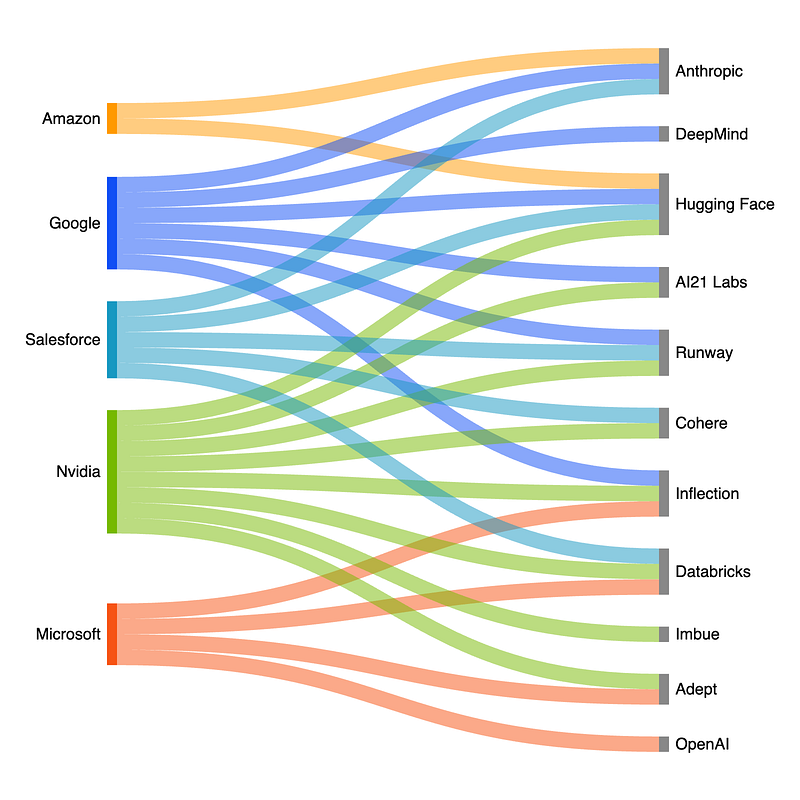
infographics created by Charlie Guo

If AI is just a good invention, but not a world-changing one, then the big companies will be the ones who benefit. They’ll be able to use AI faster than anyone else, and they’ll continue to do what they’ve been doing: offering AI products for cheap, collecting our data, and focusing on business-to-business and business-to-consumer uses. That’s not ideal, but it’s not the end of the world.

But if the AI optimists are right, and AI changes everything, then concentrating AI in the hands of a few companies means that we’re not reaching our full potential as a species. I don’t know which scenario will come to pass. No one does, really. But governments are worried enough about AI that they’re making rules to regulate it. And with all the rules, laws, and executive orders, it seems like a good idea to try to make AI available to more people, in a safe way.

AI detectors and AI who steals your job

As these regulations continue to evolve, it’s important to consider their implications for both individuals and organizations.

Imagine this: You are accused of cheating in your job. But you are categorically NOT cheating. Nevertheless, you are fired. And What IF ChatGPT might be the reason for you to be accused of cheating. That, though, is exactly what happened, as reported in the mentioned below article.
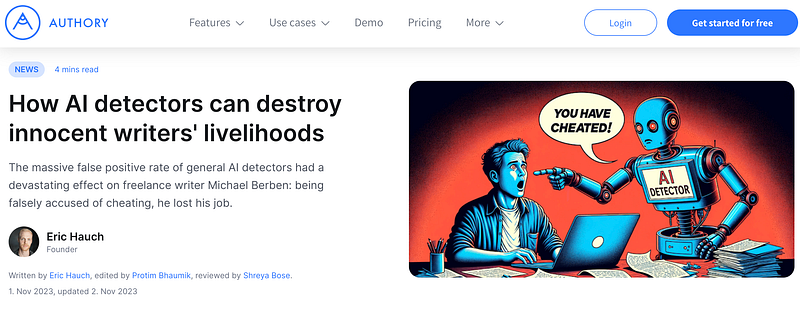
https://authory.com/blog/how-ai-detectors-are-destroying-livelihoods

Michael’s story can be my or your story too. One day, Michael’s main client informed him that they had started to use an AI detector, and the results were supposedly damning for him: his most recent articles flagged a 95% likelihood of being AI generated. His client started to look at all of his previous articles, many written before ChatGPT was even widely available, and Michael was notified that all his articles showed a likelihood of being AI generated of 65–95%. They terminated his contract with immediate effect. A decision solely based on a single number (or range) that the AI detector spit out.

The same principle is applied in many schools now: supposed to be accurate AI detectors are used by teachers to evaluate students homework? Where are we going?

First of all it should be clear that all AI detectors have a really LOW accuracy rate (even OpenAI stopped to offer its own detector…)

Secondly the main issue here is the general ignorance on how Generative AI works. I really doubt that the average teacher has a knowledge, except maybe as a beginner user, of LLMs.
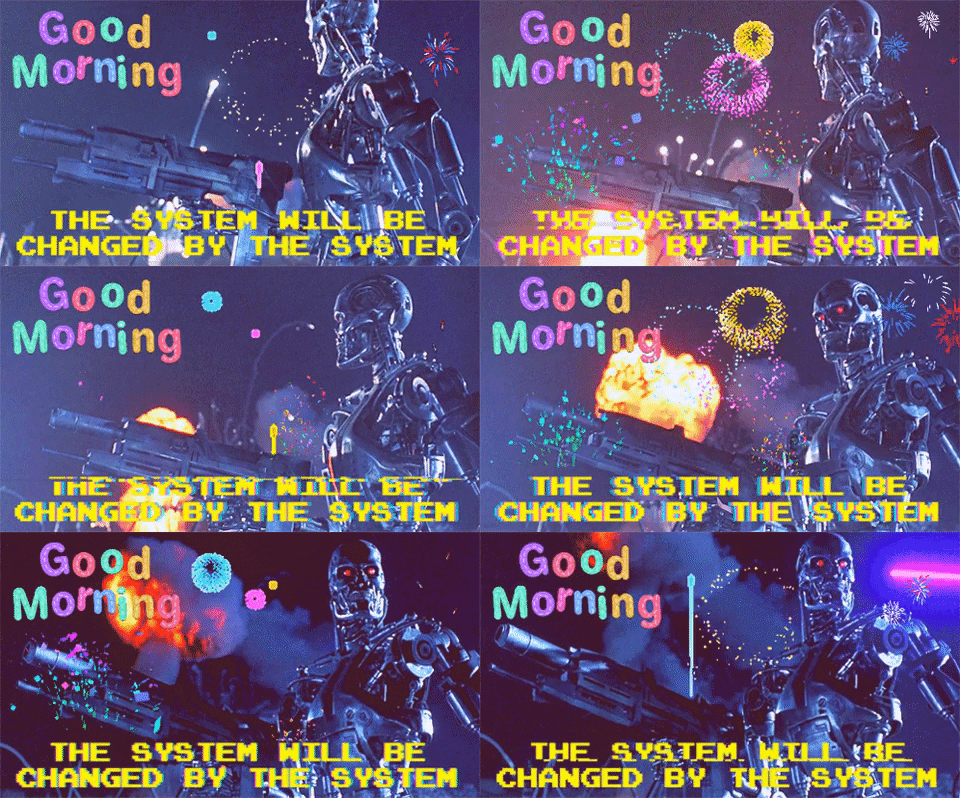
https://giphy.com/gifs/matrix-system-skynet-QljC6oOy5RBDPYXru3

The fear of AGI — Artificial General Intelligence

This seems to be the real topic here, a Terminator scenario becoming reality.

But again is this even possible?

Recent studies from Google DeepMind recently published a really interesting paper titled Pretraining Data Mixtures Enable Narrow Model Selection Capabilities in Transformer Models.

While the researcher highlights the impressive abilities of In context Learning (ICL) they also noted that “When presented with tasks or functions which are out-of-domain of their pre-training data, we demonstrate various failure modes of transformers and degradation of their generalization for even simple extrapolation tasks…” .

This basically means, in plain English, that if you want a transformer model to do something, you need to train it on data related to that task. Even if the task is simple, if the model hasn’t been trained on the right data, it might not be able to do it.

I found only one honest article published on the AGI topic and on the limits of the current Transformers Architecture to produce an AGI: it is from Steven Byrnes. He goes through the Generative AI structure and identifies 3 main deficiencies in Transformers as AGIs:

  • the sample efficiency is bound to be dramatically worse for training a Transformer versus training a real generative-model-centric system. And this makes it difficult or impossible for it to learn or create concepts that humans are not already using.
  • the finite number of Transformer layers puts a ceiling on the quality of the generative-model-search process, the time spent deliberating: Humans can stretch their capabilities by thinking a little bit longer and harder. However, if you have a Transformer that more-or-less simulates the first 100 (or whatever) milliseconds of the neocortex’s generative-model-search process, then that’s all you can ever get.
  • because the Transformer is a kind of information processing imitating a different kind of information processing, I generally expect edge cases where the imitation breaks down, leading to weird inductive biases, crazy out-of-distribution behavior, etc. I’m not too sure about this one though.

The article is quite interesting: you can read it her for your enjoyment and critical thinking

So at the status of the art, as of now, the Transformers architecture is only a foundation block for a General intelligence. And honestly all the algorithm are an attempt to reproduce the way the human mind thinks and process information, learns, abstracts and connects the dots.

The Next Steps

I believe that generally speaking the Open Source community and the universities are going in the right direction.

You can see the hints in the general trends and the new papers release on arxiv.org. The main topics are related to:

  • computer vision improvements
  • Data quality Vs Data quantity
  • RAG evaluation and new strategies
  • New quantization algorithms
  • Smaller models but with wider logic abilities
  • new generative AI architectures RCG (Retrieval Centric Generation)

Traditional generative AI models, known as RAG (Retrieval-Augmented Generation) systems, are limited by their reliance on pre-trained data.

RCG models, on the contrary, focus on retrieving relevant information from external sources rather than relying solely on pre-trained data. This allows them to generate more accurate and timely results, even when dealing with large amounts of unseen data.

To effectively utilize RCG, the model must be able to abstract complex patterns and relationships from the retrieved information. This requires the use of schemas, which are cognitive structures that represent knowledge about the world.
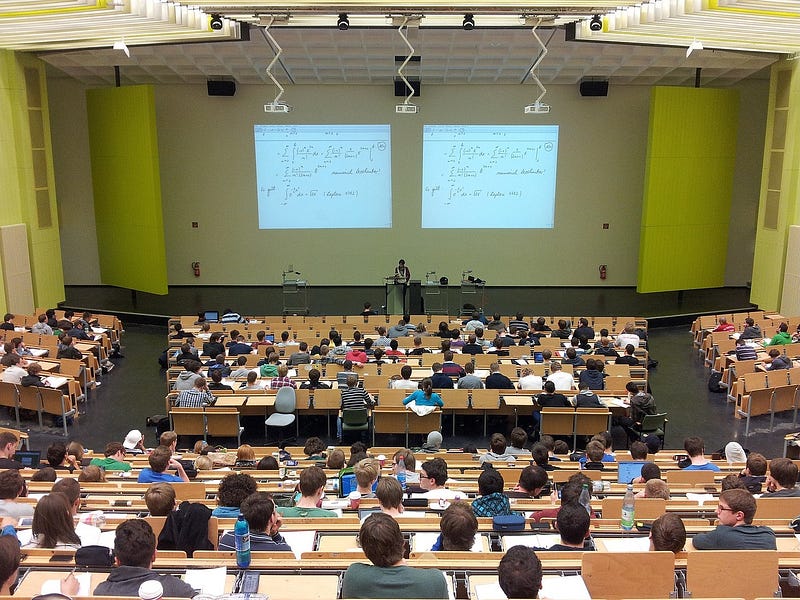
Image by Nikolay Georgiev from Pixabay

At the same time a real effort must be done on the Education systems, in all the Countries. Laws are required (and hopefully they will be not biased as well), but also collective understanding of what is and how Generative AI works is required.

As a teacher myself I would have done it already: I mean, when I was a student everyone was using Encyclopedias. General encyclopedias were often used as reference works for students and researchers. Specialized encyclopedias were used as guides for professionals in a particular field.

There is no difference now, but students and adults too, ask questions to GPTs. For both teachers and students, therefore, there are plenty of ways to embrace Artificial Intelligence:

  • Use AI as a tool to enhance learning, not replace it. AI can be a valuable tool for teachers, but it should not be used as a replacement for traditional teaching methods. AI can be used to provide students with personalized learning experiences, help them learn at their own pace, and give them access to a wider range of information. However, it is important to remember that AI is a tool, and it should be used in a way that supports and enhances learning, not replaces it.
  • Challenge and promote human debates: when the class is forced to interact it becomes clear to all whether or not knowledge has been processed or not.
  • Teach students how to think critically about AI. As AI becomes more and more integrated into our lives, it is important for students to be able to think critically about it. This means being able to understand how AI works, what its limitations are, and how it can be used to bias or manipulate information. Teachers can help students develop their critical thinking skills by teaching them about the history of AI, discussing the ethical implications of AI, and providing them with opportunities to experiment with AI tools themselves.
  • Use AI to encourage creativity and innovation. AI can be a powerful tool for encouraging creativity and innovation in the classroom. For example, teachers can use AI to help students create their own digital stories, design their own video games, or compose their own music. AI can also be used to provide students with feedback on their work and help them identify areas for improvement.

Conclusions

As we discussed so far, there are many reasons why people are afraid of AI. Some people fear that AI will take all of our jobs, while others worry that it will lead to the development of autonomous weapons that could kill without human intervention. Still others fear that AI will become so intelligent that it will surpass human intelligence and eventually enslave us.

I personally feel enthusiast and challenged!

Fears are understandable, but every time a technology advancement happened in the past, the same scenario happened: job roles changed, mentalities aligned, humanity continued to move forward.

Education is our only chance: a chance to remind that AI is a tool, and like any tool, it can be used for good or evil. It is up to us to learn how to use it and to ensure that AI is used for the benefit of humanity.

So, what can we do to ensure that AI is used wisely? Here are a few suggestions:

  • We need to educate ourselves about AI so that we can make informed decisions about its development and use. This means understanding how AI works, what its limitations are, and what its potential dangers are.
  • We need to develop ethical guidelines for the development and use of AI. These guidelines should ensure that AI is used in a way that is fair, unbiased, and ethical.
  • We need to invest in research and development of AI that is safe and beneficial to humanity. This includes investing in research on AI safety, AI ethics, and AI for social good.

By taking these steps, we can help to ensure that AI is used for the benefit of humanity, not for its destruction.

The future of AI is uncertain, but one thing is for sure: AI is here to stay.

What will you decide to do about it?

Hope you enjoyed the article. If this story provided value and you wish to show a little support, you could:

  1. Clap a lot of times for this story
  2. Highlight the parts more relevant to be remembered (it will be easier for you to find it later, and for me to write better articles)
  3. Sign up for a Medium membership using my link — ($5/month to read unlimited Medium stories)
  4. Follow me on Medium
  5. Read my latest articles https://medium.com/@fabio.matricardi

If you want to read more here some ideas:

WRITER at MLearning.ai / 28K+ GPTs / GPT alternatives / GPTs Hacks

Artificial Intelligence
Python
Learning
Local Gpt
Generative Ai Use Cases
Recommended from ReadMedium