
Agile Leader Pattern 4 for Building Awesome Teams: Enable Face-to-Face Interaction
Face-to-face interaction never goes out of style.

This post continues the analysis of J. Richard Hackman’s article, The Six Common Misperceptions About Teamwork¹. Building on the first three patterns — Encourage Different Perspectives, Stabilize Teams, and Small is Big — this fourth post in the series focuses on face-to-face interaction. Face-to-face communication is key for enabling optimal team communication and collaboration.
Pattern 4 — Encourage Face-to-Face Interaction
Misperception: Face-to-face communication is no longer necessary in the age of digital communication.
Reality: Face-to-face communication is no longer necessary in the age of digital communication.
The common belief is that today’s technological advancements make remote work just as effective as face-to-face interaction. However, Hackman’s study finds that when team members are face-to-face, they will:
- Build stronger relationships
- Experience higher quality communication and collaboration
- Accelerate team learning
Additionally, non-verbal communication is often more important than what you say. When teams are remote, picking up on non-verbal cues is extremely difficult even with the best technology available today.
Putting It Into Agile Practice
The Agile Manifesto highlights this pattern clearly in the following principle:
The most efficient and effective method of conveying information to and within a development team is face-to-face conversation.
In his book Agile Software Development², Alistair Cockburn models different modes of communication and their effectiveness. The communication quality of different communication modes is depicted in Figure A.
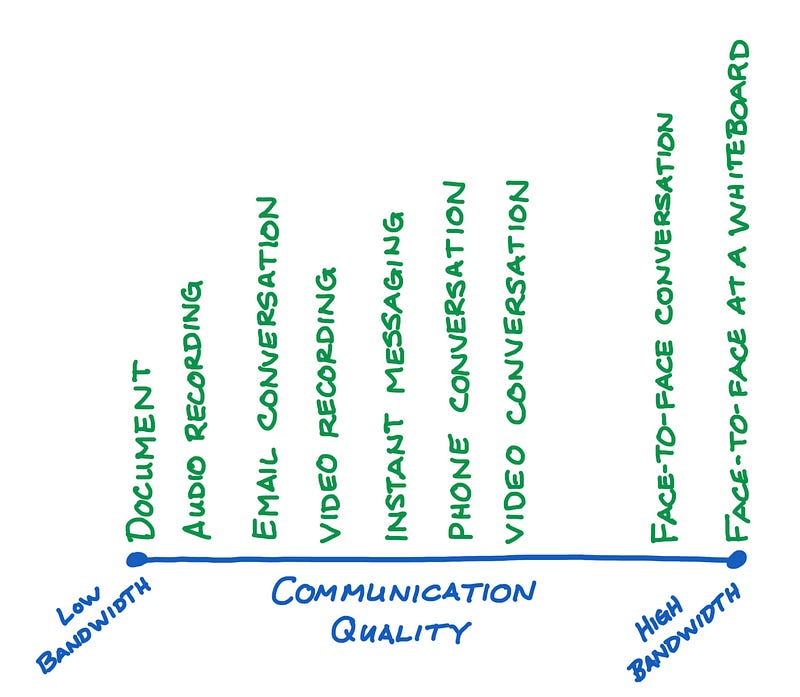
Face-to-face interaction is more effective than any other means of communication. This is largely due to non-verbal communication cues. Also, when face-to-face at a whiteboard, team members rapidly address interpretation gaps and converge to a shared understanding.
Co-location and Remote Teams
Co-location of team members and teams in a multi-team product will enable the right environment conducive to face-to-face interaction. If you have a choice, don’t have geographically remote team members or remote teams.
Interestingly, geographic distance is not the only way to hinder the effectiveness of team communication. Alistair Cockburn found that if the team’s members sit apart further than a bus length, communication drops off rapidly³. Often, team members will not get up to have a face-to-face interaction if farther apart than a bus. Therefore, being on the same floor or the same building does not count as co-location. If team members are further apart than a bus, they are not co-located.
If you have no choice but to have a Scrum team’s members separated geographically, there is something you can do. Bring team members together at the beginning and several key points throughout the life of the team. As a result, your teams will build better relationships and will be more effective when working remotely.
When you have a remote team, make it whole. Furthermore, all team members should be co-located in the remote location. For a Scrum team, this means the Scrum Master, Product Owner, and Development Team members should be co-located.
Additionally, distributed teams can also pose communication barriers. Distributed teams occur when a product has more than one team, but the teams are not co-located. In this scenario, bring the distributed teams together at their inception and as many key points as possible throughout the life of the teams.
Conclusion
The fourth pattern — Encourage Face-to-Face Interaction — shows that even with today’s technological advances, face-to-face interaction retains its top spot as the highest bandwidth form of communication and collaboration. A co-located team will also find it easier to build relationships and learn from each other.
Our posts to date emphasize the importance of a team having diverse perspectives, stability, a small size, and face-to-face interactions.
Other Posts in the Series
- Pattern 1 : Encourage Different Perspectives
- Pattern 2: Stabilize Teams
- Pattern 3: Small is Big
- Pattern 5: Enable Self-Organization
- Pattern 6: Serve the Team
References
- The Six Common Misperceptions About Teamwork, Robert J. Hackman, June 7, 2011
- Agile Software Development, Alistair Cockburn, 2001
- Agile Software Development as a Co-operative Game, 2nd Edition, Alistair Cockburn, 2006
Originally published on Coach Lankford.
You can connect with Todd on LinkedIn.


