
Agile Leader Pattern 2 for Building Awesome Teams: Stabilize Teams
Teams continue to grow the longer they stay together.

This post continues the analysis of J. Richard Hackman’s article, The Six Common Misperceptions About Teamwork¹. This second post in the series emphasizes the importance of stable teams. The first post provided a pattern for Encouraging Different Perspectives, demonstrating how harmony is not desired in a team.
Pattern 2 — Stabilize Teams
Misperception: The rotation of team members mixes things up and keeps ideas fresh.
Reality: The longer a team stays together, the better they perform.
In contrast to typical beliefs, keeping a team intact for a long time will increase the team’s performance. Furthermore, the team will continue to improve the longer they stay together.
The common thinking is that complacency will develop over time. In other words, we worry that team members, when together too long, will get stuck in their ways and not recognize that they need to pivot when changes in their context require it. If relationships and bonds become too tight, we fear that team members will become too tolerant of misbehavior within the team.
However, Hackman reveals that his research cannot be refuted in this area. Teams that stay together longer simply perform better. Our assumptions and existing beliefs are wrong.
Putting It Into Agile Practice
Usually, Scrum teams track their ability to deliver working software during a Sprint using Velocity. It is a fact that any change to the team members will negatively impact the team’s Velocity.
This impact can be best explained by referring to the Team Development Model, formulated by Bruce Tuckman in 1965². Most noteworthy, this model explains that all teams go through four stages of development — Forming, Storming, Norming, and Performing. Any change to the team composition will take the team back to the Forming stage. As a result, this disruption is akin to hitting a reset button on team dynamics and team effectiveness.
Additionally, disruption on a team can occur if their domain changes even if the team stays whole. If the team switches to a new product, for instance, this will disrupt the team for some time. The team has to build new operating norms and learn the domain. However, gaining domain knowledge builds flexibility in the team. As a result, disruption becomes a worthwhile investment if needed in the future.
With this knowledge in hand, promoting long-lived teams with skills in multiple domains provides the best results. Long-lived teams stay with a product through its entire lifecycle. Furthermore, these teams will not end when their product ends. Rather, they will live on to build a new product. As a result, their domain knowledge will expand.
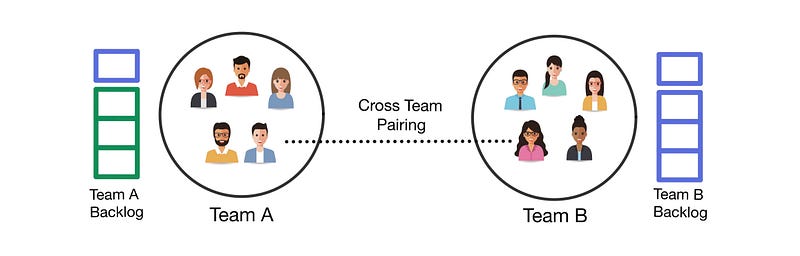
If a team needs new knowledge, allow them to organically acquire knowledge by pairing with members from another team as illustrated in Figure A. See the prior post, How a Stable Team Grows in Capability, for details on this technique and other options to avoid.
Conclusion
The second pattern — Stabilize Teams — builds on the first pattern for Encouraging Different Perspectives. In short, a diverse team with different perspectives that stays together will be the strongest. By practicing this pattern, your team will be an unstoppable force.
Other Posts in the Series
- Pattern 1 : Encourage Different Perspectives
- Pattern 3: Small is Big
- Pattern 4: Encourage Face-to-Face Interaction
- Pattern 5: Enable Self-Organization
- Pattern 6: Serve the Team
Related Posts
- We Need Managers to Become Agile Leaders
- Nine Proven Ways to Make Your Scrum Team Hyper-productive
- Do We Need a Manifesto for Managers?
- How a Stable Team Grows in Capability
References
- The Six Common Misperceptions About Teamwork, Robert J. Hackman, June 7, 2011
- Developmental Sequence in Small Groups, Psychological Bulletin 63, B W Tuckman (1965)
Originally published on Coach Lankford.
You can connect with Todd on LinkedIn.


