
Actor Anthony Hopkins and the Late Diagnosis of Autism
The next hidden Autistic you meet might be your daughter, your neighbor, your colleague, or even you.
Have you ever considered that you, a friend, or a family member might be an undiagnosed Autistic?
Probably not because for most people, the word “Autistic” evokes an imagine of a young boy who rocks back and forth, lacks empathy, and acts in socially awkward ways.
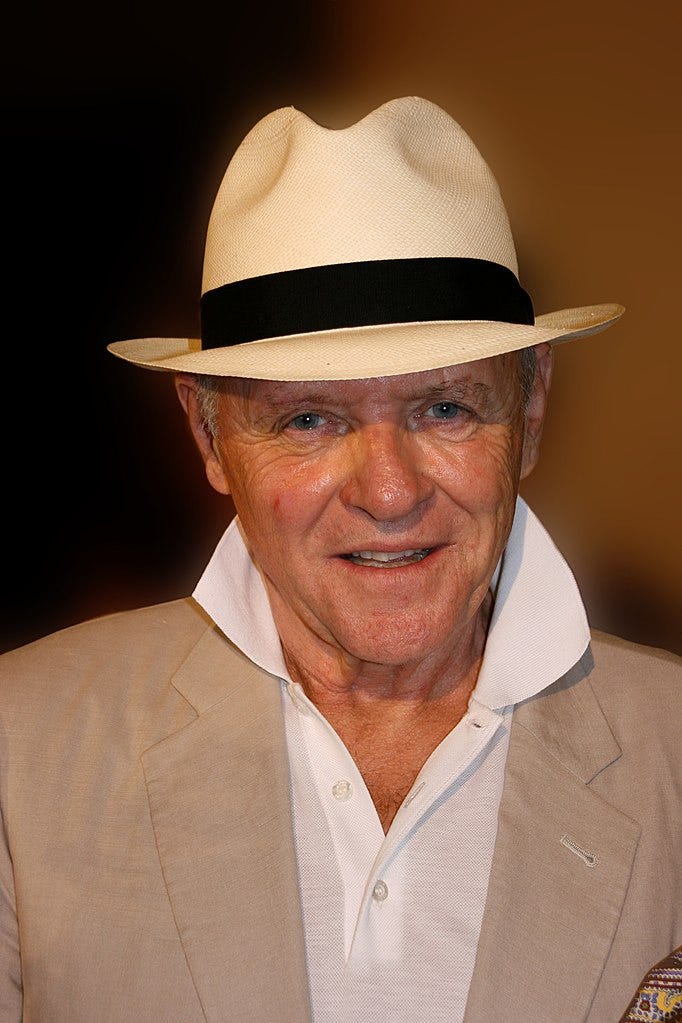
Enter Sir Anthony Hopkins who belies the stereotype.
Hopkins was diagnosed on the spectrum in his 70s. He didn’t suddenly become Autistic later in life. That’s not possible because Autism is a lifelong neurological condition—or rather a different kind of brain.
But little was known about Autism during Hopkin’s childhood years.
It wasn’t until 1980 that Autism was established as a separate diagnosis from schizophrenia with its own set of diagnostic criteria in the Diagnostic and Statistical Manual of Mental Disorders (DSM-III) published by the American Psychiatric Association.
Timing likely accounts for why Hopkins and an unknown number of other older adults have gone undiagnosed for most or all of their lives.
But there are other reasons as well. Let’s take a look because this may be relevant to someone you know—maybe even you.
Why Is Autism a Spectrum?
You might wonder why I feel so passionate about the topic of undiagnosed Autism. A random article I read made me wonder if I might be on the spectrum myself.
Could I really have been undiagnosed for 72 years? I took a deep dive into the topic to learn more about myself.
To answer my question, I think we need to truly understand autism is indeed a spectrum. Let’s begin by looking further into the late diagnosis of actor Anthony Hopkins.
Hopkins was diagnosed in his 70s with Asperger’s Syndrome, a “high functioning” form of Autism. Asperger’s is thought of as a hidden disability because the condition is usually not obvious from outward appearances.
A person with Asperger’s might be seen by others as just quirky, impertinent or a lone wolf.
Hopkins described himself as “very much a loner” in a 2017 interview with the Daily Mail in which he addressed his Autism diagnosis.
“I don’t go to parties, I don’t have many friends. But I do like people. I do like to get inside their heads.”—Sir Anthony Hopkins
Asperger Syndrome is no longer a separate diagnosis in the current version of the DSM American psychiatric bible. Along with related disorders, it has been subsumed under the diagnosis “Autism Spectrum Disorder.”
However, some people continue to use the term Asperger’s Syndrome or “Aspie,” especially due to the stigma commonly associated with Autism.
What does spectrum mean in the context of Autism? It’s easy to misunderstand. I had it confused myself.
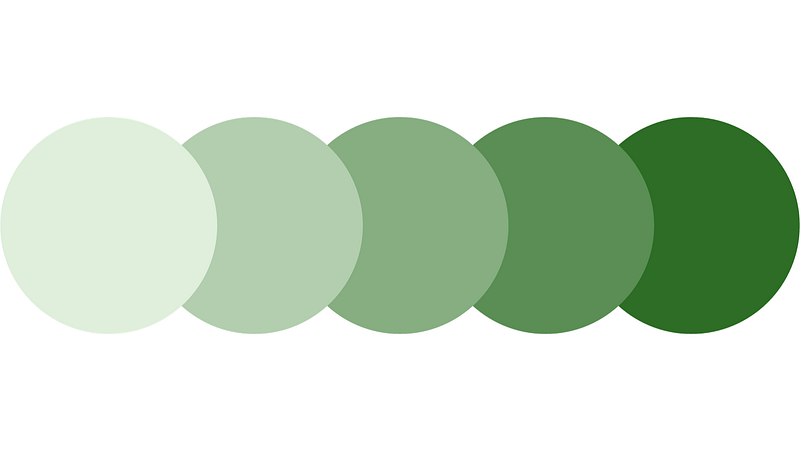
It doesn’t mean a sequence from low autism on one end to high autism on the other end or a linear progression from low to moderate to severe like the gradient depicted below.
You have autism wherever you sit on the spectrum. And life can be challenging at every single point.
The DSM currently categorizes the severity of Autism by three levels that range from people who can live independently to those who require very substantial support.
But as Autism specialist Claire Jack, PhD says in reference to these levels:
“However, thinking about autism in this way is little comfort to many level 1 autistic people whose symptoms cause difficulties in almost every aspect of their lives. People with a level 1 autism diagnosis are more at risk than the general population of mental health problems, suicidality, career difficulties, bullying, and abuse.”
Some researchers reject the linear representation of Autism in preference for a color wheel version or a pie chart like this one:
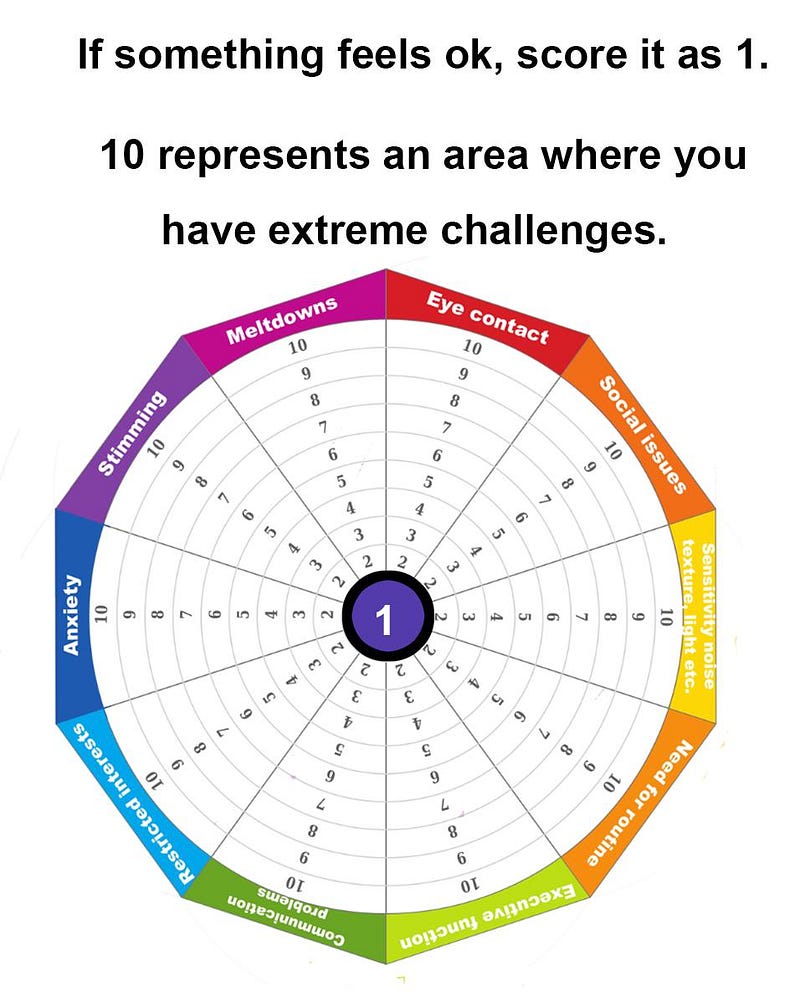
As you can see from the pie chart above, there’s an almost uncountable number of possible trait combinations. That explains, at least in part, why Autistic people can look incredibly different, many appear neurotypical, and many go undiagnosed.
Recently, in that random article, I learned sensory sensitivity constitutes one trait on the spectrum. That’s what made me wonder if I might be an undiagnosed Autistic myself. When I looked further, I realized I share a number of the other seemingly autistic traits too. And my therapist said he wouldn’t rule Autism out as a possibility.
But from a young age, I’ve always tried to fit in and excel. Which brings us to the concept of “masking,” another reason Autistics go undiagnosed well into adulthood.
Masking Autism and the So Called Female Phenotype
The terms masking, camouflaging, and compensating describe behaviors a person knowingly or unknowing uses to hide Autistic traits and fit in.
Girls and people of color are more likely to mask than boys, which is one reason they have gone wildly undiagnosed.
For example, you engage in less obvious self-stimulating (stimming) activities like biting your nails or twirling a lock of your hair instead of flapping your hands. Or, you observe how others interact socially and emulate their behaviors.
I found this perfect example of learning to mask from an older participant in Autism research:
“Fellow study participant Susan Golubock, also diagnosed with high-functioning autism later in life, has had somewhat less trouble in that area [social interaction], thanks in part, she believes, to none other than Shirley Temple. As a child, Golubock learned to model her tone of voice and facial expressions after the saccharine child actor, which helped her master those nonverbal communication cues crucial to positive social interactions.”
Despite her mastery, Golubock still feels overwhelmed when socializing.
Secondly, if you search online for “autism in females,” you’ll undoubtedly find any number of charts that list traits associated with Autistic women.
Yes, Autism in girls often looks different than Autism in boys. But sometimes it looks the same. And boys, people of color, and non-binary individuals can have traits on the so-called “female” list too.
The main point is this: the original research conducted on white male children delivered and reinforced a particular and limited stereotype of Autism. But in reality, there’s a remarkable variance among Autistics, which is why we see all these new traits attributed to a female phenotype.
These are a few more of the reasons for undiagnosed Autism, especially in girls, women, non-binary individuals, people of color and people over fifty.
Aging and Autism
Few studies have focused on Autism in the elderly until now. Children diagnosed in the ‘80’s would only be in their 40s today. And as we’ve seen, many individuals have gone undiagnosed.
But those autistic individuals in their 40s will be in their 50s or early 60s in a decade. And since the diagnosis of Autism is on the rise, there’s an incentive to learn more about Autism in adults.
“In the United States, the Centers for Disease Control and Prevention estimate the number of children who have been diagnosed with autism at 1 in 59. That means, within a decade or two, there will be a population of about 1 million adults on the spectrum. Over their lifetime, treatment expenses, lost wages for themselves and lost wages for their caretakers can exceed $2 million.”—Arizona State University News
Arizona State University has established an Autism Brain Aging Laboratory to study age-related changes in adults with Autism Spectrum Disorder.
Here’s a brief synopsis of the labs findings to date:
“Braden and her team in the Autism and Brain Aging Lab found that older adults with autism report more social communication difficulties than younger adults with autism, however verbal fluency does not appear to become more difficult with age. Using brain scans, they were also able to deduce that areas of the brain related to social communication, cognition and executive functions thinned more quickly with age in adults with autism than those without.”
Check out a few grey-haired Autistics who were diagnoses later in life in this very short video:
Breaking Autistic Stereotypes
It might be surprising to realize that a successful, respected, and prolific actor like Anthony Hopkins is on the Autism spectrum. There are many more hidden autistics that don’t fit the traditional stereotype.
I don’t in any way mean to disparage anyone on the spectrum with high needs. But there’s a swath of Autistics we never see and who may as yet not see themselves.
Fortunately, adult Autistics have begun to break the silence.
Check out their Ted Talks, watch their videos on YouTube, and read some of their top selling books. I want to be an ally for Autistics and I hope you do too. Because that hidden Autistic might be your daughter, your neighbor, your colleague, or even you.
For more inspiration, sign up for my bi-monthly Wild Arisings newsletter and receive access to free self-discovery resources.
You might also like: