
WORLD ECONOMICS & POLITICS
Actions Before 1980 Causing Today’s Shortages & Resulting Inflation
The US Presidency is too small to stop the worldwide supply chain problems. Neither Trump nor Biden are to blame.
Synopsis
Gasoline isn’t the only commodity. I went to the drug store today for my favorite disposable razors. None. Then to the grocery store. No large shrimp available, no dark chocolate candy kisses, and half-n-half (cream) was limited to two containers. There was much empty shelf space with only a few paper towels instead of 20 packages. The problem is worldwide.
The shortages were set up 50 years ago.
Just-in-Time Manufacturing
I remember when Toyota started using the Just-in-Time (JIT) manufacturing process in their plants in the 1970s. Forty (+) years later, it was used in every part of the economy.
Just-in-Time (JIT) was just a disaster waiting to happen
JIT worked perfectly as long as everything ran smoothly. It assumed all parts, material, and labor arrived just when needed, from factories to retail stores.
A single ship sinking had no real impact. Neither did a train derailment or warehouse fire. Even wars in the Middle East had little impact, except for the occasional increase in gas prices. It took something really monumental, like COVID, to stop everything.
A simple example
Your house: Suppose you ran your house using the JIT methodology. For medical reasons, you must eat 2 eggs for breakfast every day. Sometimes, you add bread or fruit. Under JIT, you eat the last 2 eggs, then go to the store that day for more. If you are lax with JIT, you go to the store the day before when there are 2 eggs left.
What happens if the store has no eggs! You skip breakfast the next day!
Suppose you go to three more stores, and they have no eggs. The fourth store has eggs, but they are 100 dollars per dozen due to the shortage.
Welcome to inflation
When it spreads across many products.
My house: We use a replacement inventory (RI) methodology. When I use my last two eggs, I reach up to the top shelf, pull down a dozen eggs, and refill the egg container. Then, I go to the store for another dozen eggs.
Suppose the store has no eggs because the roads are blocked due to snow. I can wait a few days until the next supply arrives. It would take a major disaster for me not to be able to buy eggs in time.
Summary: This is a limited example. Under normal conditions, I have nothing to worry about.
How COVID is different
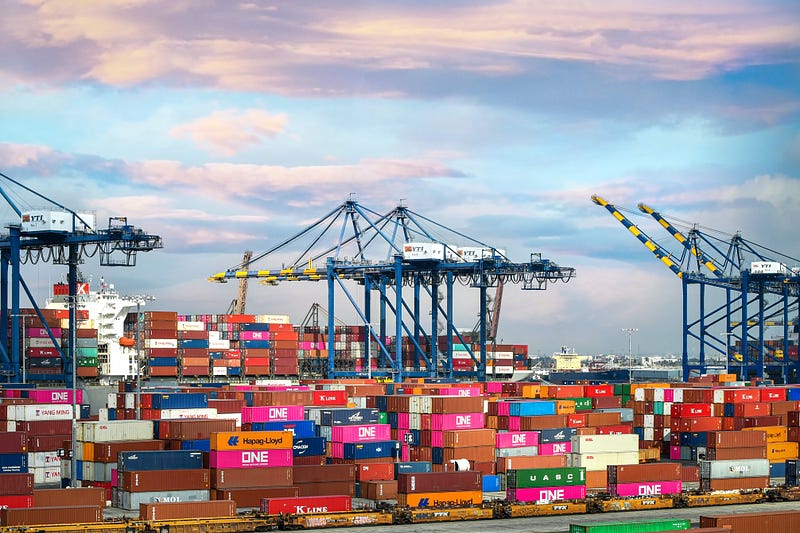
Ships were backed up due to the shutdown. When docks reopened, there were not enough facilities to handle all those ships waiting in line. Then a huge number of containers arrived at the warehouses.
There were too few truck loading docks to handle the volume. Trucks waited 8 hours to load instead of the normal 2 hours (drivers were not paid for waiting time, just the total load). Finally, there were not enough workers to load trucks, even with the reduced number of loading bins.
So, containers piled up in the warehouse parking lot causing the warehouse to accept no more containers. No more left the loading dock. Ships are still waiting in line for miles because there is no place to put containers, even if a dock was available.
It’s not limited to products. During the shutdown, the normal, or slightly increased, number of truck drivers retired. People don’t just walk off of the street and drive huge trucks. The truck driver schools, like the one in Indianapolis near my old house, shut down. No replacements were trained. The same goes for airline pilots and workers in many other industries.
At the retail end, there are shortages. My grocery store, even today, limits each customer to 2 containers of Half-n-Half. Our RI methodology requires us to have 4 containers and restock when we have 2 or less. I must go to 2 stores or go shopping more often to keep our level normal.
With JIT and the COVID-induced shortages, there is no way to know what product will be short.
Availability
The most obvious impact is with gasoline prices. With normal inflation, almost all prices rise. Inflation-adjusted gas prices would have gone from 35 cents in 1962 when I started driving to $3.18 today. Today’s increased price is due to truck driver shortages, import shortages, and even worker shortages throughout the industry.
Other industries are similar. My father owned 3 restaurants. Most restaurant jobs pay near minimum wage. This week, a local restaurant ran an ad offering a $500 signing bonus for servers! That’s unheard of. I don’t know what the salaries are now, but the restaurants have to pass those bonuses along as higher prices.
Summary
Viewing world shipping, from ships to planes to trains to trucks, as one huge rush hour traffic system, everything worked fine for 60 years. Sure, there were some minor traffic jams, but nothing big enough to generally impact the economy.
Until COVID. With the shutdown, everything in transit backed up and the supply sources stopped producing products. When they restarted, they could not ship their products. There were random shortages at the retail end. A huge mess.
The whole world is involved. Trump couldn’t stop it and Biden can’t fix it.
Politicians have less impact than they think.
Hopefully, things will settle down by next year and the general inflation won’t be catastrophic.
Note:
CNN, May 11, 2022. Latest shortage: Baby formula 43% availability reduction
References
What Is Just-in-Time (JIT)? - Started by Toyota in the 1970s — a disaster waiting to happen
I’m A Twenty Year Truck Driver, I Will Tell You Why America’s “Shipping Crisis” Will Not End - Not enough cranes to unload ships, in addition to trucks
“Let It Rip” Was The Worst Possible Strategy We Could’ve Chosen - A comment by Kent Anderson touches on JIT


