
Acritarch
Size doesn’t matter… or does it?
Today’s New York Times Spelling Bee letters:
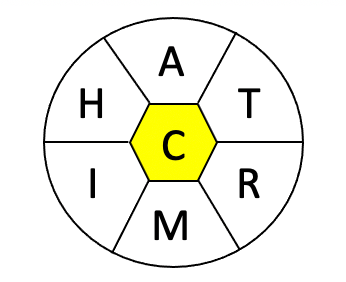
A, H, I, M, R, T, and center C (all words must include C).
Merriam-Webster says…
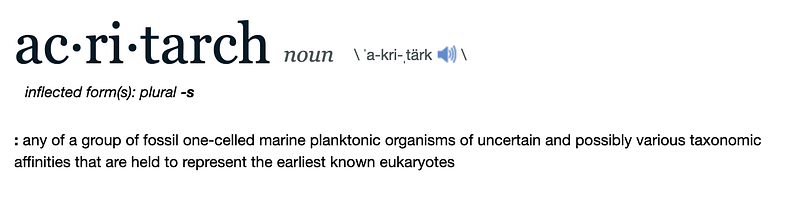
Silly little dictionary! Don’t you know acritarch can’t possibly be a word if the New York Times says it ain’t?
Also, for further fascinating facts, check out the Spelling Bee Master.
What’s your favorite dord* from today’s puzzle?
My Two Cents
What’s your favorite animal? It’s a typical question used by children to get to know each other. It’s also used by pop psychologists to analyze personality behaviors on afternoon talk shows. And those breakdowns are always one hundred percent accurate. Don’t believe me? Ask The Dodo.
By the way, for a while there when I was a kid, that was my favorite animal (the dodo, not the pop psychologist).
Currently the rhinoceros stands at the top of the list, although after watching My Octopus Teacher, I’ve considered changing my mind. (Living in Spain, however, makes it hard to get attached to octopi.) For a lot of people who spend tons of time on Facebook, it seems that cats are their favorite animals. Trust me, I’m not judging you! I myself became a cat person when I lived in the States, after being “married” to one for 17 years.
In any case, it’s a question that most people usually don’t have a problem answering. Here’s one that may be more challenging:
What’s your favorite microscopic animal?
Mine is the tardigrade. Not to be confused with the Dr. Who phone booth:
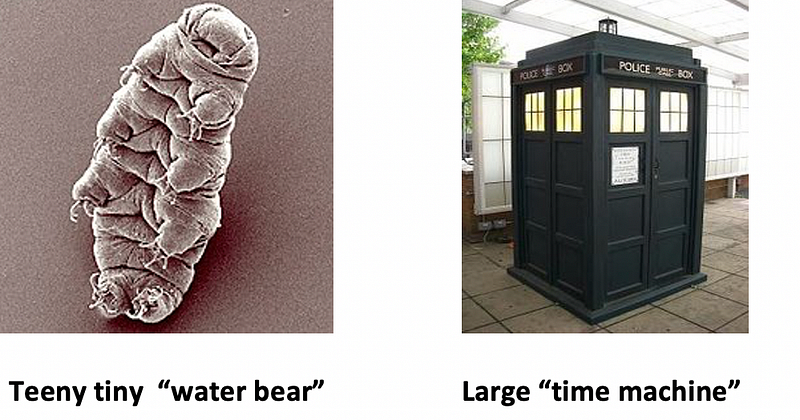
Although they look similar in size in the above photos, please don’t be fooled by my crude copy & paste skills (or complete lack thereof). The TARDIS is much, much, much bigger than the tardigrade. Trust me.
Tardigrades became an online sensation a few years ago, although I can’t remember exactly why. Maybe because they appeared on an episode of Family Guy. Or perhaps it was the other way around; they first appeared on the show and then became an internet craze.
I’m not going to get into too much detail on the tardigrade today, because the word has seven different letters (a, d, e, g, i, r, t). That means it could be in a future Spelling Bee one day. And if the New York Times rejects it as a word then, I’ll have something to rant about here.
Under the microscope
A tardigrade could, technically, be an acritarch, which is an organic microfossil. These fossils are studied by scientists because they correlate to major ecological events and paleontology developments. More than a billion years ago, acritarchs started to increase in abundance and diversity. Periods of sharp decrease correspond to ice ages.
The word was coined in 1963 from the Greek ákritos, meaning confused (from a kritēs, without critic), and archē, meaning origin. That’s because these microfossils have a central cavity that can contains the remains of a wide range of organisms.
Acritarchs are thought to come mostly from eukaryotes, which my high school Biology notes tell me are “living things with cells that have enclosed nucleuses”. (I did not remember the correct plural for nucleus back in high school.) Here are some examples:
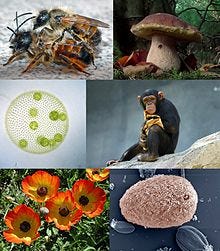
Basically, most of the animals and plants you see on a daily basis.
The other types of cells are those that don’t have enclosed nuclei, and living things with those cells are called prokaryotes. Included in this category are bacteria, for example. It does not include viruses (like the coronavirus) because viruses don’t even have cells. In fact, there is still a debate among scientists as to whether viruses are actually living things.
A large group of small fossil experts
The Micropalaeontological Society sounds like a mouthful, even if you remove that second “a” after the “l”, for American spelling purposes. This British not-for-profit scientific group was founded “to advance the education of the public in the study of Micropalaeontology”.
These fossil fanatics study things that are soooooo small… Pause.
How small are they?
(Thank you!) They’re soooo small, some of them are called nanofossils!
*Crickets…*
Well, I’m sure the scientists at the TMS would find that joke hilarious. Moving on…
Acritarchs are among the many teensy-weensy remains that The Micropalaeontological Society studies. They also examine coccoliths, pollen fossils, and dinoflagellate cysts. These last ones, known by their friends as dinocysts, are tiny sacs or capsules with marine plankton from dinosaur times.
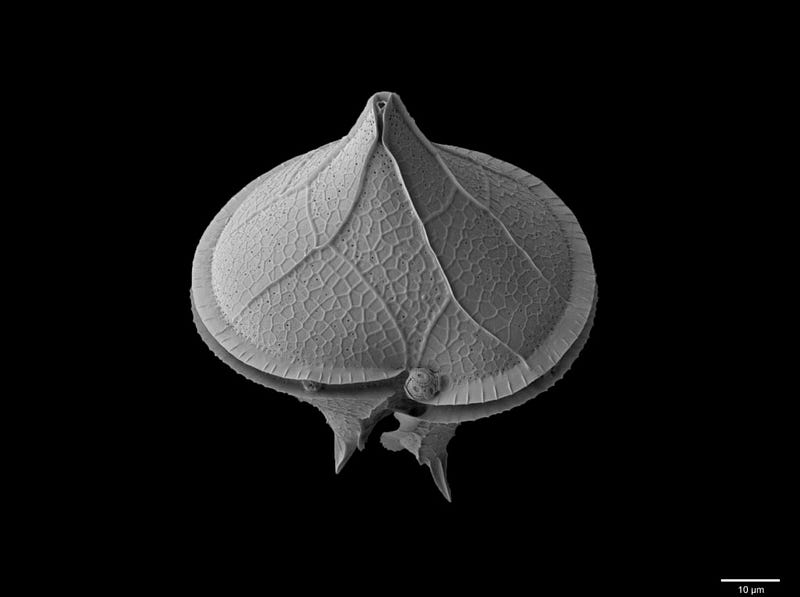
That’s what the photo at the very beginning of this article shows. A dinocyst. Namely, Protoperidinium divergens. Here it is again, so you don’t scroll up and subtract money from my Medium earnings:
See that little round thing resting on the edge, towards the lower middle part?
It’s your friendly neighborhood coccolithophore, and her name is Emiliania huxleyi. Here she is, ready for her close-up.
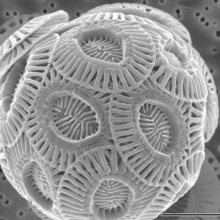
Emili, as she prefers to be called, loves to drift around most ocean ecosystems. In her free time, she enjoys being the basis of virtually all marine food webs.
The web site of The Micropalaeontological Society is filled with beautiful photos like the ones above. I highly recommend browsing through it at your leisure:
But when you tell your friends and family about this web page, please don’t use the word acritarch. Because the editors of the Spelling Bee game have determined that acritarch is a dord.*
Please check out my previous entry on another dord:
*What the heck is a dord, anyway? Here you go: