avatarAvi Kotzer

Free AI web copilot to create summaries, insights and extended knowledge, download it at here

3553

Abstract

so vegetal </i>in Spanish). In Cuba it’s known as the <i>arbol de seso </i>or<i> palo de seso </i>(brain tree); in Guatemala and Panama as <i>huevo vegetal </i>and <i>fruto</i> <i>de huevo </i>(vegetable egg or egg fruit); in Mexico as <i>arbol del huevo </i>and <i>pera roja </i>(egg tree and read pear); in Venezuela as <i>merey del diablo </i>(the <b>Devil’s cashew</b>); and in Colombia as <i>bien me sabe </i>or <i>pan y quesito </i>(“tastes good to me” and “bread and cheese”). Whew!!</p><p id="bf5e">The fruit is pear-shaped and has anywhere from two to four lobes. It turns bright red to yellow-orange once ripe, which is also when the lobes separate to reveal three large, shiny black seeds. Each seed is partly surrounded by soft, or spongy, white to yellow flesh . The aril ––an appendage that develops after fertilization as an outgrowth that sometimes envelops the seed itself––is the part that has the nutty flavor and texture of scrambled eggs.</p><p id="5915">I’ve asked Iva Reztok to create a beautiful collage and not just copy and paste wikicommons content…</p><figure id="697c"><img src="https://cdn-images-1.readmedium.com/v2/resize:fit:800/1*AljRTGnyi7H3Y7ipyZf_vA.png"><figcaption>Screenshotted by Iva Reztok</figcaption></figure><p id="eeb2">…but it’s clear that he has no desire to work on a Friday afternoon.</p><p id="b4f6">Regarding its infamous toxicity, I’ll refer again to Julia F. Morton’s <a href="https://hort.purdue.edu/newcrop/morton/akee.html">article</a> on the fruit (boldface highlights are mine):</p><blockquote id="e47c"><p>The <b>toxicity of the akee</b> was long misunderstood and believed to reside in the membranes attaching the arils to the jacket, or only in the overripe and decomposing arils. There have been intensive clinical and chemical studies of the akee and its effects since 1940, and it is now known that the unripe arils contain hypoglycin, <i>a</i>-amino-<i>B</i>-(2-methylenecyclopropyl) propionic acid, formerly called hypoglycin A. <b>This toxic property</b> is largely dispelled by light as the jacket opens. When fully ripe, the arils still possess 1/12 of the amount in the unripe. <b>The seeds are always poisonous.</b> They contain hypoglycin and its y-glutamyl derivative, <i>y</i>-L-glutamyl <i>a</i>-amino-<i>B</i>-(2-methylene cyclopropyl) propionic acid, formerly called hypoglycin B. <b>The latter is 1/2 as toxic as the former.</b></p></blockquote><p id="c161">Basically, the <i>ackee</i> is the fruit equivalent of the blowfish: a real bitch to eat! So, if you’re an amateur when it comes to the <b>Devil’s cashew</b>, don’t go out picking <i>ackees</i> yourself; get an expert to guide you with it.</p><h2 id="1a42">Bounty… the quicker picker uprising</h2><p id="254e">The scientific name of the <i>ackee</i> is <i>Blighia Sapida,</i>in honor of Captain William Bligh, who in 1793 took plants of the fruit from Jamaica to England. A couple of decades before that, as mentioned earlier, he had brought them to Jamaica from West Africa.</p><p id="8fb2">In between shipping poisonous fruit around, Bligh became infamous for a little uprising that happened on his ship, the Royal Navy vessel HMS <i>Bounty, </i>as it sailed across the South Pacific Ocean.<i> </i>On 28 April 1789, some unhappy mariners, led by acting-Lieutenant Fletcher Christian, took over the ship and put Bligh and eighteen of his supporters adrift. Fortunately there was an artists right there to quickly paint this selfie:</p><figure id="5732"><img src="https://cdn-images-1.readmedium.com/v2/resize:fit:800

Options

/09jWdCd-Kt6v8hRoB.jpg"><figcaption>Selfie by Robert Dodd</figcaption></figure><p id="dde9">The mutineers went off to Tahiti and the Pitcairn Island. Bligh and his skeleton crew somehow managed to navigate more than 3,500 nautical miles (4,000 land miles, or 6,500 km) in the launch and safely reach Timor, where he immediately began the process of bringing the mutineers to justice. Unfortunately the painter died, so there is no selfie of Bligh’s arrival. However, we can clearly see how the mutiny affected him:</p><figure id="4b77"><img src="https://cdn-images-1.readmedium.com/v2/resize:fit:800/1*25t8ZGpy9z-9IzXVw_iG4A.png"><figcaption>Screenshotted by Iva Reztok</figcaption></figure><p id="9cb4">In 1790, Bligh was honorably acquitted at the court-martial of his loss of the <i>Bounty.</i> Taking advantage of his fame, he published <i>A Narrative of the Mutiny on board His Majesty’s Ship “Bounty”; And the Subsequent Voyage of Part of the Crew, In the Ship’s Boat, from Tofoa, one of the Friendly Islands, to Timor, a Dutch Settlement in the East Indies.</i></p><p id="f000">This was later made into a film with the much, much, much, much, much shorter title of <i>Mutiny on the Bounty</i>, starring Marlon Brando and Trevor Howard.</p><figure id="5ff2"><img src="https://cdn-images-1.readmedium.com/v2/resize:fit:800/1*bpbQwbeiWwbrnUBxlB1xnQ.png"><figcaption>Credit: imdb.com</figcaption></figure><p id="1554">It took only 16 years for the English to reward Bligh for his valor by appointing him Governor of New South Wales in Australia. There he attempted to clean up the corrupt rum trade going on, but his actions resulted in yet another mutiny, the so-called <b>Rum Rebellion.</b></p><p id="ce2d">So, not very lucky with underlings, this Bligh guy. Eventually he ended up moving to London, where life itself decided to give him a mutiny, killing him at the ripe old age of 63.</p><p id="7d49">To recap, we’ve learned about a poisonous fruit and a poisonous leader. You can talk about Bligh to your heart’s content, but don’t mention the <i>ackee </i>he exported to the Americas… because the editors of the Spelling Bee decided that <i>ackee</i> is a dord.</p><p id="3b90">You can check out my previous entry on another <b>dord* </b>here:</p><div id="2ac3" class="link-block"> <a href="https://readmedium.com/cachaca-1e59ae70f326"> <div> <div> <h2>Cachaca</h2> <div><h3>That last c sounds like an s… it that why this word was rejected?</h3></div> <div><p>medium.com</p></div> </div> <div> <div style="background-image: url(https://miro.readmedium.com/v2/resize:fit:320/0*QTlY-KBt1opErj1L)"></div> </div> </div> </a> </div><p id="12e5">*What the heck is a <b>dord, </b>you ask? Here’s the answer:</p><div id="2dff" class="link-block"> <a href="https://www.merriam-webster.com/words-at-play/dord-a-ghost-word"> <div> <div> <h2>'Dord': A Ghost Word</h2> <div><h3>One of the questions people like to ask lexicographers is this: Can you sneak something into the dictionary? Can you…</h3></div> <div><p>www.merriam-webster.com</p></div> </div> <div> <div style="background-image: url(https://miro.readmedium.com/v2/resize:fit:320/0*kvmV2MbzT0TE_bO3)"></div> </div> </div> </a> </div></article></body>

Ackee

This fruit caused a mutiny!
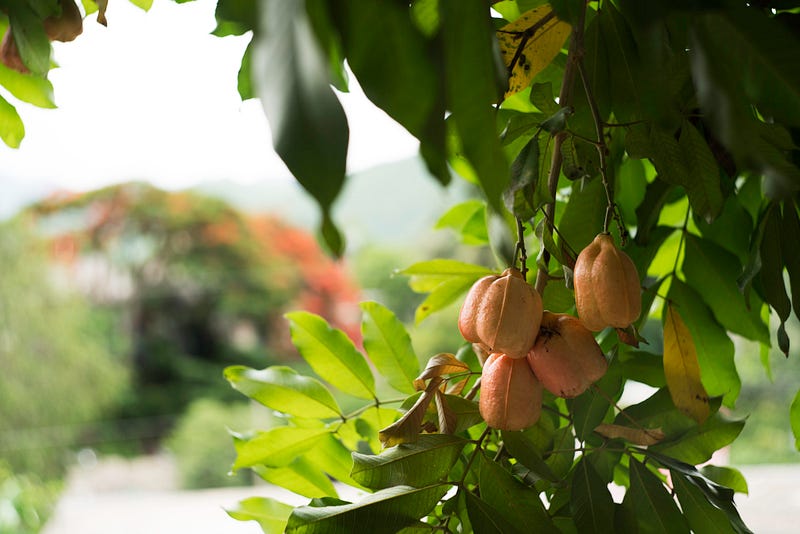
Photo by Elite Inception Co on Unsplash

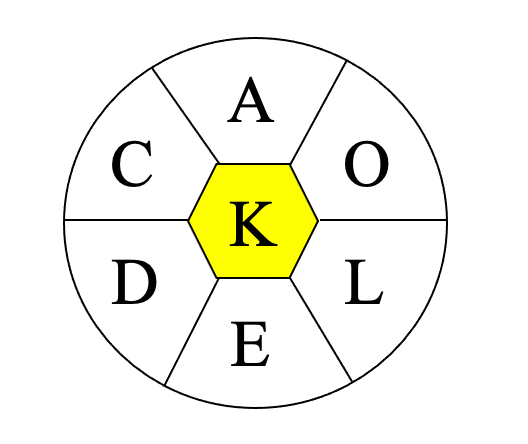
Today’s New York Times Spelling Bee letters:
Art: Iva Reztok

A, C, D, E, L, O, and center K (all words must include K)

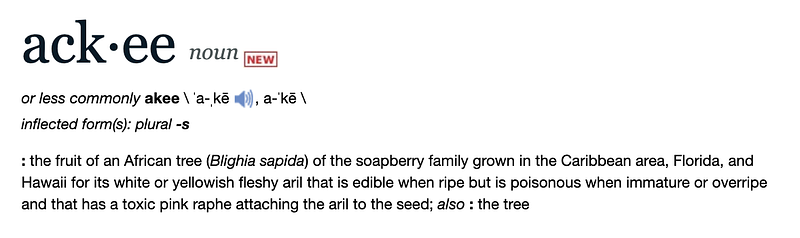
Merriam-Webster says…
Credit: merriam-webster.com

Silly little dictionary! Don’t you know ackee can’t possibly be a word if the New York Times says it ain’t?

For further fascinating facts, check out the Spelling Bee Master.

What’s your favorite dord* from today’s puzzle?

My Two Cents

I admit there’s a slight element of clickbait in the title of today’s column. And by “slight” perhaps I mean a lot. But truth be told, between the name of the fruit and the photo that Unsplash provided, I needed to drum up some excitement for this article. And it’s not like there’s no relationship between the ackee and the mutiny on the Bounty… it just might be a matter of a decade or so between them. Read on to find out.

Poisonous fruit of the tree

The dictionary states that the word ackee comes to the English language from the term ā-kee of West African language Kru. That’s because the evergreen tree that produces the fruit is native to that area of the world. But in the latter part of the 18th century it was brought to the Caribbean––especially Jamaica–– from where it was later taken back across the Atlantic, this time to England. All this thanks to a an officer of the Royal Navy named William Bligh, famous for a mutiny that took place on his ship, the HMS Bounty.

The ackee had a terrible association with slavery, as it was brought over on slave ships with the intention of providing cheap food for the slaves. Also, the damn fruit was effin’ poisonous unless eaten at just the right time in just the right way… which I’m sure didn’t bother the effin’ slave owners one bit.

But as National Geographic explains, today “Jamaicans have reclaimed it as part of their national dish… [they] sauté the boiled ackee with saltfish (salt-cured cod), onions, and tomatoes. Sometimes the dish is served atop bammy (deep-fried cassava cakes) with fried plantains.” The government of Jamaica declared it the national fruit.
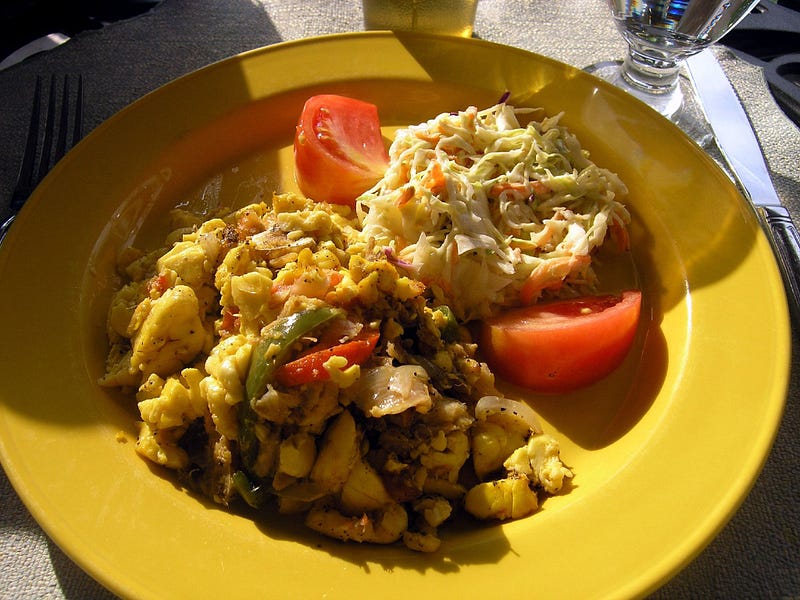
Photo by gailf548 from New York State

Wow, now I’m hungry! That looks delish!

Because of its texture when cooked, the ackee has developed create monikers across Latin America. According to Julia F. Morton, the fruit is called “vegetable brain” (seso vegetal in Spanish). In Cuba it’s known as the arbol de seso or palo de seso (brain tree); in Guatemala and Panama as huevo vegetal and fruto de huevo (vegetable egg or egg fruit); in Mexico as arbol del huevo and pera roja (egg tree and read pear); in Venezuela as merey del diablo (the Devil’s cashew); and in Colombia as bien me sabe or pan y quesito (“tastes good to me” and “bread and cheese”). Whew!!

The fruit is pear-shaped and has anywhere from two to four lobes. It turns bright red to yellow-orange once ripe, which is also when the lobes separate to reveal three large, shiny black seeds. Each seed is partly surrounded by soft, or spongy, white to yellow flesh . The aril ––an appendage that develops after fertilization as an outgrowth that sometimes envelops the seed itself––is the part that has the nutty flavor and texture of scrambled eggs.

I’ve asked Iva Reztok to create a beautiful collage and not just copy and paste wikicommons content…
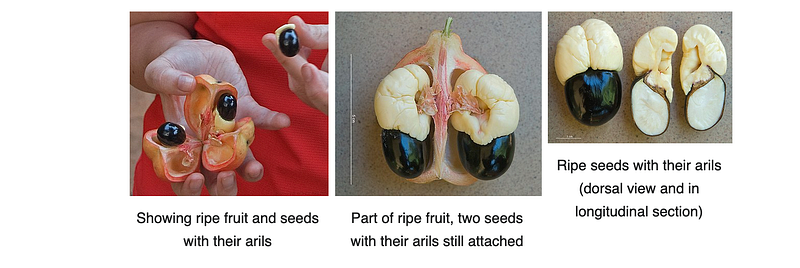
Screenshotted by Iva Reztok

…but it’s clear that he has no desire to work on a Friday afternoon.

Regarding its infamous toxicity, I’ll refer again to Julia F. Morton’s article on the fruit (boldface highlights are mine):

The toxicity of the akee was long misunderstood and believed to reside in the membranes attaching the arils to the jacket, or only in the overripe and decomposing arils. There have been intensive clinical and chemical studies of the akee and its effects since 1940, and it is now known that the unripe arils contain hypoglycin, a-amino-B-(2-methylenecyclopropyl) propionic acid, formerly called hypoglycin A. This toxic property is largely dispelled by light as the jacket opens. When fully ripe, the arils still possess 1/12 of the amount in the unripe. The seeds are always poisonous. They contain hypoglycin and its y-glutamyl derivative, y-L-glutamyl a-amino-B-(2-methylene cyclopropyl) propionic acid, formerly called hypoglycin B. The latter is 1/2 as toxic as the former.

Basically, the ackee is the fruit equivalent of the blowfish: a real bitch to eat! So, if you’re an amateur when it comes to the Devil’s cashew, don’t go out picking ackees yourself; get an expert to guide you with it.

Bounty… the quicker picker uprising

The scientific name of the ackee is Blighia Sapida,in honor of Captain William Bligh, who in 1793 took plants of the fruit from Jamaica to England. A couple of decades before that, as mentioned earlier, he had brought them to Jamaica from West Africa.

In between shipping poisonous fruit around, Bligh became infamous for a little uprising that happened on his ship, the Royal Navy vessel HMS Bounty, as it sailed across the South Pacific Ocean. On 28 April 1789, some unhappy mariners, led by acting-Lieutenant Fletcher Christian, took over the ship and put Bligh and eighteen of his supporters adrift. Fortunately there was an artists right there to quickly paint this selfie:
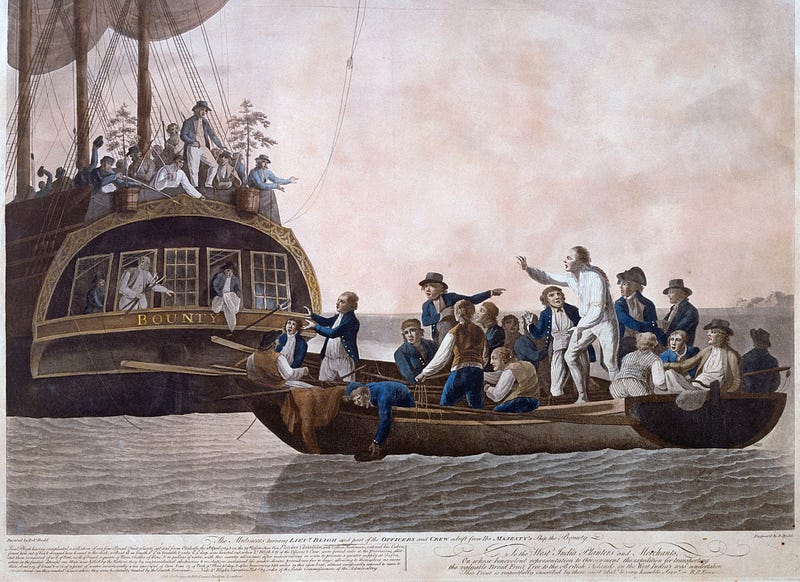
Selfie by Robert Dodd

The mutineers went off to Tahiti and the Pitcairn Island. Bligh and his skeleton crew somehow managed to navigate more than 3,500 nautical miles (4,000 land miles, or 6,500 km) in the launch and safely reach Timor, where he immediately began the process of bringing the mutineers to justice. Unfortunately the painter died, so there is no selfie of Bligh’s arrival. However, we can clearly see how the mutiny affected him:
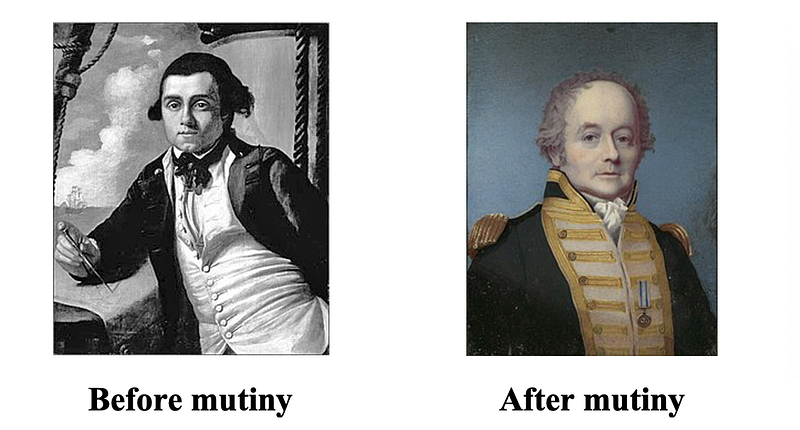
Screenshotted by Iva Reztok

In 1790, Bligh was honorably acquitted at the court-martial of his loss of the Bounty. Taking advantage of his fame, he published A Narrative of the Mutiny on board His Majesty’s Ship “Bounty”; And the Subsequent Voyage of Part of the Crew, In the Ship’s Boat, from Tofoa, one of the Friendly Islands, to Timor, a Dutch Settlement in the East Indies.

This was later made into a film with the much, much, much, much, much shorter title of Mutiny on the Bounty, starring Marlon Brando and Trevor Howard.
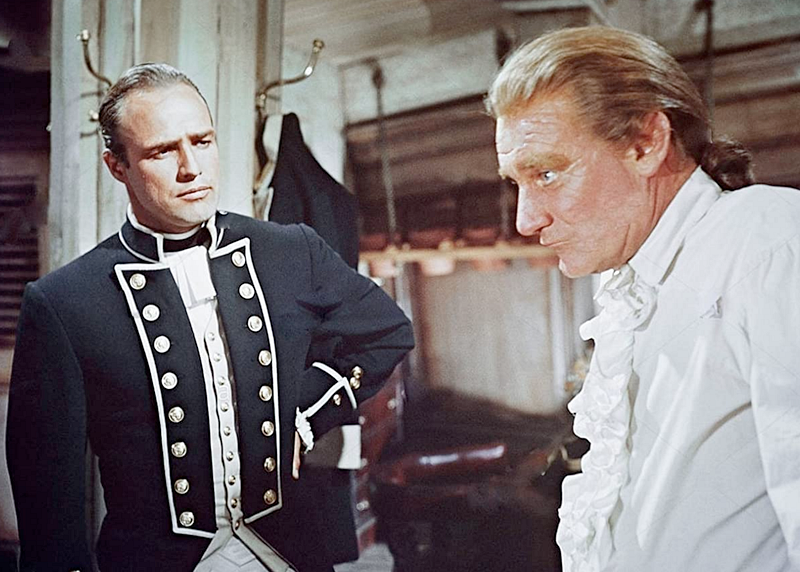
Credit: imdb.com

It took only 16 years for the English to reward Bligh for his valor by appointing him Governor of New South Wales in Australia. There he attempted to clean up the corrupt rum trade going on, but his actions resulted in yet another mutiny, the so-called Rum Rebellion.

So, not very lucky with underlings, this Bligh guy. Eventually he ended up moving to London, where life itself decided to give him a mutiny, killing him at the ripe old age of 63.

To recap, we’ve learned about a poisonous fruit and a poisonous leader. You can talk about Bligh to your heart’s content, but don’t mention the ackee he exported to the Americas… because the editors of the Spelling Bee decided that ackee is a dord*.

You can check out my previous entry on another dord* here:

*What the heck is a dord, you ask? Here’s the answer:

Spelling Bee
Language
History
Fruits
Jamaica
Recommended from ReadMedium