
To Be a Journalist You Need to Know the Bottom Line
That’s what makes the headline
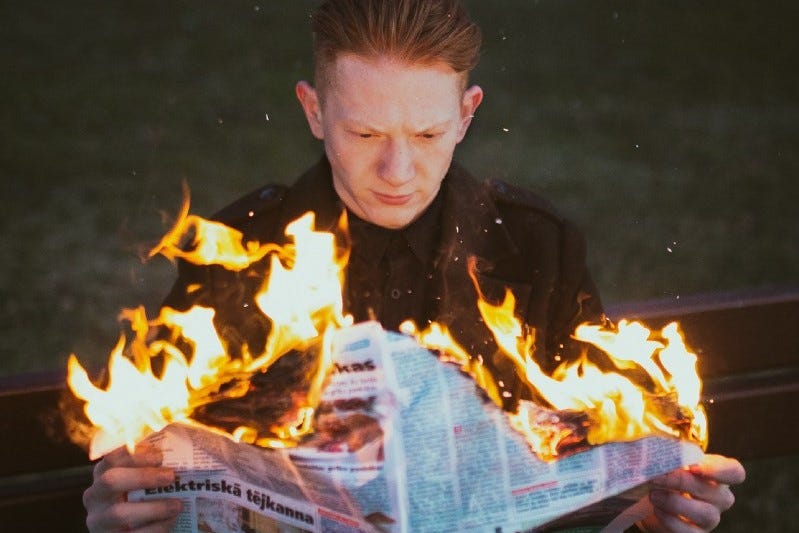
It’s a breathtaking moment when you figure out the point of the story.
This is Nora’s experience in her first journalism lecture.
The teacher instructed the class to use the following information to write the headline for the front page of the school’s newspaper.
Here are the story facts
“Kenneth L. Peters, the principal of Beverly Hills High School, announced today that the entire high school faculty will travel to Sacramento next Thursday for a colloquium on new teaching methods. Among the speakers will be anthropologist Margaret Mead, college president Dr. Robert Maynard Hutchins, and California governor Edmund ‘Pat’ Brown.” — Made to Stick
— now make up your best headline
Nora’s class set about their task — they beavered away reordering the facts, taking out the filler, condensing the information, and producing their leads.
Have a look over the information again.
What would your headline be?
You can pause here, think up your headline and post it in the comments. I guarantee you will get more fulfillment from this article if you do.
I am curious to read what you come up with.
Go on give it a go before you read on.
Journalism
We have all read newspapers, they are part of our culture. We see them everywhere. We glance at them, get the gist, and move on.
The most important information is at the top. Often, the headline is all we need to know. That’s how they are set up. The headline is there to drag the reader into the story.
The sub-heading gives a little more information. Within a few lines you have the who, what, where, when, and why.
News writing is a skill with unique rules and structure. It differs from other forms of writing.
It begins with the most important information and follows with supporting facts. And it concludes with the less important — but relevant — filler quotes and summary.
We pick up a newspaper because we want to know what is happening in the world, but our attention settles only on what affects us.
- How much more will I be taxed?
- Will the rail strike stop me from getting to work?
- Is my energy bill going to explode?
The details aren’t important. We want to know the bottom line.
Nora’s headline
Nora consumed the information and regurgitated it as a single sentence. Her classmates did the same. They handed their sheets of paper to their teacher, who read them one by one.
They were all similar, something like:
The Principle of Beverly Hills High School will be taking his faculty to learn new teaching methods in Sacramento.
The teacher laid the sheets of paper on his desk. He picked up a piece of chalk and went to the blackboard. He began writing.
This is what he wrote:
There Will Be No School Next Thursday.
It was a breathtaking moment for Nora. She figured it out. Journalism was not just about regurgitating the information, journalism meant figuring out the point of the story — why it matters.
You can have all the information, all the facts, and figures but to be a journalist you have to understand what they mean.
You need to know why it matters.
That is the essence of great journalism.
Nora
Nora is Nora Ephron an American journalist, writer, and filmmaker. She is best known for her romantic comedy films Silkwood , When Harry Met Sally, and Sleepless in Seattle.
As a high school student, Nora dreamed of going to New York City to become a writer, satirist, and critic. Her teacher inspired her to change her mind and become a journalist first.
Nora worked for the New York Post for five years before launching her mega-successful writing career.
Every story has a human angle
We often get an idea for an article, type it out and submit it. Somewhere in the process, we think up a headline and fill in that space.
Sometimes we get it right, often we get it wrong. I confess to getting it wrong more than I get it right. Headline analysers can help. But they are just algorithms.
Delve deeper. Discover what it is about your story that impacts people’s lives. What is it that makes the information relevant to the reader?
“There will be no school next Thursday,” is something every pupil at the school needs to know and wants to know.
You can apply this to anything you write.
Focus on what is valuable. Don’t tell us that the prime minister made a speech, tell us what he said that will make a difference to us.
Who cares where and when an event is taking place? That's details we don’t need. Focus on what is important to the reader — that’s the bottom line and your headline.
Addendum
How could anyone top this?
Well, someone did. CJ Sterling came up with an even more mind-blowing headline. CJ is a journalist — of course she is — she read the text, delved deeper, and wrote her headline in the comments.