
Absolutely The Last Thing You Should Have To Do After Leaving A Restaurant
But it happened to me in Los Angeles and it illustrates a sad state of affairs
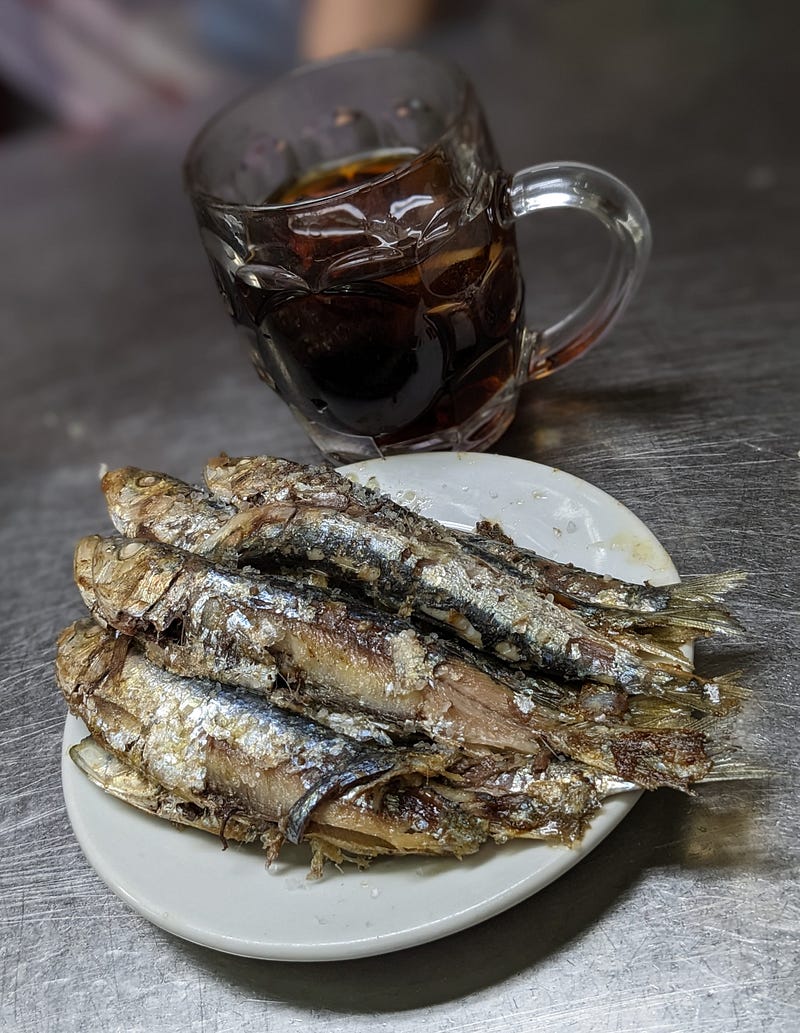
The other night my girlfriend, her daughter and I dropped $177 at a Los Angeles restaurant in a relatively random neighborhood north of downtown. Technically, it’s a Portuguese-themed bar that serves food. Next door, there’s a co-owned pizza place that does slices.
Good thing they have the adjacent pizza place because we were pretty much starving after our meal. I wonder if they structured things this way on purpose. We’ll charge people entree prices for tapas-size portions, then dazzle them with what amounts to a bargain in LA.
A $3.75 slice with cheese.
Isn’t this one of the big failures in the restaurant industry? Guests leaving hungry. But we did. And this is a first. The three of us go out to eat together regularly and always walk away satisfied, if not full.
And here’s the thing — the food was good. It was just a ripoff. It was one of those situations where you walk out feeling like a complete fool.
First, a breakdown of what we spent. Second, a few (more) thoughts. Third, a (pretty damn good) idea.
To start, $14 for five see-through slices of Iberico ham. $10 for five small pieces of bread and a tiny wedge of cheese. And $6 for a plate of olives. We bought these three things together for $28.
In a Spanish tapas bar, you’re unlikely to even pay for the olives. And the bread and cheese might run a couple to a few euros max.
For the record, I understand the dynamics that dictate price differences between the U.S. and Southern Europe. At the same time, I’m not an idiot. Charging what the market will bear — on steroids — is uniquely American. It’s one of our worst exports that hopefully never catches on in places where society still has a soul.
Anyhow —
Then, $34 for rice with two prawns, two mussels and two clams. $18 for two whole sardines (quantity not specified on the menu). And $12 for five bacahlau fritters, probably the best value of the entire meal.
Tack on $35 for a carafe of sherry, $7.50 for two 8 oz. beers, a 20% service charge and tax and you arrive at $177.
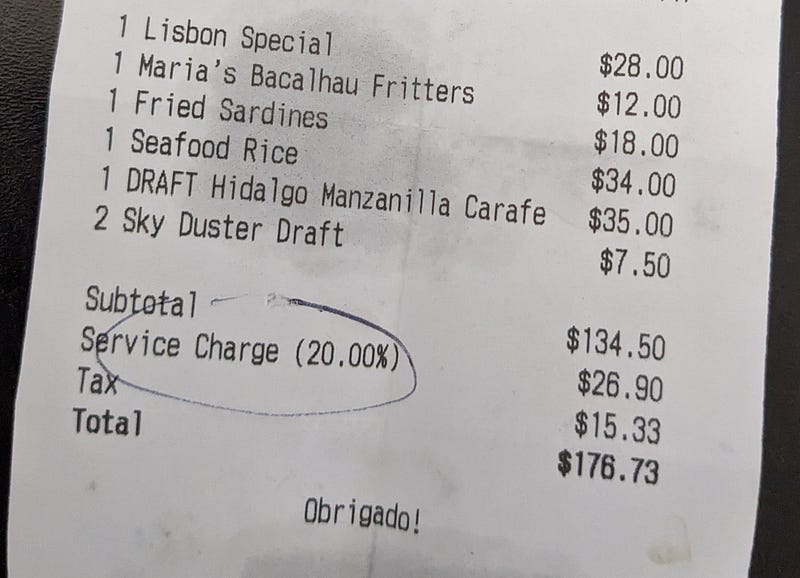
Fucking highway robbery.
Ultimately, it’s the consumers’ fault. We’re the ones responsible for these high prices. Because we’re willing to pay them. We help fuel inflation with our consumption. Regularly pay $14, $17, $19 and more for a glass wine or $22, $26 and $28 for a plate of pasta and establishments will more than happily set these as minimum price points.
My girlfriend and I have sworn off eating and drinking out in restaurants and bars in this town. We only go a few times a month now. And we tend to go to places where we know what we’re getting. Nine times out of ten new places disappoint in one way or another.
It blows my mind that governments can prohibit retail businesses from offering deals in the name of consumer protection (more on that in a second), yet they have nothing to say about these absurd markups and shrinkflation.
We’re being screwed. If you want to live in a big city — or even an increasing number of not so big ones — you have to make tons of money and be willing to blow it without regard in order to go out to eat multiple times a week.
I realize the world has bigger problems. However, isn’t going out for a hit of food and drink and dose of hospitality one of the ways to forget about everything else? There’s war. There’s a retirement crisis. There’s a housing crisis. There’s even a fucking car crisis. Global and individual level conundrums of epic proportion and you can’t even walk into a knock off of a bar in Portugal and get anything close to what you expected — or deserve — for your money.
Maybe these prices are justified. Maybe this place could reveal their costs and prove to us it’s just the way it has to be. Though, having managed a bar that serves food prior to the pandemic, I’d argue they can’t. I’m willing to bet we’re being gouged.
That the hospitality industry — at least some of it — has taken to amplifying their very real problems and using the inflationary environment we’re in to set a new baseline on prices.
They might lose people with less disposable income and those of us who refuse to participate in the inanity. But they’ll keep the relatively well off and others who so badly want to romanticize mediocre value as “ the best meal I’ve had all year” in an Instagram story.
Society loses in this equation.
I love to cook at home. My girlfriend and I do it frequently. Once we move to Spain, where dining and drinking out is a relatively affordable part of the cultural fabric, we likely still will. We love the ritual, experimentation, cost savings and quality of it all.
However, we shouldn’t be forced inside. And when we venture outside, we should not be taking advantage of to this extent. Two medium-sized sardines should never cost $18. A wimpy portion of rice with less seafood than the average survivalist eats on Naked and Afraid absolutely should not go for $34.
But I have an idea.
As I referenced above, some governments have banned loss leaders. I wrote about this last week here in Rooted:
A loss leader is “a marketing approach where a product is intentionally sold at a loss or minimal profit to attract customers.” Basically — use a loss leader to get them in the door with the hope that they’ll buy more …
… I find it funny that governments, particularly in the U.S., are in the business of protecting consumers against their urge to impulse buy, yet they set no regulations I know of around, say, charging $12 for a beer that generates something like a 90% margin.
Pursuant to this, my idea is transparency around how much bars and restaurants pay for their products.
As far as I know, consumers have no access to this information from the suppliers and distributors. I used to, back when I did the ordering for the aforementioned bar that serves food. Without a log-in, I can no longer access the price lists.
But I should be able to. And so should you.
I should know cost on the wine, beer and sardines a place serves. I should know cost on the rice they use. And so forth. I should know the source. And I should be able to very easily go online and see the lists restaurant and bar owners and managers see when they order and do inventory.
Why is it such a big secret?
What’s wrong with letting us see this information so we can run the math and make actual informed decisions on how and where to spend — or not spend — our money?
For more on the aforementioned money-related crises, you can —
Receive a notification each time I publish a Medium article by going here.
You can also subscribe to my Never Retire: Living The Semi-Retired Life newsletter where I chronicle my big decisions on lifestyle, housing and cost of living, which includes moving to Spain sooner rather than later.