
The Allegedly Unethical Tactic I Wish Bars And Restaurants Would Use More Often
I didn’t realize ‘loss leaders’ were such a big deal
As I (maybe we?) lament the increasingly high cost of eating and drinking out in the United States, I got to thinking about loss leaders.
A loss leader is “a marketing approach where a product is intentionally sold at a loss or minimal profit to attract customers.” Basically — use a loss leader to get them in the door with the hope that they’ll buy more.
As I’ll detail in this article, I see more nuance to it than this seemingly disingenuous strategy.
You don’t see loss leaders much anymore. At least, I’m not seeing them. Could be because I’m in California where, much to my surprise, they’re against the law. And it’s not just here.
According to the American Economic Association (AEA), loss leading “has been banned in some European countries and half of all US states over concerns that it’s anti-competitive and ultimately hurts consumers.”
There’s an entire debate around this. One we won’t get too deep into today, but there’s one side that argues loss leading exploits consumers and helps large retailers turn the screws on their smaller competitors. Walmart can afford to take a loss on a product to lure shoppers, which, in theory, stops these bargain finders from patronizing local businesses.
The AEA summarized research that counters this position:
[…] big stores aren’t necessarily choosing their loss leaders based on what the competition is carrying. In fact, they’re picking them based on what they know will lure shoppers to their store, regardless of whether a smaller store sells it …
In order for this loss-leading strategy to work, however, retailers depend on consumers making those impulse purchases. It’s a fair assumption.
I get the logic on both sides. However, I find it funny that governments, particularly in the U.S., are in the business of protecting consumers against their urge to impulse buy, yet they set no regulations I know of around, say, charging $12 for a beer that generates something like a 90% margin.
Which brings up another question.
Is it defined as a loss leader on the A-to-B basis of we paid this much for the product and sell it for this much? Or does it take into account the other costs associated with doing business beyond buying inventory? I assume it’s the former, given that the latter complicates things way too much. But it’s an important distinction.
I’m still searching for more detail on this. While I look, let’s go with the former.
Which made me recall —
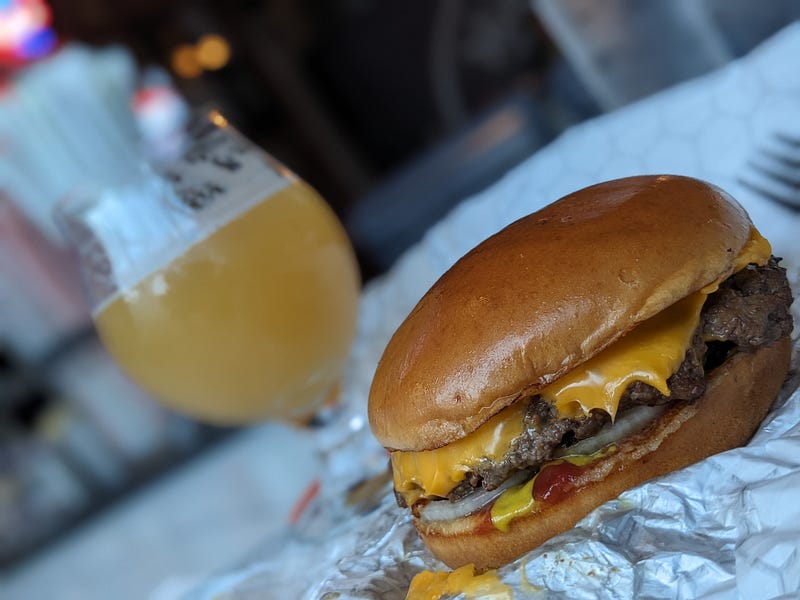
The time I suggested to the owners of the bar I managed that we do an $8 burger and beer special. We would not have lost money on the transaction given the cost of the bottle or even draft and the sandwich if you only take into account the cost of the products. However, we likely would have lost money — in isolation — if you factor in the cost of labor and other overhead. But, whatever, because even at regular prices, there were days — even periods — where we lost money just by keeping the lights on.
So, the theory was to create higher volume, which might just lead to an increase of sales large enough to also increase profit. At the same time, this creates goodwill. Good, solid word of mouth.
If you’re a community establishment (and maybe also a destination) like so many bars and restaurants are, there’s something to be said for providing a relatively affordable option or two. Whether for a local or somebody who travels a longer distance. For the person who might not otherwise come to your venue because it’s too expensive for them. But also for the big spending regular who likes the idea of getting a deal in return for their loyalty.
Yeah, it’s not a charity, it’s a business. But also if you’re not an asshole, you want to provide some value beyond the so-called experience of eating and drinking out.
In the present environment, you’d think you’d see more of this. However, given that you don’t maybe I have no idea what I’m talking about. Or maybe bar and restaurant owners are too jaded and scared to take a chance.
I know it’s apples to oranges, but I know when I go to Europe, it’s much easier to drop a few euros more beyond my comfort zone on some jamón when I’m paying two or three euros for a beer rather than six or eight. Regardless of the tapas bar or cafe’s pricing structure, in my mind, that beer is a loss leader. And I’m more than okay with it.
Because there are plenty of people who sit at a tapas bar, only drink the cheap beer or vermouth, eat the free snacks (definitely a loss leader) and resist the temptation to consume anything else.
We all have the right — for want of a better word — to be able to pull up a stool or relax in the plaza with a drink. In the end, the people with the means and/or desire to spend more subsidize the consumer you might be taking a loss on or extracting less of a profit from.
Translate that thinking to America and I just don’t know why we don’t see more of this.
I mean — for goodness sake — even happy hours are super lame these days. You can’t get out of most bars or restaurants without spending $20 minimum for two people (and that’s super low) no matter the time of day.
Maybe not as pressing, but like the other cost/personal financial crises facing America (retirement, housing, cars), the high cost of hospitality is a big deal. It’s a problem. Because it’s a key ingredient of social interaction — of feeling alive and part of something — that should be accessible to as much of the population as reasonably possible.
More bars and restaurants need to remember their function beyond turning profits. They have a role in society that absolutely can coexist alongside making money.
For more on the aforementioned money-related crises, you can —
Receive a notification each time I publish a Medium article by going here.
You can also subscribe to my Never Retire: Living The Semi-Retired Life newsletter where I chronicle my big decisions on lifestyle, housing and cost of living, which includes moving to Spain sooner rather than later.