
Do I contradict myself?
About Me — Scott Hughey
Writers Are Crafted
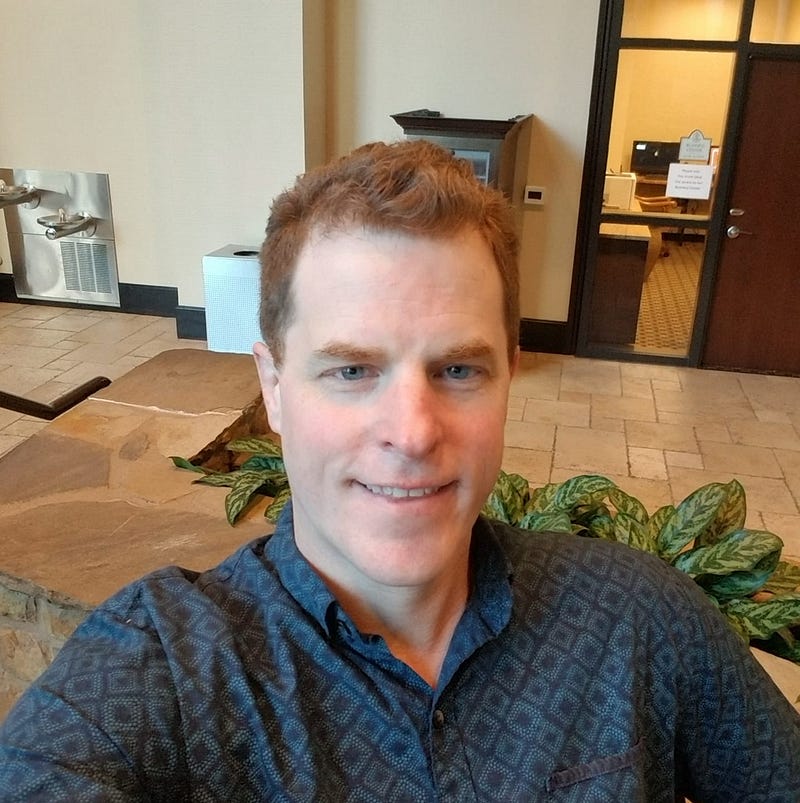
I put off an About Me story, first because I didn’t know what to say and then because I couldn’t decide what to leave out.
We all have a multitude of stories.
For this post, I decided to tell the complicated one about admitting I was a writer then how I later became one.
Do I contradict myself? Very well then I contradict myself. (I am large, I contain multitudes.) — Walt Whitman
Do I contradict myself? Very well then. I contradict myself. (No, I don’t. Yes, I do. Hush, you.) — Scott Hughey
I was an early lover of words and language. Oddly so, given that so many people couldn’t understand mine.
I was adopted, along with my twin sister, at four-months-old. Stacey became my interpreter. She was the only one who could understand me.
One day in kindergarten, something clicked in my head. I can still see the reading corner in the room when the teacher (Mrs. Roberts) went over the lesson, and I read the words before she read them to us.
Eureka!
When we got home, I probably said something like, “MomnDad. You’llneverguesswhat!Guesswhat!Icanreadnow!IcanreadIcan read!!”
Yeah. I used to run my words together back then.
MomnDad looked at Stacey.
Without needing to be prompted, she said, “He says he can read now.”
From there, I started a lifelong journey of reading which led to writing.
Story dazzled me. From There’s a Monster At The End Of This Book to The Chronicles of Narnia (pay no attention to the link that calls this Book Two, The Lion the Witch and the Wardrobe is and ever shall be Book 1,) and Where the Red Fern Grows; I was hooked.
In 7th and 8th grades, we studied poetry. That’s where I first took up the written word as a tool beyond just schoolwork.
I filled journal after journal with horrid poetry, both love and angst-ridden. (Remember, I was in the 7th and 8th grades.) The occasional gem came through.
The journals continued for some time. Slowly, decent poems began to outnumber the horrid ones, if only just.
Somehow it felt okay to call myself a poet. A writer? No. Those were the geniuses that made novels. No, better than that. They wrote Story. With a capital S.
And then I discovered him. Douglas Adams.
The Hitchhiker's Guide to the Galaxy
It’s funny if you know anything about Douglas Adams and his writing.
Every young writer, I believe, starts off trying to imitate the writers they enjoy. Well in Douglas, I found someone who seemed to write the way I thought. This is, of course ridiculous, but so was the way Douglas wrote. So was, at times, the way I thought.
I realized I would become a writer.
That goal feels inevitable now while and at the same time like it meant moving mountains. Picking Douglas as a role model didn’t help my growth.
I love deadlines. I love the whooshing noise they make as they go by — Douglas Adams; The Salmon of Doubt.
I could have chosen any of a dozen other writers and had a better chance of initiating the style. Every writer has a style unique unto them. Douglas had a nearly inimitable style.
James Goss came close in Doctor Who and The Krikkitmen, but he also had the advantage of working from the scripts and notes of Douglas.
When I failed to produce a novel in the style of Hitchhiker’s Guide on my first attempt, I decided I wasn’t a novelist. And in those days, novelist was synonymous with a writer in my mind.
I remained a poet.
The idea of writing wouldn’t let go of me. My professional life always had a modicum of writing involved. But, I told myself, not-fiction didn’t count.
I became a Journalism major for about a year.
I took Journalism in college. More than once. Sure, I took tons of writing classes during the year and a half I was an English major. Journalism taught me so much more
- I learned to be succinct.
- I learned to edit.
- I learned that if you’re going to take an incomplete in Journalism, get the conditions of completing the class in writing. Otherwise, you might have to take it more than once.
I started writing fiction. Then I embraced non-fiction as well.
I also took shortcuts. Writing, I decided, should come easily. One must read in order to write. I’d read more than most. I understood stories and characters. Most of all, I knew Story.
Writing is a craft though. You have to work at the craft. I wasted several years not being willing to work and improve.
Eventually, I did. Along the way, I started ghost-writing and blogging for pennies. Since it was only for pennies, I stopped, but the experience taught me I could write about anything.
Non-fiction felt so easy compared to fiction.
Along the way, I wrote and sold tons of short stories. Novellas. Two novels. One of them was good. (Spoiler alert… the good one is at the bottom of this article.)
But I also embraced my non-fiction side. I self-published non-fiction books that outsell my fiction by an embarrassing margin.
And I rediscovered article writing. Short-form writing. Non-fiction.
And I decided that a writer is someone that writes. Well, someone that writes well. A professional writer? That’s someone who writes well and makes money from it. Both definitions apply to me.
And now? Now I want to take it to the next level.
I’m a writer. That means I write.
I’ve accepted my voice. I’ve also accepted that there is skill involved in every form of writing. I still write novels. I’ve got one half-written and another outlined and started.
But writing novels isn’t what makes me a writer.
Writing is what makes me a writer. Improving and putting the work out there is what makes me a professional.
That’s what I am. I’m so much more than this, but it’s also a part of who I am.
Hello, world.
I’m Scott Hughey.
A writer.
Scott Hughey invites you to check out a sampling of his other writings below. The Zombies and Zinfandels link is not an affiliate link, but because he is the author, Scott will still get some money if you read it.


