
Revolution Or Death: The Great Bifurcation
Civilizational Boom Or Bust
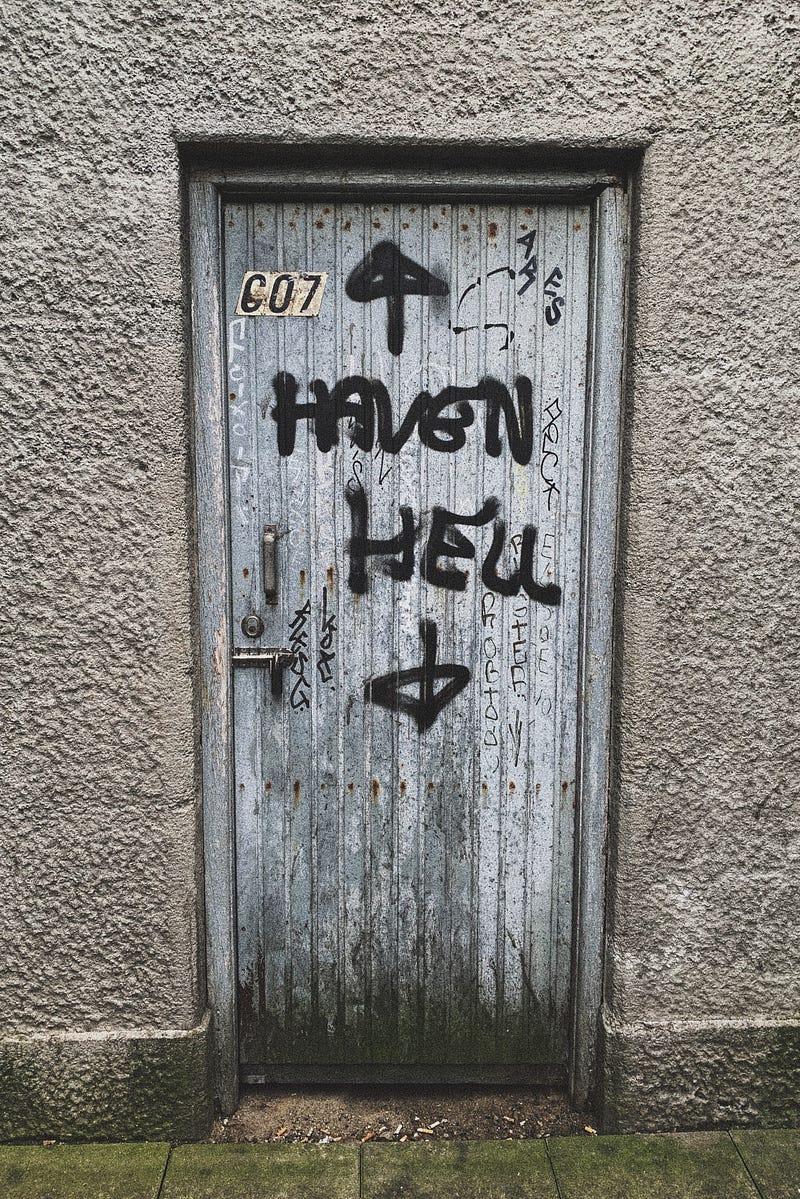
At the end of the 18th century global population was booming. This led the economist Thomas Malthus to predict a coming disaster, a ‘Malthusian crunch’, in which exponential population growth but linear agricultural growth, would lead to mass starvation, war, and collapse.
He was wrong.
The 2nd industrial revolution came to the rescue with mechanized agriculture and artificial fertilizer.
Now, scientists are predicting a new Malthusian disaster (e.g. 1, 2, 3). ‘Code red’ for humanity the latest IPCC report read, warning that climate change will cause untold misery by the end of the century. Others are drawing an even grimmer picture were the mantra is ‘faster than expected’.
I’ve written extensively on the idea that modern civilization is about to end (see here). To summarize, we are gunning for infinite growth in a finite environment. By borrowing from the future (fossil fuels primarily) we’re far above the natural carrying capacity of Earth. As a result, we’ve grown into a complex, intertwined, global civilization that consumes everything it touches.
The climate and ecological crisis is testament to that fact. But, complexity doesn’t come for free, and the debt we owe is staggering.
Soon we will have to pay the entropic bill.
Or to put it in simpler terms; life as we know it is about to end.
To better understand our predicament, it’s useful to look at one of the simplest life-forms out there.
The Virus
“You move to an area and you multiply and multiply until every natural resource is consumed and the only way you can survive is to spread to another area. There is another organism on this planet that follows the same pattern. Do you know what it is? A virus.” - Agent Smith, The Matrix
All organisms, virus or otherwise, will spread and eat until they hit a ceiling. That ceiling could be spatial constraints, limited food, predators, or even themselves as they destroy the habitat providing for them.
When the organism hits the ceiling, there are three options
(1) Stay there (2) Collapse (3) Expand
The first option is pretty self-explainable. It represents equilibrium. Neither expansion nor contraction, such as an indigenous tribe in the Amazon.
The second option happens when there are non-linear interactions between an organism and its environment, such as in the predator pray model
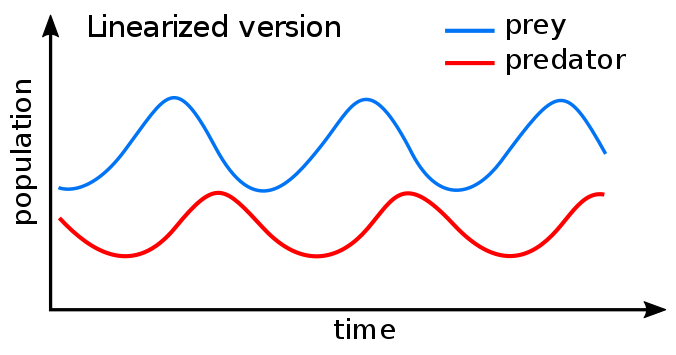
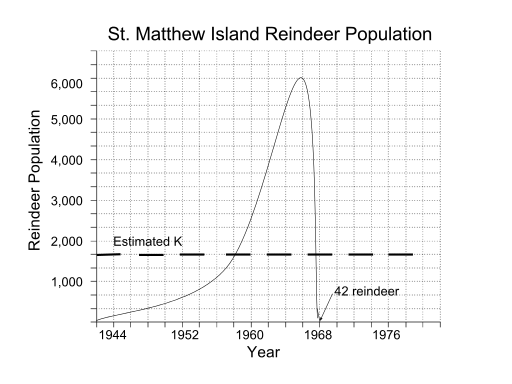
Sometimes though, the predator is too efficient, eating its prey into extinction, as happened with the St. Matthew island reindeer:
The third option is what the Coronavirus does now, mutate and expand.
A virus will infect a host and then hope to get to another host before its current host dies or defeats it. If the immune system is too strong, say after a vaccine, the continuous mutations of the virus’ genome might prove lucky as the right change at the right time can give the virus just what it needs to get past the bottleneck.
In other words, it expands its reach into untapped environments and overcomes barriers to further proliferation.
We humans are extraordinarily good at mutating. But instead of mutating our genes, we mutate our memes; the ideas that makes us so flexible and indomitable. When burning wood for power didn’t yield enough energy, we turned to coal. Then oil and gas, now nuclear and renewables. Diseases that used to kill millions every year are now cured by vaccines or antibiotics. And when the soil wouldn’t give more food, we gave it artificial fertilizer.
But what if the virus is too effective?
Boom or bust
The reindeer shown above expanded (not of their own volition) to an environment they were supremely adapted to. They boomed in population with no checks and balances to counteract their dominance.
But they were too effective. As with the reindeer, humans have tapped into resources that will eventually run out. What’s worse, some of those resources, like top soil, sustain that which we depend on; food. Coupled with the future need for energy and resources to pay for the massive bill that is due, we’re in a precarious position:
We’ve hit the ceiling, and equilibrium is not an option.
Either we’ll become a smoldering husk of our former self, or we will hit the stratosphere a million miles a minute.
It is one or the other.
If we fall though, unlike previous times in history, climbing back up won’t be possible. For example, at the start of the oil age in the 1850s, simple wells or boreholes could get at reservoirs of oil that seeped out of the ground. Today, we need increasingly expensive and complex operations to get to ever diminishing stores.
The same goes for other minerals such as copper and iron. What was once easily accessible by a team of hard-working individuals now need the concentrated effort of thousands in an ever-increasing supply chain.
Thus, what we used to crawl up the ladder won’t be there again for a million years or so (see here for a deeper look).
But, like a virus, might we expand our reach, might a new industrial revolution save us again?
The great bifurcation
In chaos theory, even minuscule changes in the initial conditions of a system can have drastic changes later down the road. A butterfly flapping its wings on one side of the globe can lead to a tornado on the other side.
For example, in the plot below, you can see how changing one initial parameter (x-axis) of a system leads first to a predictable change in the equilibrium point (y-axis), until suddenly the graph splits in two, then four, and so on. This is called a bifurcation.
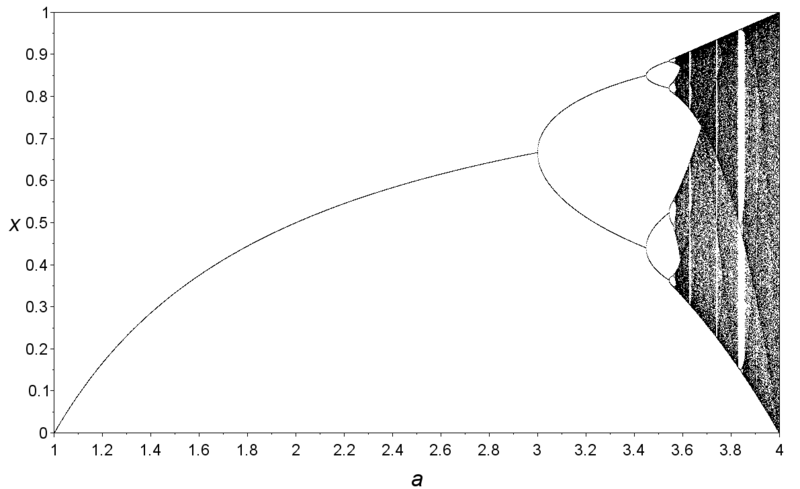
Now, imagine the x-axis is ‘progress’ (industrialization), and the y-axis is ‘technology’ (our collective capacity to enact change, i.e. the human colossus). While industrialization has allowed humanity to dominate the Earth with a corresponding increase in population and technological capacity, the consequences are hitting the news in bigger and bigger letters.
If we’re on the left side of the bifurcation point, then we’ll end up in a stable equilibrium. However, if we’re somewhere on the right, we’re looking at either an oscillating boom and bust cycle, or we’re in the land of complete unpredictability which even includes near extinction (far right side).
So far it seems we’ve been lucky and bifurcated “upwards”, but only time will tell if our chaotic interplay with our finite world will knock us down.
While this model is not gospel, it is an interesting illustration of how increasing, for example, the rate of progress can lead to wild futures going in all kinds of strange directions.
‘Collapsologists’ like Nate Hagens and Joseph Tainter believe there’s little we can do but drop, that we better drop now before we get too far right and risk never getting back or even collapse completely. Techno-optimists, on the other hand, believe even more ‘progress’ is the answer.
Expansion
As with viruses, we need to spread to a new host, or mutate enough for our current host not to kill us.
The below video shows how E. coli bacteria defeats stronger and stronger antibiotics in order to reach the next sugar field.
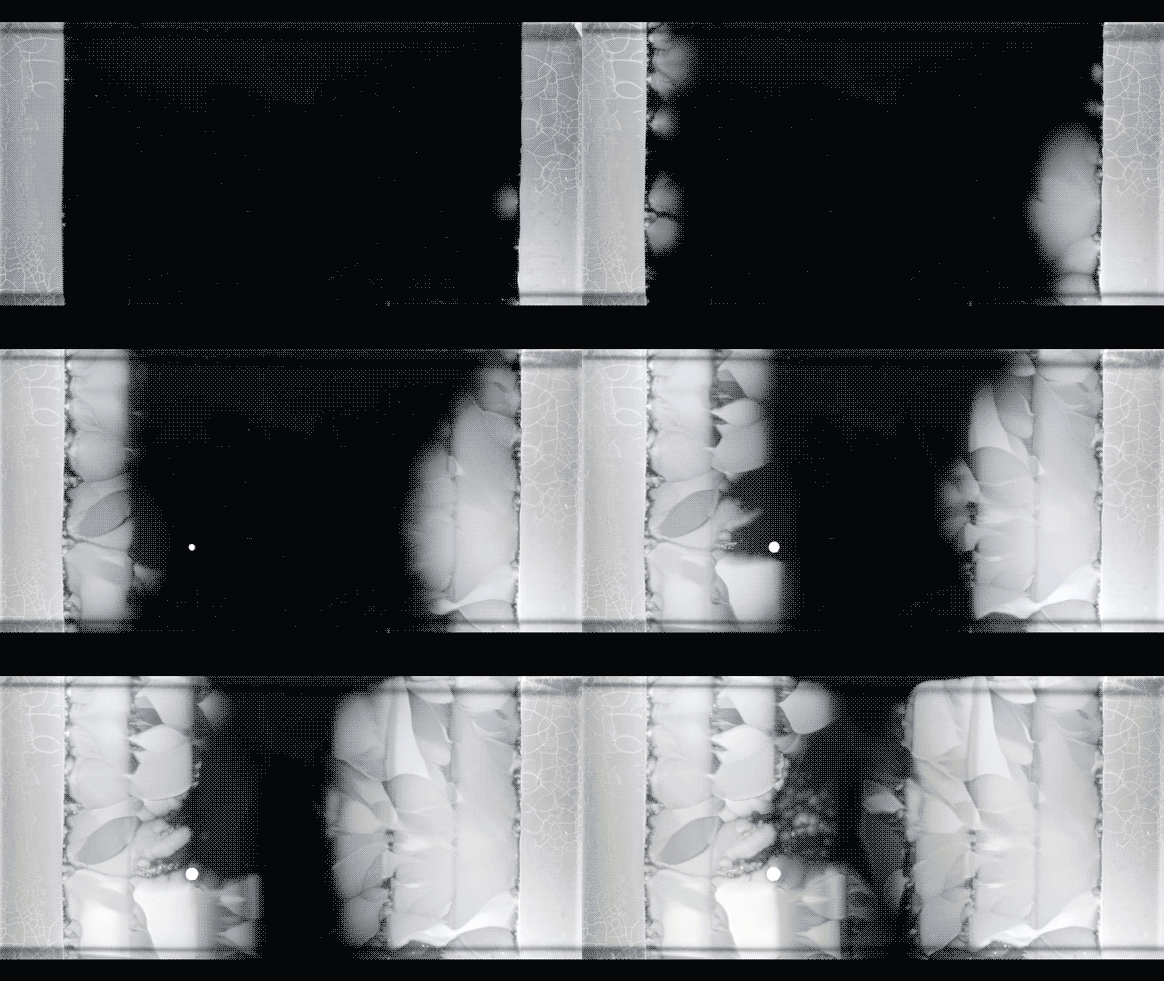
It’s easy to draw a parallel to space exploration. We need new celestial bodies to consume if we are to survive and flourish. Just like islanders in Micronesia sailed from atoll to atoll, how Europeans spread out over the Americas, and how we now turn to mining new ground like the arctic sea floor, so we must explore strange lands once again.
Put another way, we no longer die from diseases or starvation (as we used to do), we’re omnivores with no environmental niche, and the only thing stopping us is old age and other humans. Sky’s the limit. But, this is a delusion, a fever dream we’ve collectively come to believe.
Instead, we straddle the awkward middle ground between being at the mercy of nature, and dominating it completely. What grants the powers we have is an abundance of energy and resources. When we consume that, nature will show us that our genes are not that of apex predators like the shark.
Thus, if we are to fulfill our belief, we need the next paradigm, the next industrial revolution, the next frontier.
But in our way are diminishing resources, an increasingly chaotic climate, and decaying infrastructure and institutions.
It’s a race against time. More resources and energy might not be enough.
The third industrial revolution
According to economist Jeremy Rifkin, an industrial revolution happens when new forms of communication, transportation, and energy, converge. The second industrial revolution is characterized by centralization of production of parts or assemblies, vast supply chains, the use of oil and steel, railroads, and so on, all managed and synchronized by telegraph, telephones, radio, or television. This allowed the world to become interconnected with central hubs generating goods and energy for others.
The third industrial revolution, according to Rifkin, consists of an integration of the internet with transportation of goods and decentralized renewable energy production. This would allow optimalization to new levels, democratization of energy use, and allowing us to become even more interconnected than before (see more here).
Others champion the blockchain, fusion, space exploration and colonization, or even artificial intelligence. Regardless of which ‘techno-hopium’ you subscribe to, we need a major paradigm shift and it’s not so certain that we’ll get it in time or how much it will cost.
The choice
If it’s not too late, then I believe we need to raise our eyes from the ground in front of us. There’s no time to squabble with our neighbours or fight for small scale fixes to giant structural problems.
Our economic and political system is massively interconnected. If change is to happen in time, we need to see the forest and not the trees. With this overview we can ask:
Do we gather together and push to break through our current limits, do we make a conscious choice to scale the whole thing back until we’re mature enough to forge onwards again, or do we keep on keeping on until we fall flat on our faces?
I know which option I’d choose, and which we’re currently going for. But, in celebration of a movie that shakes loose the yokes of old:
“The choice is an illusion. You already know what you have to do.” - Bugs, Matrix Resurrection
Want to read more excellent stories, or contribute with your own? You can join Medium.com through this link, and directly support my writing and the writings of all the other writers on Medium. By becoming a member you get access to everything, and even get paid to write. The affiliate link is the same price as non-affiliate, but a small part goes directly to me. I would greatly appreciate that! Thank you.


