
9 Concepts That Changed My “Why”
And I hope it will change yours too

I think It’s truly unique that the matter turns over the question of its own existence as we do. I admire psychologists and neuroscientists because they try hard to find “why” to our operating system.
With this article, I wish to share concepts, biases that I have discovered over the years and that resonate deeply with who I am. You know the ones I can’t help but scream in my mind something like: “Wow, that’s so true,” or “I could never express it, but this is what I think,” when I stumble upon for the first time.
There are 9. I tried to order them in order of preference, but that’s like choosing which children I prefer, so it’s not.
For each of them, I will describe as simply as possible what it is about. Then, I will conclude the topic by telling you why it is important to me.
1 — Flow State
In positive psychology, a flow state is a mental state in which a person is fully immersed and cheerful in the process of an activity.
Flow theory began between the 1970s-1980s, initially on artists. Mihaly Csikszentmihalyi described it as an “optimal experience”. The flow state is a clever mix of skill and difficulty often represented by the following 8-channels diagram:
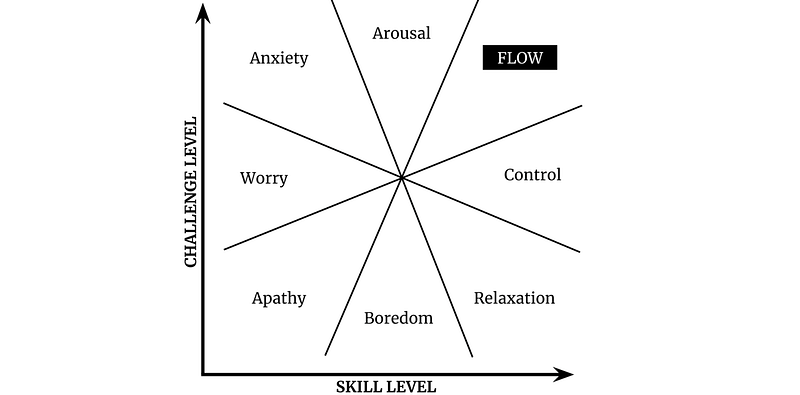
Theories have explained 5 vital factors to achieve this state:
1. Intrinsically rewarding activity (Doing what you love),
2. Clear goals and a sense of progress (A scaffolding of goals to achieve what you want in the end),
3. Clear and immediate feedback (What you’re doing & where you’re going),
4. Match of challenge and skill (The above diagram),
5. Intense focus on the present.
My Why
Sometimes I’m doing my thing — like writing an article — and I experiment flow. My fingers loudly hit keys on my keyboard, music takes me away. Without realizing it, 30 minutes, 1hours passed. I’m out of time.
Flow state is something I look forward to when I’m testing activity. If I can reach it, I’m on track to continue.
2 — Learned Helplessness
Learned helplessness happens when you repeatedly fail, and you conclude that you are unable to improve.
Ultimately, this attribution keeps you from trying to succeed. It results in increased helplessness, continued failure, loss of self-esteem, and other social consequences.
Our brains weigh our past failures against our future attempts, and while a series of small, easy victories gives impetus to our success, a series of failures breaks our morale.
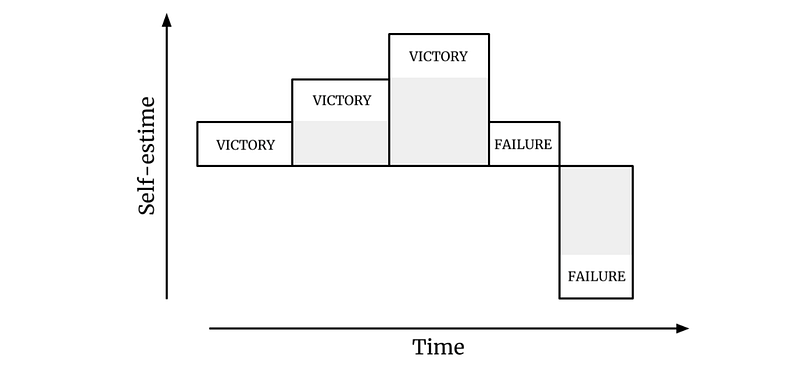
People often say: “I’m not good at that. It’s not for me.”
If you think, I’m not good at math, you won’t do the math; therefore, you won’t be good at math. You will even reject everything in that field.
My Why
I have in mind a story. By far, the best technique to tie an elephant wasn’t physically, but in his head.
First of all, attach a baby elephant by placing a rope on one of his legs attached to a sturdy wooden post. This is the first and most important step to keep the elephant within certain proximity for the rest of its life.
After maybe several attempts, the baby elephant will understand that he is incapable of breaking it. He will grow with the idea that trying to escape will be vain. The elephant learned helplessness.
Learned helplessness tied up your mind as I wrote here: “Learned Helplessness | A Tied-up Mind That Keeps You From Succeeding.”
3 — GRIT
In psychology, grit is a positive, non-cognitive trait based on an individual’s perseverance of effort combined with the passion for a particular long-term goal or end state.
Angela Duckworth studied it and observed that:
- Individuals high in GRIT can maintain their determination and motivation,
- They are more resilient. They overcome failure and adversity more easily over the long-term.
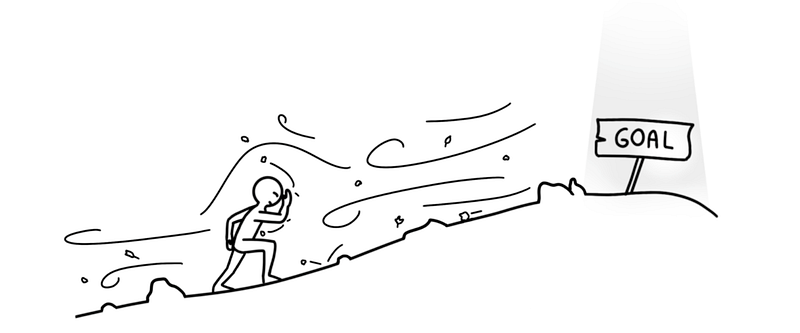
Angela studied many groups of people, from students to children to employees, and tried to predict who would succeed in the field they were studying. She notably found that intelligence only accounts for 30% of your achievement.
Duckworth emphasized that GRIT is a better predictor of achievement than intellectual talent (IQ). GRIT assists as the overriding factor that provides the stamina required to “stay the course” amid challenges, and setbacks.
GRIT and perseverance can be developed, regardless of the talent, you were born with.
“When things get tough for most people, they find something more peaceful to work on. When things get hard for gritty individuals, they find a way to stay on schedule.” — James Clear
My Why
I’m always suspicious when we’re talking about measurement to predict success and intelligence. In “Forrest Gump’s Fundamental Lesson About Intelligence”, I write this :
“The IQ is to intelligence what the shadow of a hand is to a hand.”
GRIT is certainly not a perfect way to predict success. But I think it’s more accurate than most preconceptions out there. Plus it gives hope. Unlike IQ, GRIT can be developed. Everybody can become more gritty, can start working hard on their passion.
4 — Growth Mindset
All in all, In a growth mindset, people believe that their most basic abilities can be developed through dedication and hard work, brains and talent are just the starting point.
The mantra of growth mindset is the word “yet”. Any time you feel like you’ve reached your boundary, just adding “no yet” reframe your thought process.
The idea is not to be good but better, not focus on your goals but your progress.
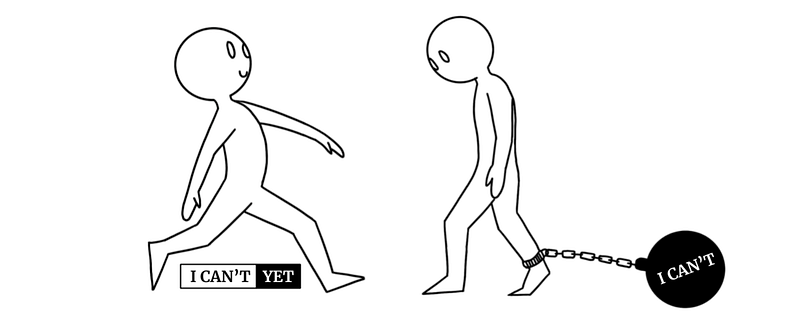
My 3 bits of advice to embrace it:
- Ban this self-limiting belief that some people are gifted, or naturally talented. Society seems to value them more than hard work, that’s stupid.
- Distinguish your performance and your identity, accept negative feedback. Don’t take them personally!
- Don’t simply repeat stuff you already know. Avoid getting comfortable in what you do. Instead, always dance to the limit of your performance.
My Why
Growth mindset is a way to fight learned helplessness — write about it above — and all self-limiting beliefs. As for GRIT, you need to realize that you can’t do pretty much everything. Do not wait for external approval or any kind of legitimacy.
There is no “You’re made to …”. As I wrote in “My Little Da Vinci Curse”, no need to specialize in something to be the next Mozart of it. Do what you love, and if it changes, it’s ok. Eventually, you’ll find your Ikigai. But if not, that’s ok too.
“I think that multipotential people can also find their place in this world. They too can make the most of the situation without being a Leonardo Da Vinci.”
5 — Generation Effect and My Why
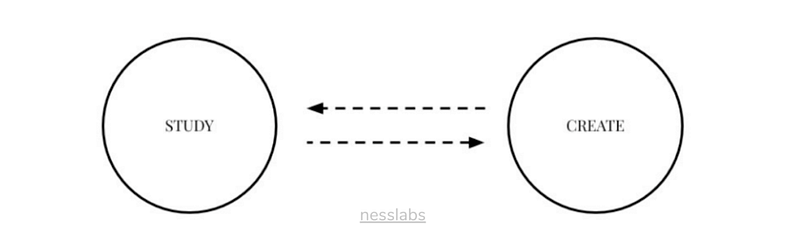
Scientists described it as the phenomenon where information is better remembered if it is actively created from one’s own mind rather than simply read passively.
It is one of the reasons I share what I do.
It’s an extra step in my learning routine that :
- Commit me more with what I do = I learn more,
- Share knowledge open to all = You learn more,
- Attracting like-minded people = Build an audience online.
The downside is that we can feel kind of dumb compared to others. But the humility to say: “I’m ignorant on this…but I’m trying to change that” often resonates with most people. Internet is kind in that case.
6 — Authority Bias
Authority bias is the tendency to attribute greater accuracy to the opinion of an authority figure.
Humans generally comply with authority because it’s the way our society works. The problem is when this one takes precedence over our common sense and ethics.
Stanley Milgram has made experimentation. Three individuals took part in each session of the research:
- Experimenter; the authority figure who claims to be the person experimenting,
- Teacher; a volunteer that is in charge of the session,
- Learner; is an actor who pretended to be a volunteer.
The teacher/experimenter and learner were in an adjacent room where the learner was strapped into what appeared to be an electric chair. He was then given a list of word pairs that he was to teach the learner.
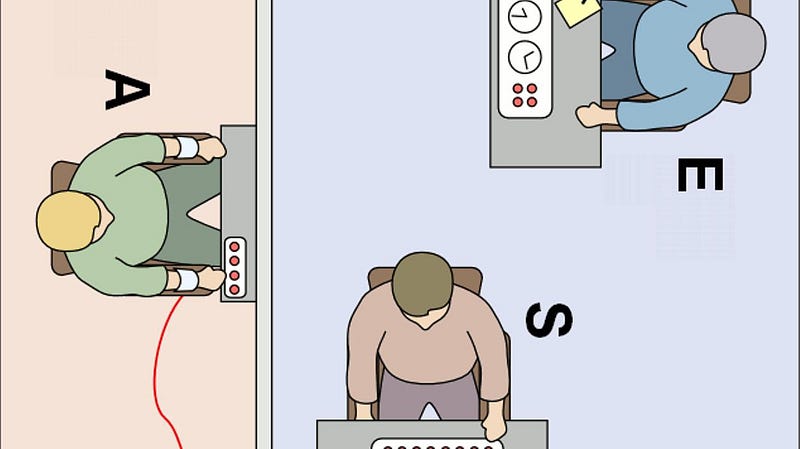
The teacher, next, questions the learner to test his memory on the paired words. If the answer is incorrect, the teacher administers a shock to the learner, with the voltage increasing in 15-volt increments for each wrong answer.
At any time, if the learner indicated a desire to halt the experiment, the experimenter was instructed to give specific verbal prods. These, are to convince the learner to continue.
In the end, 65 percent of experiment participants administered the experiment’s final massive 450-volt shock.
My Why
Authority bias can be dangerous for you. I remember giving my ID card to someone that looks like a security man. I was not sure that he was. It’s ok when it’s an ID card, but if he asked me my bag?
I think it’s paramount to “Understand Our Obedience Bias to Avoid Manipulation”, that’s why I’ve written an entire article about it.
7 — Cognitive Miser
Just as a miser seeks to avoid spending money, the human mind often seeks to avoid spending cognitive effort. Our brains are made to make the slightest effort. For it, apprehending mental objects in their entirety is unimaginable.
No matter how much you think you’re thinking rationally or cautiously most of the time, you make shortcuts. Our brain loves automatic thoughts. And when it has to choose between ease and truth, all too often he chooses ease.
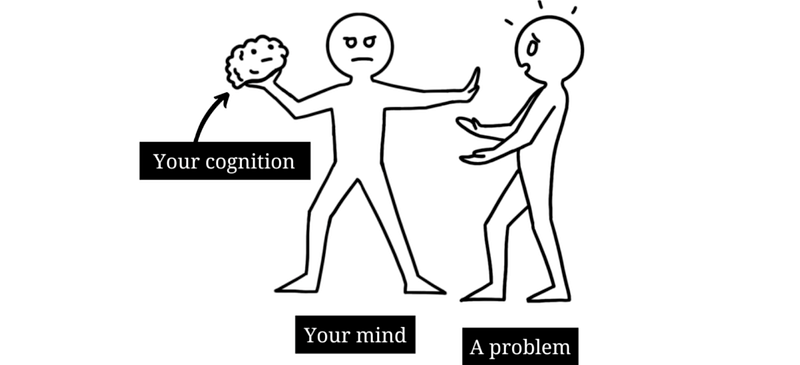
Cognitive misers usually act in two ways:
1. Ignoring part of the information to reduce their own cognitive load,
2. Misuse of certain information to avoid finding other information.
My Why
Success often refers to your ability to make hard choices. Hard choices, easy life. Easy choices, hard life the saying goes. Cognitive miser explains why we won’t reach success. We prefer eating candies all day rather than doing something that matters to us.
8 — Cognitive Dissonance
It is a psychological discomfort arising from having two or more differing attitudes, beliefs, values, or actions. This discomfort is due to the inconsistency between them. It pushes us to find a way to obtain consistency.
The typical example to illustrate a classical cognitive dissonance is smoking :
- Action: I smoke cigarettes.
- Belief: Smoking cigarettes is unhealthy.
We all search for some sense of truth to understand the world. Therefore, we want a clear and consistent picture of it, and so, we make sure that our thoughts are in agreement with our values, beliefs, and actions.
Such inconsistency creates a sort of bug in our own matrix. We feel bad, and we want to feel better.
We then choose among 4 strategies to solve it:
- Change your thought: You could think that smoking is not that unhealthy.
- Change your behavior: You could stop smoking because you acknowledge that smoking is harmful.
- Add a thought to rationalize: If you run every Sunday, you can smoke from time to time.
- Trivialize the inconsistency: You could just tell yourself: “I don’t care”.
My Why
Cognitive dissonance underlines the importance of consistency in humans behaviors. Changing is hard, that’s why people struggle to let go of old ways of thinking. They often prefer to add a thought. The Downside of Consistency is just about that.
9 — Antifragility
Robustness is the ability of a system to resist failure.
Antifragility is the ability of a system to recover from a failure.
It is a concept developed by Professor Nassim Nicholas Taleb in his book, Antifragile, and in technical papers.
“Antifragility is beyond resilience or robustness. The resilient resists shocks and stays the same; the antifragile gets better” — N.N. Taleb
Falling one meter for a solid glass might not break it. But two meters and you’re good at picking up the pieces.
Drop an antifragile glass from one meter. If it does not break, it will get tougher. Same for two meters.
In any anthill, about 10% of ants are doing nothing. They even disturb others. Surprising as it may seem, they are not useless. Because if you take them out, the whole anthill falls. Why is that?
Because they train others to face obstacles. And as Nietzsche wrote :
“What doesn’t kill me makes me stronger.”
My Why
In a world where Covid, wars, corruptions, weather disasters happen and will happen more and more, antifragility goes beyond a concept, it’s something we need to cultivate.


