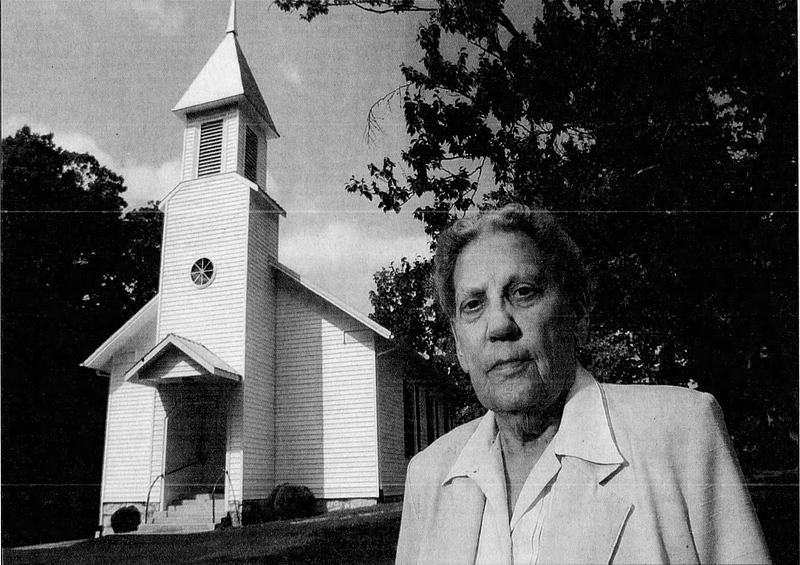
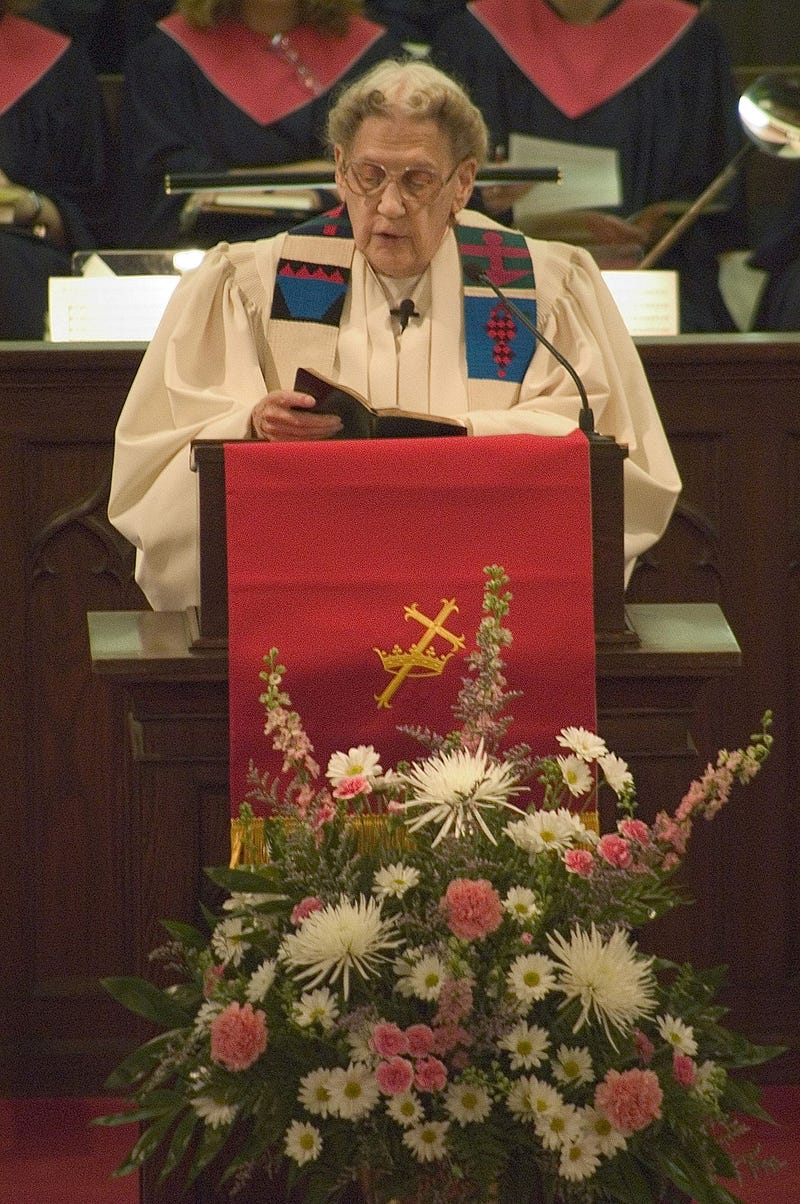
The Southern Baptists ordained a lesbian feminist in 1964
The bizarre story of Addie E. Davis
Christians love the idea of God “calling” men to be church leaders, but even Southern Baptist churches have recognized women as pastors.
The first woman to be ‘ordained’ as a Southern Baptist pastor is considered historic, and often held out as an example of a female pastor. But it turns out Addie E. Davis was keeping secrets.
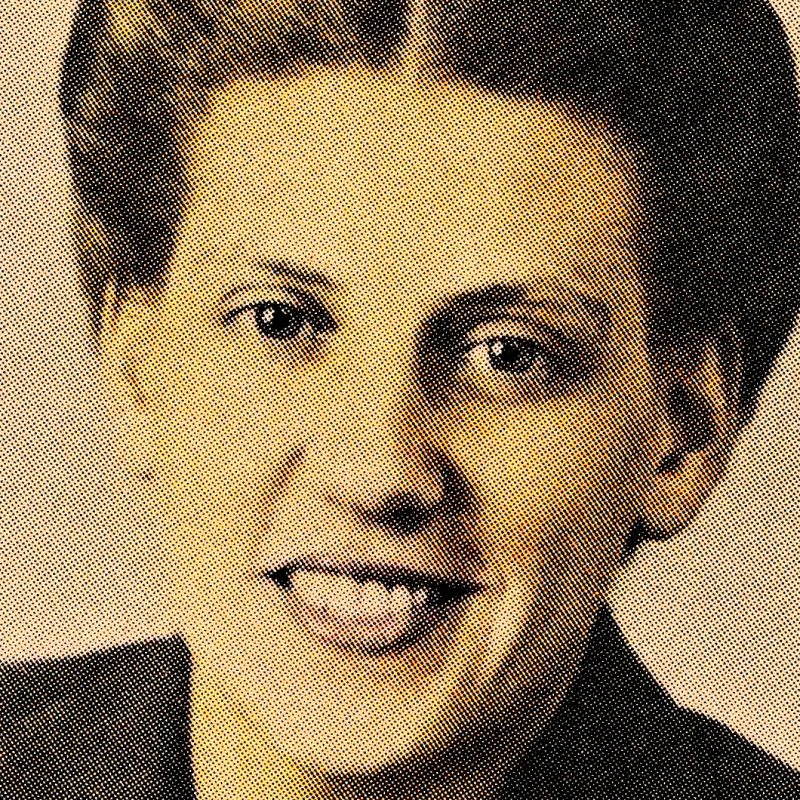
Addie is well-known mostly because of a Baptist historian named Pamela R. Durso.
In the early 2000s, Durso needed a mascot for the issue of female pastors, as in her book Courage and Hope: The Stories of Ten Baptist Women Ministers. Addie seemed like a great one.
She’d certainly told a nice story about her life. Born on June 29, 1917, she grew up in Covington, Virginia. Her parents worked in a paper factory, and they all attended Covington Baptist Church.
Since a girl, she said, she dreamed of being a pastor.
She ended up studying psychology in college.
Then she took a job as education director for a Baptist church, then worked as a dean of women at a Baptist college in West Virginia. She also taught psychology classes. Strange for a Southern Baptist woman?
Addie’s own psychology remains puzzling. She never married. In writings about her, the subject just doesn’t come up. Just once, I find, in a 2004 newspaper profile, she was asked if she’d wanted to marry.
She replied: “I could have married, but looking back, I’m glad I had the time to spend with my people.” That was it.
She felt a call to be a Baptist pastor!
That’s the story she liked to emphasize, but the details puzzle. In 1944, during World War II, she entered Yale Divinity School—a fact she later suppressed. That school is Episcopal.
Her father’s death the same year prompted her to return home to help her mother. Then Addie became critically ill with appendicitis and peritonitis.
As her life hovered in the balance, she recalls, she resolved that “if I was permitted to live, I would do what I’d always felt in my heart I should do, which was to be a preacher.”
She enrolled in a Baptist seminary.
She was now driven to be, specifically, a Southern Baptist pastor. She says the seminary staff knew of this intention, and the president warned her it “would be difficult.”
Addie’s comments and sermons are oddly light on Bible references. She was more interested in feel-good speeches. She made no effort that I see to engage the verses said to prevent female clergy.
Pamela Durso’s early writings on Addie didn’t discuss this, but a 2018 paper assessed an archive of Addie’s papers. Durso found “numerous pamphlets and mimeographed copies of articles” on Christian feminism—by Anglican or Catholic writers.
A different framing is suggested around Addie’s life: not a Southern Baptist woman so much as a Christian feminist of no denominational preference—whose mission had been to infiltrate the Southern Baptist Convention. Facing death, it was a mark she’d resolved to make.
She asked her pastor to ordain her, and he said ‘no’.
In an aggressive move around him, she wrote a letter to the congregation. The pastor headed her off by taking up the matter officially with the board of deacons.
Addie saw she was headed for rejection, and withdrew her application.
“I did not want to be the center of any controversy,” she explained.
That was dishonest. Had her home church ruled against her, other Christians might’ve seen a bad sign. She was playing the game.
She asked local churches to ordain her, and all said no.
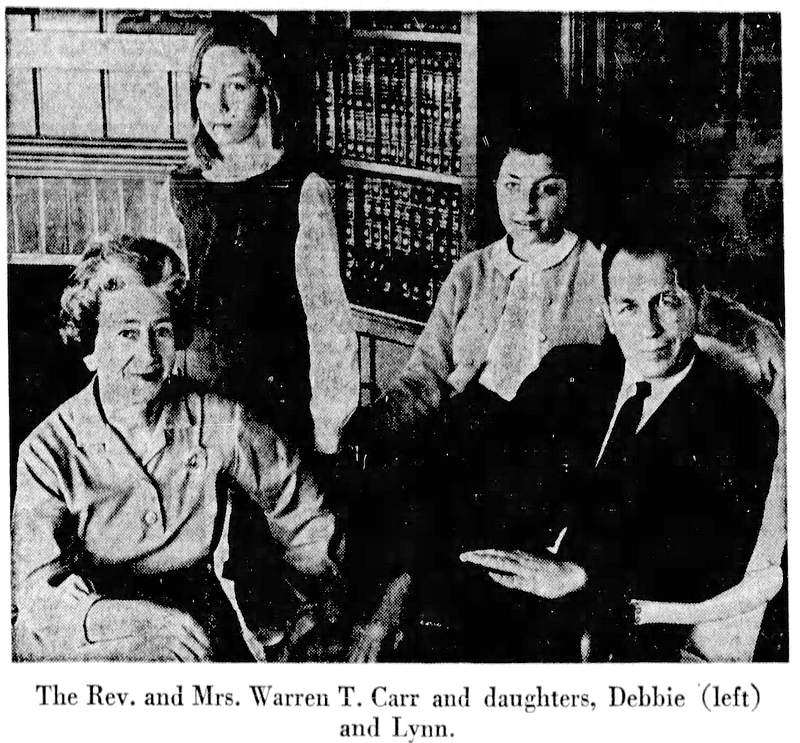
Then she began to focus on Watts Street Baptist Church in Durham. This was a liberal congregation owing to its proximity to nearby Duke University. She’d been socially friendly with the pastor, Warren T. Carr.
He’d recall being taken aback when Addie asked him to ordain her. But the problems with race were much on his mind in the Civil Rights era, and he’d developed a firm belief in Christian equality.
He was working on being a national commentator as a liberal Baptist—a difficult thing to be. But he’d had articles in national Christian magazines, and been discussed in Christianity Today. In 1964, he’d just published his first book—even if it got little notice.
The first ordination of a woman was liable to get attention, and may have had dimensions of a P.R. move for a ‘reformer’ on the ascent.
Warren Carr announced that Addie was ‘called’ to the ministry.
“She belonged in the center pulpit, according to our tradition, to proclaim the gospel on the Lord’s Day,” he said. “She was called to be a preacher.”
She was interviewed by the church alongside another candidate, a student at Duke University who did not believe in the ‘Virgin Birth’. He was rejected. But Addie said she did believe in the Virgin Birth.
Two elders, even so, were against ordaining a woman. But another student at Duke University stepped forward with a resolution.
“Brethren,” the student is recalled saying, “I’m a little confused. You gentlemen have been so concerned that our candidate believe that a virgin bore the Word. Now you are hung up on a virgin preaching the Word?”
If there’s one subject Baptists like, it’s virginity, and this became the goofy grounds for Addie being made a pastor—that she, like Mary, was a virgin.
Another fact tends not to be noted.
When ordaining her, Warren Carr was getting ready to leave Watts Street Baptist. Only days later, he went to work at Wake Forest Baptist Church in nearby Winston-Salem.
Maybe the ordination was the church’s personal gift to him—the pastor who seemed like he’d become a national figure. Or maybe the church just assumed Carr himself would get any blowback.
After the ordination, Carr recalled getting a pile of harsh letters, saying he ought to be defrocked, etc. He also recalled many women contacting him asking if he’d ordain them, “as if we were running some sort of ordination mill,” he laughed.
He turned them all down. It just wasn’t his issue, he decided. The women around him, he’ll note, viewed him as a ‘chauvinist’, and he thought of feminism as “nonsense.”
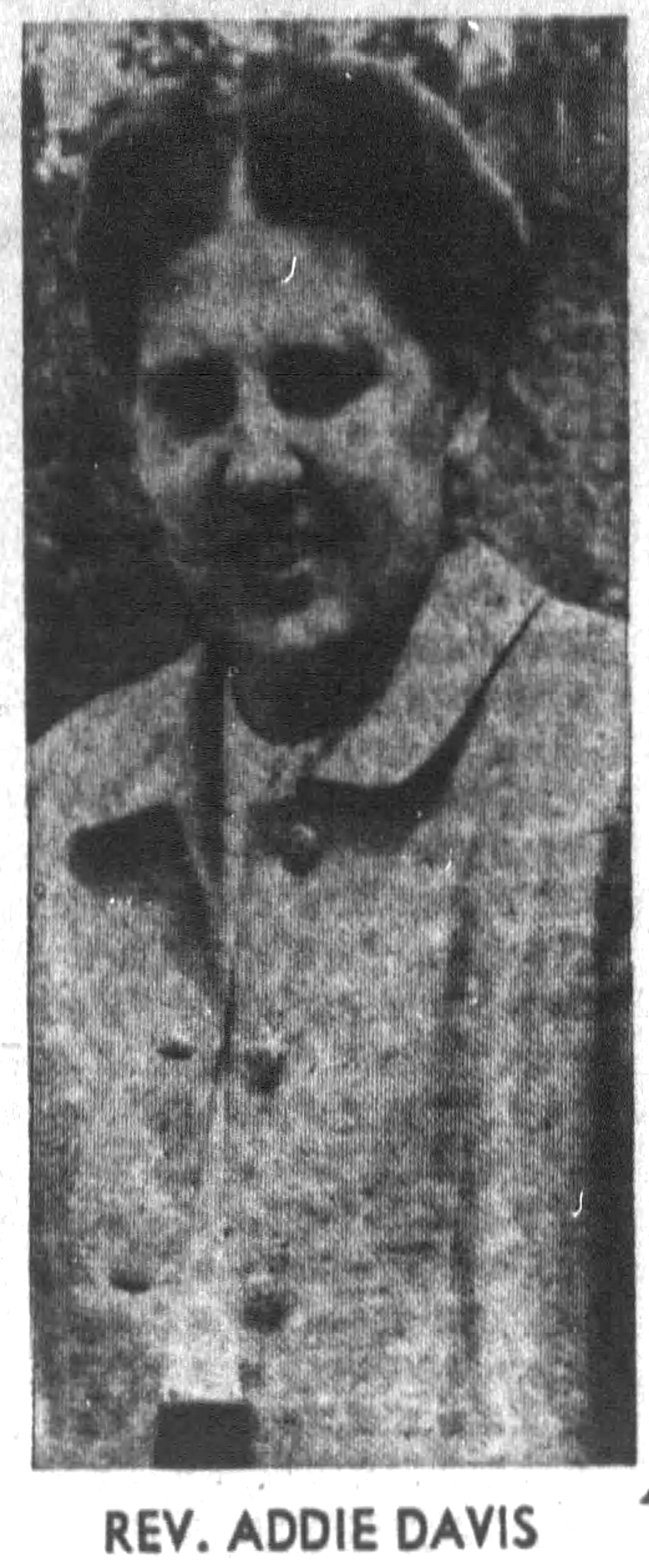
Addie got letters from all over the country.
“Renounce your ordination,” one man demanded. Another letter, she recalled, addressed her as “a child of the devil.” She never answered them.
She asked around, throughout North Carolina and Virginia, but even churches that had no pastor had no interest. She recalled: “They would rather have nobody than a qualified woman.”
She thought of becoming a Methodist, but a friend told her of an American Baptist church in Vermont looking for a pastor. That denomination was fine with women pastors.
Then in general, Vermont is very liberal and very lesbian.
The SBC never officially censured anyone.
But Warren Carr was never again prominent in Southern Baptist circles. The religion was done with him.
Just before his retirement in 1985, he reflected on his reputation as a Southern Baptist “troublemaker.” I have a feeling he thought he was capable of more.
He never wrote of the experience with Addie. He was asked about her in a 1985 oral history interview. He noted that Southern Baptist pastors often support reforms, but won’t defy their congregations.
In contrast, when he thinks of a good idea, he says to himself, “Well, that’s what we’re gonna do.”
“I’m a kind of sneaky guy,” he adds, and laughs.
But did Carr get hostile to her over the next years?
In 1994, a news report of a service held at Watts Street Baptist to celebrate the 30th anniversary of her ordination featured the two of them on a panel discussion, and included an odd moment.
Carr criticized the ordained women, saying they “talk only with themselves,” and suggested it was “the beginning of a cult…”
A female panelist tartly replied that “men have been in a cult for quite a few years.” Addie seems to have kept quiet.
It seems that Carr publicly said that Addie then did not read to him as even Christian. And a female-only energy around her deeply provoked him.
Warren Carr lived to see both his churches leave the SBC.
Watts Street Baptist left in 1989, and Wake Forest Baptist Church left in 2000—after it agreed to host a lesbian wedding. Carr died in 2007, when it’d have become clear the historic church had signed its death sentence. The church dissolved in 2022.
The reality is that people go to Southern Baptist churches for a blast of male personality and anti-LGBT theology. To be “called” as a pastor mostly just means you want to be the alpha dog of the pack.
Addie thought she could work her way in—to find she couldn’t. The Southern Baptists really do want a rude, obnoxious man.
She ended her career in a non-denominational church. 🔶