
Things we don’t think about
A Window to an Industry You Probably Know Nothing About
What Is Building Automation?
There are so many systems in our daily lives we don’t think about regularly, and even more in which we place our complete trust. We place our lives in the hands of an immeasurable number of strangers every single day.
Not to spur paranoia, but we get in vehicles and drive on roads with other machines and people and untold variables. We get on planes built by thousands of machines and robots and people that are regularly serviced and inspected by thousands more.
A pilot or two get in the driver’s seat and are directed by a bunch of people and drive a flying bus through the sky at hundreds of miles per hour. And they, too, put their trust in untold numbers of people and systems.
We could go on and on with this thought exercise, and you can go in almost any direction. It’s intimidating, but it is an example of how far collaboration can take us.
(Quick aside: Have you ever read the short story “I, Pencil” by Leonard Read? You can find it here for free. It’s a story from the perspective of a seemingly simple pencil who is out to prove that a pencil is not as simple as it seems. It’s a fascinating thought exercise worth a few minutes of your time. Do you know how to make a pencil? I don’t. Don’t get smart with me.)
Have you ever stopped to think about how your heating and cooling works on a large scale? I don’t mean your house, I mean your office. Your building. Your school, or your hospital. There are complicated systems in place to make it all work together in the most efficient manner possible.
In the heating, cooling, and ventilation world, we’re a bit of an unsung hero. The mechanical equipment does the magical work, but in an increasingly more technical world, we’re being forced to evolve.
Modern schools, hospitals, and buildings aren’t only worried about keeping us warm anymore. These days, especially since COVID-19, we’re more aware than ever about Indoor Air Quality (IAQ), air changes per hour, CO2, etc.
Medical facilities specifically are exceptionally complicated. Operating rooms must have the correct pressure and air conditions to perform surgeries on you safely. There are also plenty of rooms kept at specific pressures to keep pathogens and other contaminants where we want them to be.
Covid/tuberculosis rooms, for example, are always kept at a negative pressure and exhausted into the atmosphere. In other words, more air must be exhausted the room than enters it. Blow the contaminants outside where they’ll be diluted and essentially eliminated.
A friend in the industry likes to say, “The solution to pollution is dilution.”
So exciting!
I’ll give you an example of a typical system.
Many modern buildings have what we call a central plant. Many times it’s where large chillers or boilers cool or heat water/glycol by way of mechanical cooling/heating. That water is then pumped from the plant to the equipment that needs it via pumps driven by variable frequency drives. In this case, the water is piped and valved to large air handling units with large fans that use the water to heat and cool the air.
Downstream of that air are boxes (known as variable air volume boxes or VAVs), usually in the ceiling of every room that vary the amount (measured in cubic feet per minute), and temperature of the air to keep the room satisfied. They are paired with piping from treated water systems that can further adapt the temperature to keep your room comfortable and healthy.
Large gathering places like arenas and stadiums have immense and powerful equipment to control all parts of air conditioning, including complex CO2 or smoke control sequences.
One sequence I set up years ago included smoke dampers that would open and close on certain floors, “pancaking” the smoke to a certain area, to be subsequently evacuated by huge exhaust fans. It was impressive to see it in action.
Schools are a little simpler, with each room having a unit ventilator to control those large rectangular fan-type boxes along the windows. Inside them are valves and dampers to control water and airflow, bring in outside air, etc., to keep your little kiddos comfy.
With each one of these pieces of equipment, electronic controllers contain programming, algorithms, sensors, valves, and other inputs and outputs set to measure and control all these variables.
This also means that each one of these controllers needs power, water, and communication to monitor and/or control them. Each one is typically wired back through a network to a central piece of software in a computer somewhere, which presents the data via a nice, pretty graphical interface that the facility engineers can run.
They communicate to a central command center for the entire building that can control most major mechanical systems in the building, from elevators to lighting to heating and cooling to access control and security camera integration.
And it doesn’t even have to be onsite. It can be anywhere in the world.
Had enough? Sorry, we’re not quite done yet.
Before these systems ever come online, there are folks like me working with engineers and contractors to create the drawings and plans for them to use to install this equipment.
Project engineers take all the information and compile it. We ask questions and pick the equipment necessary to accomplish the mission. We write complicated sequences of operation for the equipment so the field and software teams know how to set the equipment up. We are tasked with putting together the package the field teams will use as their guide to putting all the pieces of this massive puzzle together.
Here’s a quick example of a drawing for a single room in a single elementary school:
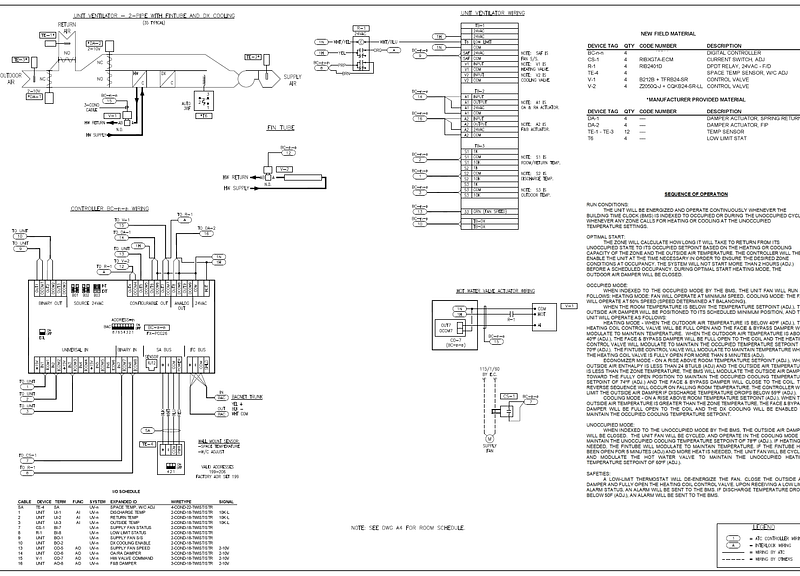
A single room!
It’s pretty wild to think that every room in every building has this kind of setup.
Dozens of contractors from different trades are involved in the installation. Electricians, pipe fitters, insulators, painters, etc. all play a role. Each controller must be programmed and configured to control the equipment and communicate via proper protocols to the front end and other equipment.
Forgive me for geeking out on this for a bit, but I do think it’s truly fascinating.
Some think things would be better if we went back to simple on/off switches on the wall. But those are the days of the dinosaurs when efficiency and energy savings weren’t important or even considered. Today we need to work with these systems to save as much energy as possible while still getting the job done.
Yesterday was Bring Your Kids To Work Day in the US. Before now I had never had a job that made sense to bring my kids to, mostly because I was a nomad. I had technical field jobs where I was at different places all the time with different customers, and never felt it appropriate to take my kids to a mechanical room in the bowels of a hospital. Safety first.
While the kids were in the office, the owner of my company, who has a 5yo himself, sat with the kids. He asked, “Guys, do you know what your parents do for a living here?”
Crickets. But they’re kids, so how could they know, right?
Except that, in this case, I realized I’ve been in this business for almost 15 years and I still have a hard time describing what my industry is or what we do every day. I think it’s worth explaining how some of these elements come together.
As always, there’s more than meets the eye.
Here are a couple others you may enjoy.