
A Tale of Two Spices
The fallacy behind Ancient Science claims
Tropical climates characterized by high heat and high humidity are more conducive to the growth of microbial life, including dangerous pathogens. People living in such climates need an extra boost of bacteria-inhibiting agents to stay healthy. This is where spices come in. Spices contain phytochemicals that plants evolved to protect themselves against insects and bacteria.
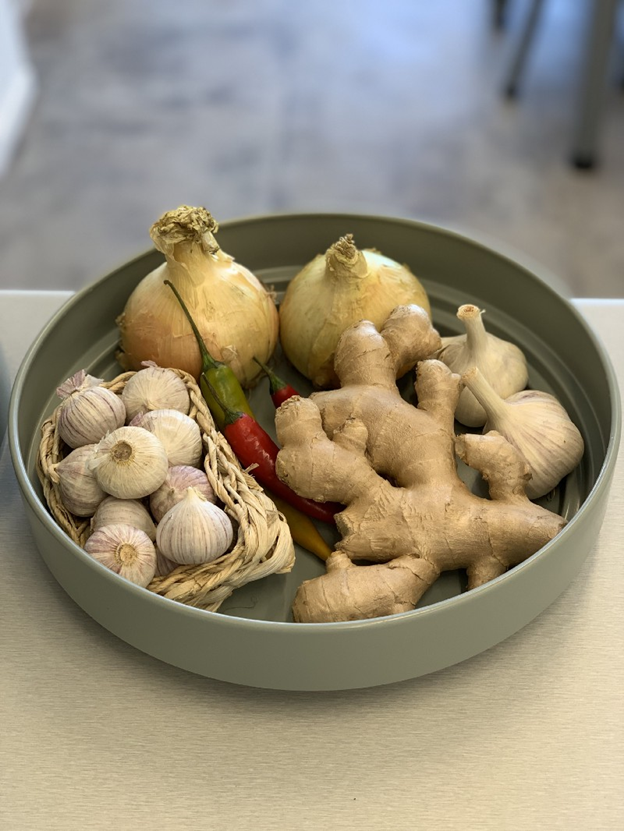
Recent studies have shown that spices and herbs have a very strong inhibiting effect on disease-causing bacteria, some to the extent of 100%! The two most effective anti-microbial agents are the humble onion and garlic, the defining elements in any “Indian Curry”.
This is where the Ancient Science claims will slip in. Our wise forefathers must have known about the specific health benefits of spices centuries before modern science “rediscovered” them. They decided to pass this knowledge down to future generations in the form of recipes that we now call “traditional” recipes. That is how these spices, with all their natural goodness, came to be a regular feature in our diets. Eureka.
Evolutionary Gastronomy
The high spice content of tropical diets had puzzled scientists for a long time. Certainly spices don’t contain much in the way of calories or proteins or even vitamins. They do contain minerals and antioxidants, but that doesn’t explain why people living in the tropics would need to consume more spices than people living in colder, drier climates.
You could argue that cuisine is an aspect of our culture. We use an assortment of spices and we use them in large amounts because that’s what makes food tasty for us. Of course, that only begs the question of how we came to develop such tastes in the first place. In other words, we are looking not for a proximate cause but for an ultimate cause. I am quite certain that there are no human cultures anywhere that are repulsed by sugar and honey or attracted to feces and vomit². Obviously there are some systematic factors at work and one possibility is that our tastes are adaptive — we evolved specific tastes because of the survival advantage they provide. So is there an explanation for the overabundant use of spice in tropical cuisines that does not invoke Ancient Science?
Maybe there is.
The Alternative Hypothesis
Imagine a population that has exactly two kinds of individuals — those who love the taste of onion and those who despise it. Assume that this preference is heritable i.e. if you love onions your children will also. Let’s also assume that people prefer to marry someone who shares their affinity/aversion towards onions (imagine the fights at the dining table otherwise). Finally, assume that this population lives in a tropical region, say India. Based on the fact that the climate is conducive for harmful pathogens and eating onion inhibits these pathogens, we should expect the individuals who consume a lot of onion to be healthier on average. That means, ceteris paribus more of their children and grandchildren, make it into adulthood. It’s easy to see how, over many generations, the preference for onions can spread through the population and become a ubiquitous trait. That, in a nutshell, is Natural Selection.
Despite the deliberate oversimplification, this is not as implausible as it sounds. Before the advent of modern medicine, life expectancy was much lower and infant mortality much higher than today. If you happened to get infected by bacteria, there were no antibiotics to save you. Diet would have played a much greater role in staying healthy. As it happens, the inhibitory effects of onion and garlic are on E. Coli, Salmonella, and Staphylococcus which cause most of the common stomach and skin infections. Our hypothesis also neatly explains why within India, cuisines of colder, drier regions (e.g. traditional Kashmiri recipes) tend to use fewer spices and in lower amounts.
But the crux of the argument is this — the folks eating a lot of onions versus no onions weren’t doing it because they were aware of its anti-microbial effects but simply because they were genetically predisposed to find onions tasty. Over time, this can give rise to a society in which everyone loves the taste of onions but no one has any clue why. Here’s an analogy: does the fact that most ancient societies had strict rules prohibiting marriage between siblings and close cousins imply that knowledge of genetics (harmful recessive genes etc.) was present in them? Obviously not!
‘Ancient Science’ is an oxymoron
Based on our little fable, we have a far more parsimonious explanation for the fact that tropical societies tend to consume more spices. Our ancestors could have been completely oblivious to the existence of germs, but their food preferences would have evolved in the “right direction” regardless.
Most Ancient Science claims tend to attribute far more knowledge to our forefathers than is necessary or even reasonable. It is possible, over many generations, to discover natural remedies for some ailments by a process of trial and error without actually knowing why they work. In fact, trial and error is very much a part of scientific research with several major discoveries having been lucky accidents. But it is delusional to believe that the mechanisms described in systems of traditional medicine (like doshas and chakras)⁴ are somehow compatible with a modern understanding of the human body.
More generally, Ancient Science claims tend to have a few things in common;
- Many of them are based on extremely liberal extrapolation of cryptic verses pulled out of scriptures, when the “target” fact is already known thanks to modern science³
- They don’t account for prerequisite knowledge and technology without which it would have been all but impossible to gain the knowledge claimed. For instance, the germ theory of disease could not become generally accepted until after the invention of the microscope.
- They are always invoked in support of traditional practices but never in opposition to them. If science says that fasting has no clear health benefits, then science is yet to find out the benefits.
As long as pseudoscience remains enmeshed with our group identities (family, community, nation…) we will continue to have trouble thinking straight about such claims. Distance Brings Clarity.
Notes
¹ Some of the facts cited are from Darwinian Gastronomy: Why We Use Spices by Paul W. Sherman and Jennifer Billing published in BioScience, June 1999
² Just because humans find feces repulsive doesn’t mean there aren’t species adapted to eating it. Examples include dung beetles, rabbits, chimpanzees, and dogs.
³ For example, there is a claim about speed of light in the Rigveda. A detailed critique by Raziman T.V. is available as a Quora answer.
⁴ These concepts are themselves based on the hopelessly outdated idea of five classical elements