
3 Ideas Whose Time Is Past
So why are they still around?
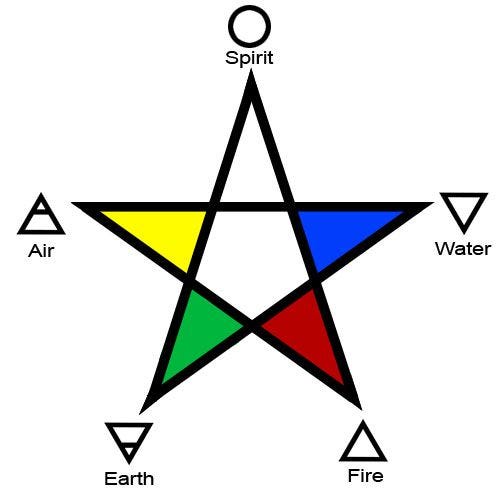
#1: The Classical Elements
Isaac Newton, the father of modern physics, was also a dabbler in alchemy who spent his last years trying to create gold by melting together cheap metals. In hindsight we could say it was a futile exercise because gold is an element. Nevertheless, these carefully documented early explorations are considered to be the precursors of modern chemistry, much as astrology was the forerunner of astronomy.
Before the 100-odd elements of the periodic table were discovered, all matter was believed to be composed of the five classical elements Earth, Water, Wind, Fire and Ether. Until fairly recently¹ this idea was prevalent in almost all major civilizations including India, Persia, Greece, and in a modified form, China.
Modern science does not support the notion of matter being composed of five elements. Despite this, several traditional systems of medicine that are based on this belief remain popular today. For example, Ayurveda is based on the principle of the five elements Prithvi, Jal, Tejas, Vayu and Akasa which are believed to combine into three doshas or constitutional types.
So we are now faced with two conflicting beliefs — the modern view where matter is composed of the 100-odd elements of the periodic table, versus the ancient belief that matter is composed of the 5 elements.
How do we reconcile the two? The short answer is we cannot. Instead you will find that the five elements are now claimed to be a “symbol” of this or a “metaphor” of that², and this creates enough confusion to allow all manner of pseudoscience to coexist with modern empirical science.

#2: Vitalism or ‘elan vital’
What exactly is the difference between a living being and an inanimate object? Knowing nothing of modern biology or biochemistry, people in ancient times did the best they could — they came up with the idea of a “vital force” or “life force”, a thing or substance that animates all living things. The Western idea of elan vital is mirrored in the ancient Indian concept of prana and the ancient Chinese chi, proof of the enduring intuitive appeal of this idea through the ages.
We now know that there is no qualitative difference between the chemical reactions that occur in living versus non-living systems. In fact, many biochemical reactions can be reproduced in the lab. Vitalism, the belief in a “life force” which supposedly differentiates living from non-living matter, died gradually after Friedrich Wohler’s experiment in the 19th Century.
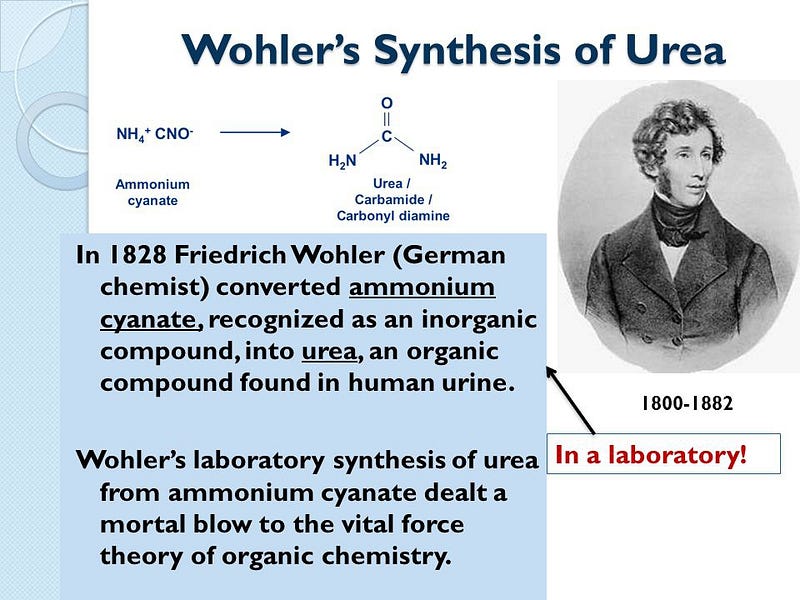
But unfortunately, the systems of ancient medicine founded on Vitalism, such as Ayurveda and Chinese Traditional Medicine (which includes Acupuncture) continue to thrive in modern times.
#3: Disembodied Minds

The notion of a soul or spirit may have been postulated to explain the difference between a living person and a dead body in terms of a thing or substance that “leaves” the body. We now understand these differences far better in terms of biological processes that maintain a state of homeostasis.
The concept of a soul or spirit is present in every human society. There is a shloka in the Bhagavad Gita (vāsānsi jīrṇāni yathā vihāya) which states that as a person sheds worn-out garments and wears new ones, at the time of death the soul sheds its worn-out body and enters a new one.
The concept of soul is tied to what is known in Western philosophy as Cartesian Dualism: the duality of mind and matter expressed by Rene Descartes in his statement “I think therefore I am”. The idea of minds unattached to physical things like bodies, is not supported by evidence.
In fact, if there is anything that minds are for it is to process sensory data from the environment and generate predictions useful for the survival of the body. This is supported by the observation that absolute sensory deprivation (like solitary confinement in a quiet, dark room) tends to produce dysfunctional minds with symptoms like hallucination and paranoia.
But having said that, the thought of minds free of bodies is not only intuitive but also appealing. It allows us to believe in reincarnation and afterlife, which are morally reassuring. Rather than accepting that many bad deeds go unpunished and many good deeds unrewarded, you get to believe that all accounts are neatly squared off in subsequent lives.
Growing Up In The Universe
All three ideas that are the subject of this critique have something in common — they make the universe appear simple and intuitive. Science, in contrast, has a habit of making everything seem hellishly complex and counter-intuitive. It’s something we just have to get used to. As Neil deGrasse Tyson puts it, “the Universe is under no obligation to make sense to you”.
Notes
¹ Antoine Lavoisier in the late 18th Century is largely credited as being the “father of modern chemistry”. He was guillotined during the French Revolution on charges of fraud.
² For instance, earth, water, wind and fire are sometimes claimed to represent the states of matter solid, liquid, gas and plasma respectively
³ We do have plenty of fossils that represent intermediates between modern and ancestral species. But we certainly do not expect to find intermediates between any two modern species. The “crocoduck” is a parody of this idea.