
Music and the March of Technology
A Strong Opinion, Loosely Held: The Case for a Triumphant Return to Vinyl
There are many ways to listen to music. And that’s a good thing.
I’ve been writing a series called “You Need to Listen to This Song” for just over a year now.
It doesn’t get the same amount of traffic as my non-music articles, but if I have a niche that I most enjoy, that’s it. At the bottom of each article, in an appeal to readers to subscribe to Medium through me, I usually say something like “I’m going to buy this record. Just as soon as I get a record player.”
Well, yesterday, I did get a record player. And at the bottom of the latest edition, #40, in the same place, I changed it to “and now I have a record player.”
It was just a small adjustment, but it was spotted by two eagle-eyed readers, Natasha MH and Bill B, who took the opportunity to comment on how this acquisition would change my life. Or at least change the way I listen to music. Or at least add a new dimension to an already tight living space.
So far, so true on all accounts.
Bill put it into words better than I ever could in his comments, “The joy of rebuying many of my sold albums was a lot of fun. Adding in new music on vinyl rounded out the experience. Ah, to hold the album art and lyric sheets with both hands. The tangible act of caring for these as if they were babies, and cleaning them before each play was a treasured ritual. I had forgotten how much it added to the experience of listening.”
Like many things, we have been sold the illusion of convenience when it comes to music. But I wonder who’s convenience it is actually for? The consumer? The artist? The record companies? The tech companies that constantly change the way music is delivered to us?
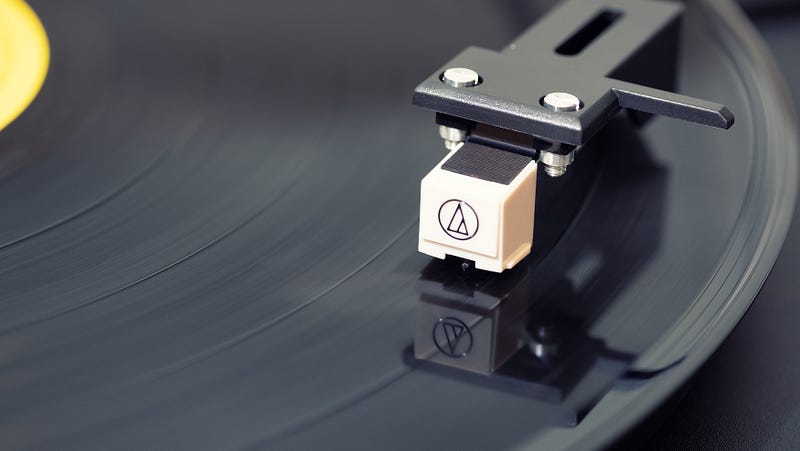
The equipment that I got yesterday is pretty basic; it didn’t cost me anything and didn’t require any additional speakers. Actually, it’s one of those little portable numbers that come in a suitcase and can fit in a very small space.
Which is good because that’s what I have.
Is it top-of-the-line? No, and I don’t need it to be. But it fills my place with a warm, crackling sound that I haven’t heard in a long time. I’ll graduate from it eventually when the space I inhabit gets bigger, and I really want to hear the nuances of the recording — the lows of the bass and the crisp highs of the crash cymbal and everything in between — but for now, it’ll do just fine.
I still have about ten records I’ve been dragging around for years. I always wondered why I did that, and now I know. Yesterday, I put on the first one I ever bought — “Synchronicity,” the last album by the Police from 1983 — and just let it play. It had not a scratch on it, and I knew all the words and which song came next.
The whole process and the end result is so much more satisfying, and the opposite of how music has been pushed at us since probably the advent of the cassette tape in the 80s. I didn’t have touch-of-a-button access to jump ahead when I got tired of a song that was coming to me through a Bluetooth speaker.
I just let it play.
Granted, putting a needle into the grooves of a spinning wax disc to produce sound was also a leap forward and forever changed the way music was produced and consumed. Were there people that decried it at the time as the death of music when it became widely available? Probably.
But I don’t wish it would have stayed that way forever. I have gone from LPs to cassettes to CDs in my music-buying lifetime. I could tell you what albums constituted my first purchase of each. I can’t do the same for the first song I downloaded for free from Limewire, paid for on iTunes, or paid a monthly subscription to listen to on Spotify. I was not opposed to any of these technologies when they came my way, and I have adapted to them as much as the next guy.
However, newer is clearly not better, and I get the feeling that music technology has not necessarily been produced and evolved with the listener in mind, but rather the producer.
And by producer, I’m not talking about the artist. Things are designed to get more clicks in an attempt to answer the question, “How do we make it easier to sell more, and how can we use new technology to drive profit?”
I think my small decision to return to vinyl is partly a reaction against this, much like trying to make my own granola instead of buying it in the store, like reading physical books and not e-readers, like going to movie theatres and getting rid of Netflix. I think every time we are made to leap forward, we leave some things behind. Maybe some aren’t worth saving. But certainly, some are.
Despite their years-long predicted demise, record shops, bookstores, and movie theatres are still around. In many cases, they continue to form the foundations of the community feel of many parts of town. People still want something that all the automation and relentless march of technology just cannot give them.
I know I am not the first person to have this epiphany, and it’s not like I discovered the cure for cancer here.
I just want to slow down and reacquaint myself with something we’ve been told we no longer need. Technology constantly pushes forward and insists its way into our lives. They say that’s progress. Maybe so.
But for every song I can listen to on Spotify, for every movie I can watch on Netflix, for every ChatGPT-produced article I can read, for every dating app that can allow for an incredible laziness to seep in, for every delivery app that can bring food to me so that I don’t have to go and get it, much less make it myself, something gets lost.
My own little pushback, the acquisition of an old — and yet still relatively new in the grand scheme of things — way to listen to music is how I will deal with this notion of progress and the increasing speed with which we are required to digest it.
And with that, the secondary joy of having a record player ensues: Now the collecting can start. Again.


