
Music
You Need to Listen to This Song Right Now #40
Heavy Rotation — Shoot Speed Kill Light, Primal Scream (XTRMNTR, 2000)
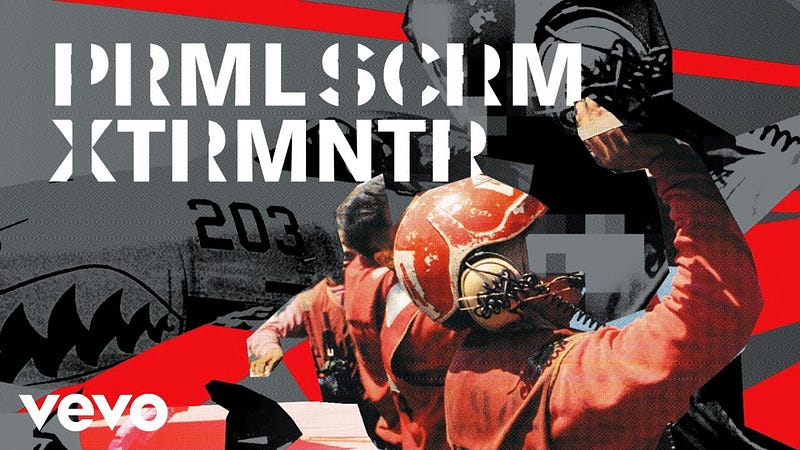
Heavy Rotation was a music industry term for songs that, one way or another got incessant airplay. It referred to the large amount of rotations that a particular record was given on turntables at radio stations. Since, until the 1980s, this was the only way to get new music into the ears and brains of listeners, heavy rotation meant increased sales. These were good for record companies and artists alike.
Today, some of us still put records on at home and give them a spin. Most of us don’t. However, the term still applies, just in a different way. Streaming services like Spotify sell subscriptions to listeners and then pay artists based on listens. At least, that’s the way we think it works.
For me, heavy rotation means a song that is in my head for some reason. Maybe for a moment, maybe for a day, maybe for longer. It’s a song you come back to occasionally and still feels just as good.
This series of articles is dedicated to these songs.
Here, I aim to highlight a particular song by a particular band or singer. We should know a bit about the band, a bit about where the song fits into its history, and where the song fits into what was happening in music at that time. Then there’s the song itself. Who’s playing on it, what are the lyrics getting at, and why is it so good? How does it still occupy sonic space in our lives?
I’ll (try to) keep it short. It shouldn’t take you any longer to read this than the song itself. To that end, I’ll put a Youtube clip of the original recording at the top of the article so you can listen as you read. Or not. And because a song is often much different live than in the recording studio, I’ll stick a live clip on at the end.
What song is in your head right now? Here’s the one that won’t leave mine today:
#40 — Shoot Speed Kill Light, Primal Scream (XTRMNTR, 2000)
If you have spent any time with Primal Scream, you know to be ready for just about anything with each passing album.
They’ve made eleven of them since 1987, and all are different. Rock and roll, jazz, funk, electronic, soul, house, country — there is a bit, and a lot each spread over their recorded output over the past thirty-plus years.
Their biggest album is arguably 1991’s “Screamadelica,” their third. Heavily influenced by house music and the LSD / MDMA drug scene that went with it in the early nineties, it produced mind-blowing bangers such as “Slip Inside This House,” “Loaded,” “Movin’ on Up,” and “Come Together,” all in the name of not fighting it, rather feeling it, as the Britpop Explosion gathered steam.
If grunge, U2, Guns n’Roses, Metallica, and Red Hot Chili Peppers weren’t your vibe in those years, it was this one, along with Massive Attack's “Blue Lines,” that was taking your ears in a different direction.
That album was followed by “Give Out But Don’t Give Up” in 1994, which featured their greasiest possible Rolling Stones impression with “Rocks” and then the more subdued “Vanishing Point” in 1997.
With “XTRMNTR” in 2000, things go in a deliciously new and strange direction. “Swastika Eyes” is a frantic disco dancefloor pounder that encapsulates the pre-millennium tension of the times.
But it’s the last track of that album where my attention is hypnotized today. This song, Shoot Speed Kill Light, is probably the most Jesus and Mary Chain-sounding song that the Scream has ever done. This makes sense since frontman Bobby Gillespie spent parts of the 80s on drums with the seminal Glaswegian outfit.
This one comes through the door bouncing, and the bass drum and snare insist their way in at 00:06; we are heading for the moon. The staccato repeated guitar chord by Andrew Innes follows right behind, along with a high-pitched and futuristic swirling Hammond organ, courtesy of Martin Duffy.
At 00:46, the bass of Gary “Mani” Mounfield comes in to play a seven-note melody that repeats throughout the song. Mani, it’ll be recalled, was also in the Stone Roses before they fell apart for the second time in the mid-90s.
All is fuzz, distortion pedals, and over-amped bass, and everything sounds like it is being played through a megaphone. It is a wonderful chaos, and from 1:27 to 1:58, Gillespie adds his voice to the fray, singing the only four words he’d sing in this song, backed by a joyous la-la-la wailing.
It feels like we are heading to the future together. Or at least chasing the setting sun to the horizon. Crunchy, grinding, pounding, swirling, pulsating, pure rock and roll. The feeling of being surrounded by frantic but hopeful noise when you put the headphones on. You can envision the state of the crowd when this one comes on during a live show. I was part of it at the Corona Capital Festival in Mexico City in November 2015, and I unequivocally state that it was one of my life's best live music moments, these 5 minutes.
Bobby Gillespie shambled around in his bell-bottomed trousers and Chelsea boots, eyes barely open as the crowd heaved ecstatically beneath him. He didn’t have much else to do, this song being virtually vocal-free. And yet, everything was centered on him. Back he comes at 3:06, megaphone in hand, low bass pushing us forward…to the end.
Eyes closed, head nodding emphatically, grateful to the glory of being alive that is affirmed by the fortune of living at the same time that this music was made.
Here they are, live in 2006 at the height of their powers.
If you have made it this far, it will occur to you that if this is #40 in this series, then there must be 39 previous ones. This is a correct assumption, and here I will link #39. At the bottom of it, you will find a link to #38, and at the bottom of that, you can — if you so choose — be taken to #37. This ingenious system that I thought up all by myself continues all the way to #1.


