
Nature, Photography
A Starling Sighting on Horseshoe Loop
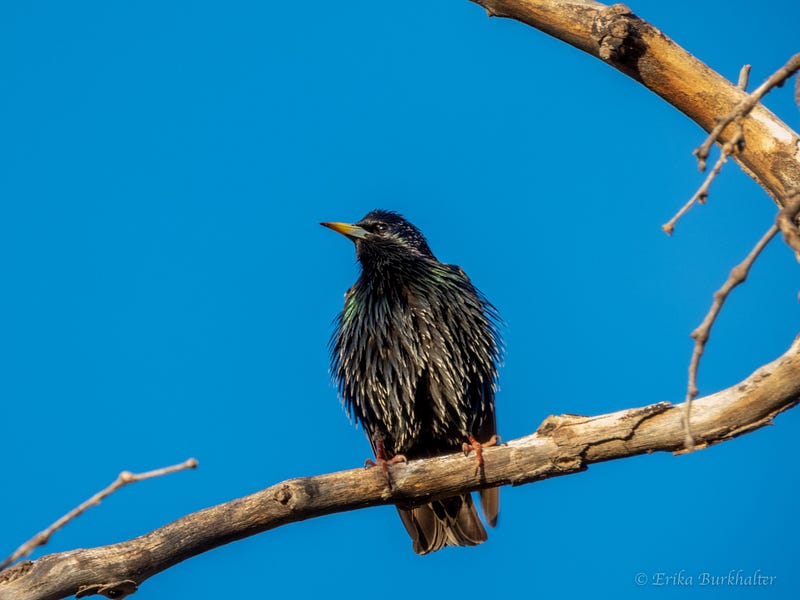
Zooming in on Starlings with my Nikon COOLPIX P1000. What an intriguing little bird!
If you’ve been reading my hawk tales of late, you’ll know that I’ve been following “Andromeda, Alonso” and “Elena” while on my mountain bike rides through the hills of Southern California and in my own backyard.
I’ve always loved nature photography (and birds in particular), but I’ve never wanted to bring one of my nice cameras out on the trail with me, for fear of crashing my bike (which happens with some frequency) and crushing the expensive equipment. But I’ve been so curious about what the various birds I was seeing were doing, and what, exactly, types of birds they are.
So, I recently bought a Nikon COOLPIX P1000, which has a megazoom. It’s not sooooo expensive that if I land on a rock and kill it, I would be crushed. And it has a lot of really cool features. Namely, it can zoom. It has a 125x optical zoom (24–3000mm full-frame equivalent).
And, while some of the photos have been sharp as a tack, others, taken while birds are grooming or about to fly have not been quite as sharp as I’d like. But, nonetheless, a whole new world, which I wasn’t able to see before, has opened up in front of me.
I’ve seen my neighborhood crows courting for the last couple of weeks. It’s not quite time for nest building, but last year I watched them gathering twigs and frantically carrying them to the top of the pine tree a couple of houses over. Right now they are squawking to each other with urgency and flying side by side through the wild blue yonder.
So, when I saw some small black birds perched in a tree near the riparian corridor next to Horseshoe Loop, where I ride most days, I was sure they were baby crows.
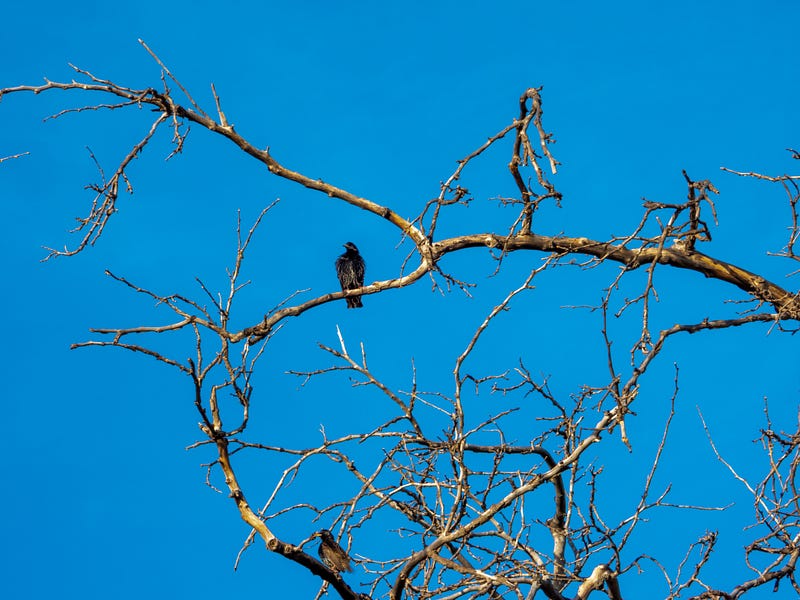
I hopped off of my bike and tried to zoom in. But these birds were busy, busy, busy. They were chatting and grooming and would not sit still long enough to pose for a photo.
I got a lot of photos like this one:
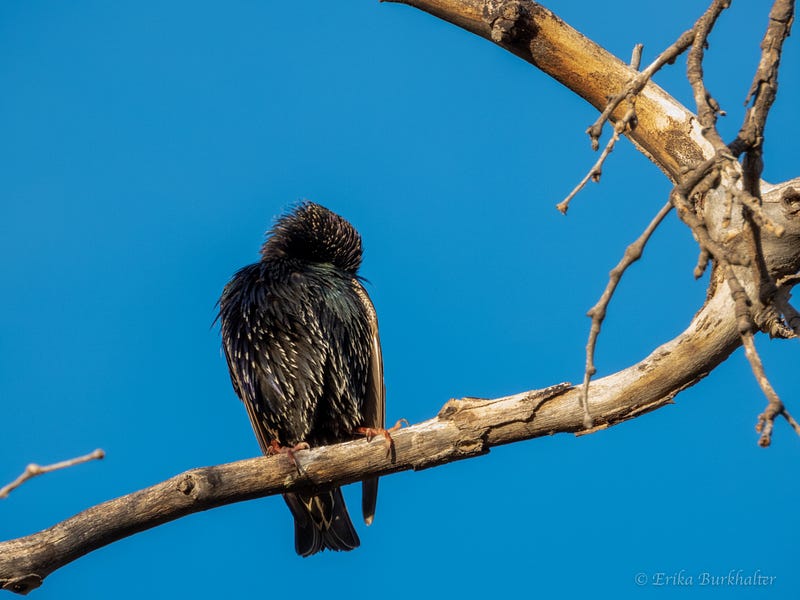
Or this one:
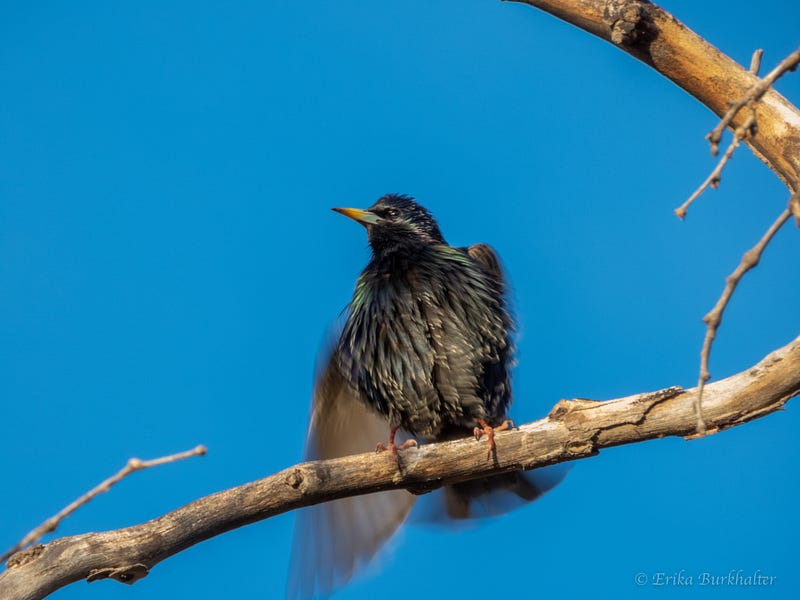
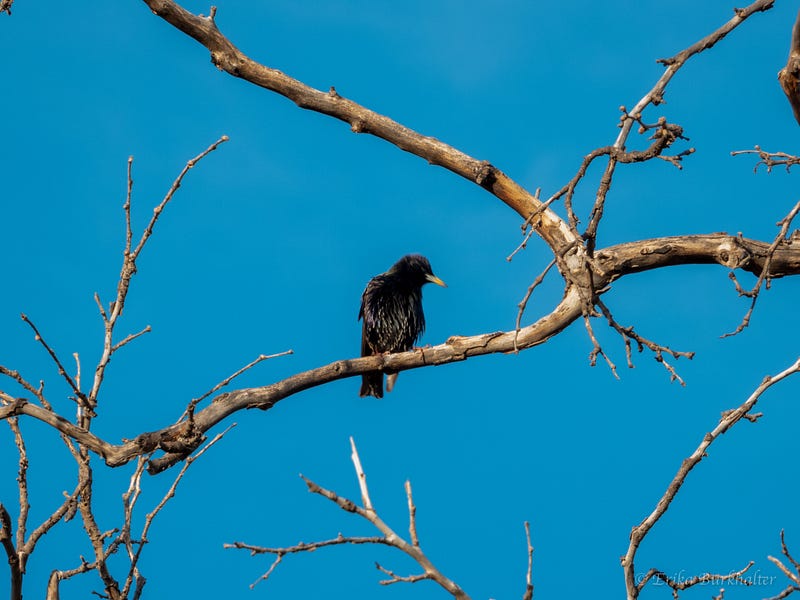
I did get a few decent shots of the one bird who stayed put for a bit while I was fiddling with my camera.
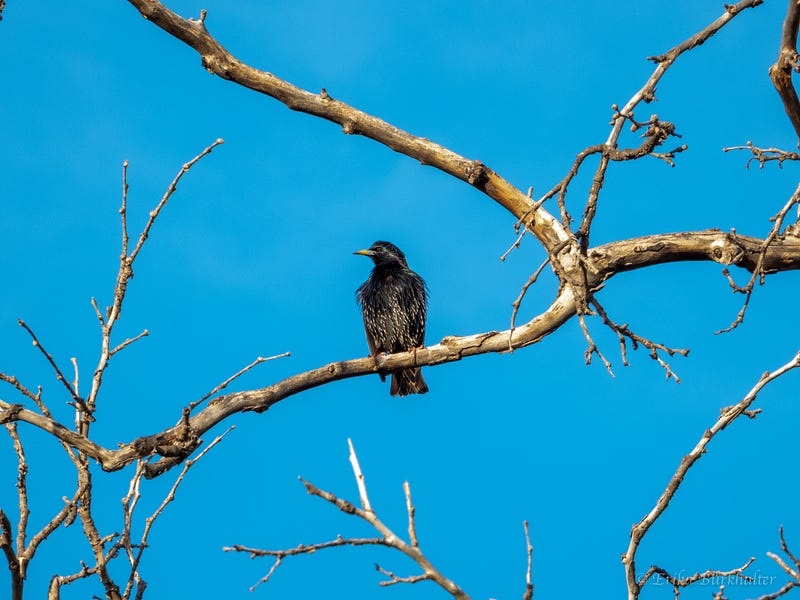
Until he turned his back on me:
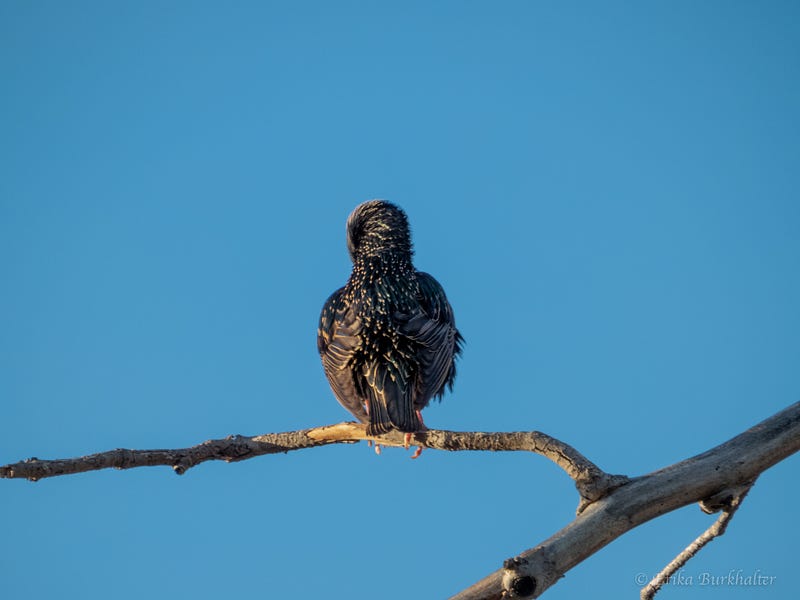
But, he could not resist for long. He knew that I watching him and he was curious.
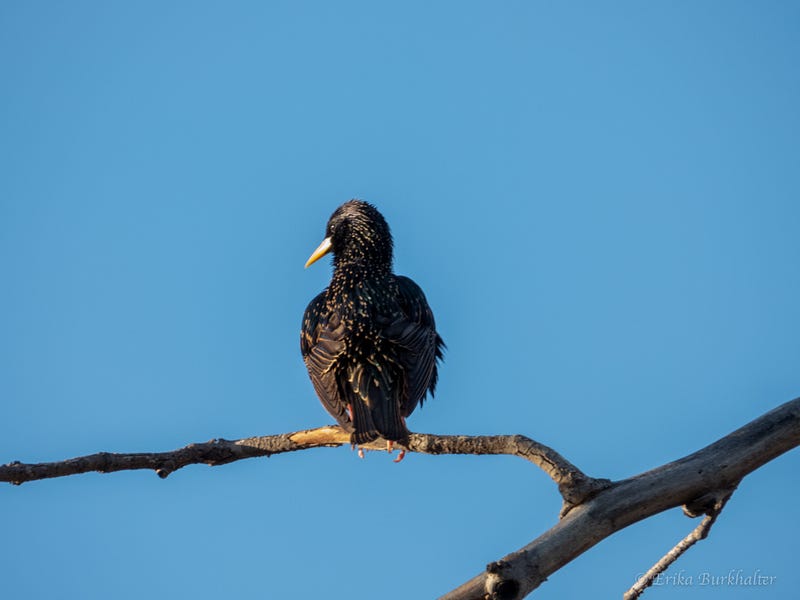
And then he turned all the way back around, looking like a little god of birds with the wind ruffling his feathers and facing into the late afternoon sun.
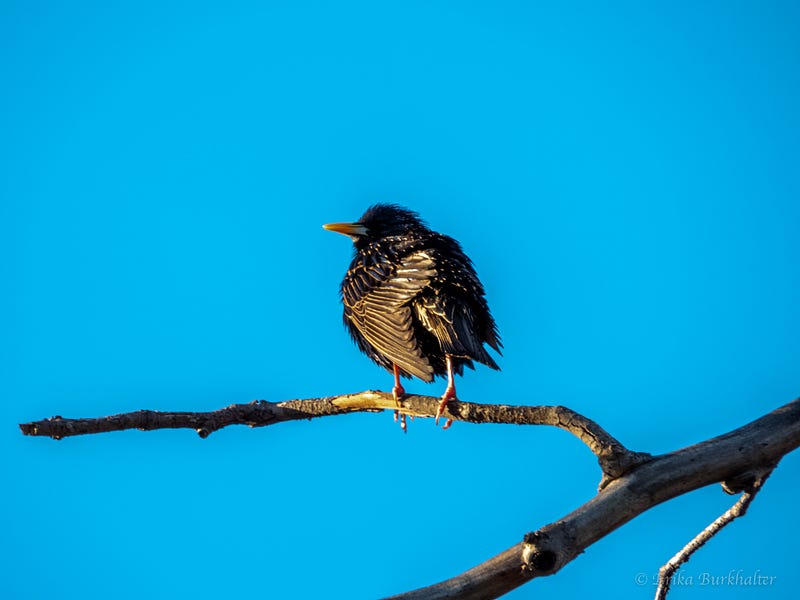
I was so certain that I had captured photos of baby crows, that I stopped a little further down the trail, at a spot where the crows tend to congregate (you can read about my experience getting caught out after dark (in mountain lion country) here) to watch a little family of crows getting ready to settle down for the night.
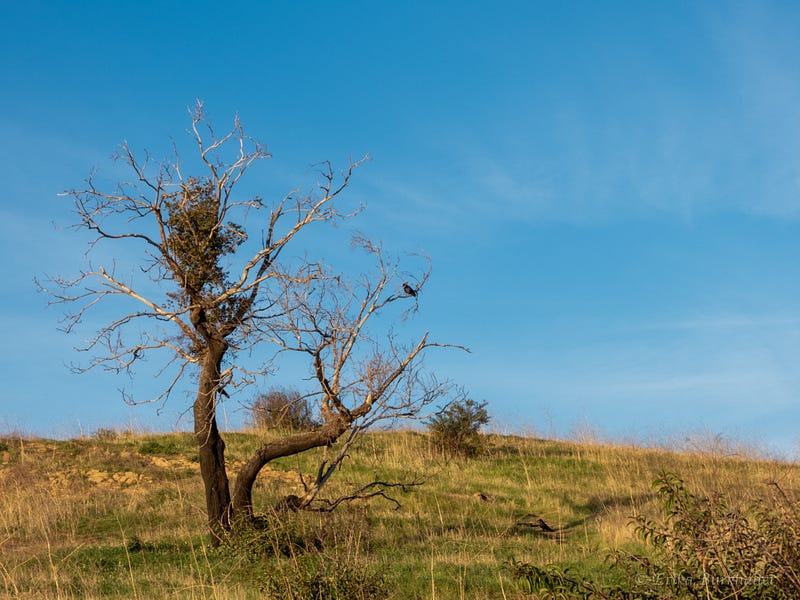
I saw this sleek and shiny lady keeping her eye on me and I thought, “who knows, that could even be ‘Crow Mama?”
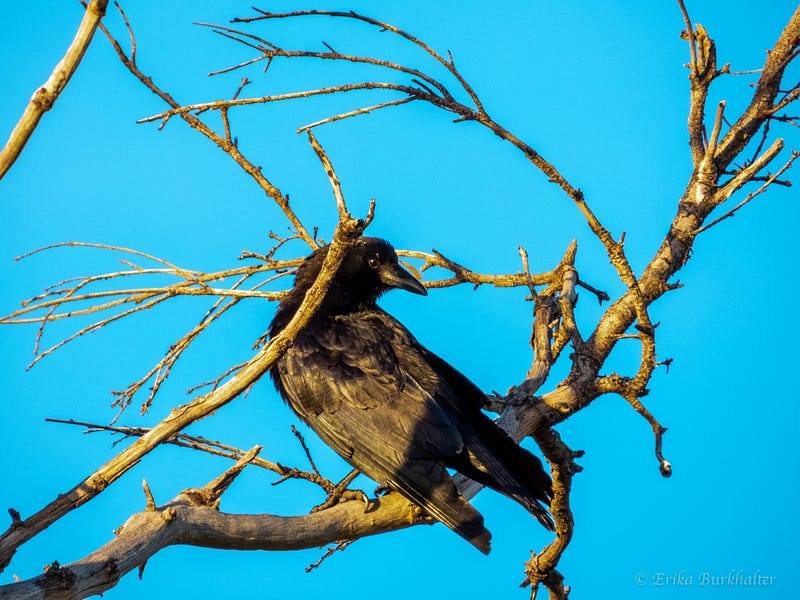
But when I got home and put the photos into Lightroom, I realized that those little black birds were not crows at all. They were Starlings.
I’d heard of Starlings. But I don’t think that I’ve ever seen one up close before. I wouldn’t have been able to tell you what they looked like. But when I did a little research with the Cornell Lab of Ornithology site (a great reference site and an amazing organization), I learned that these stocky black birds with short tails, triangular wings, and long, pointed bills were first brought to North America by Shakespeare enthusiasts in the nineteenth century.
They are now among the continent’s most numerous songbirds and are sometimes resented for their abundance and aggressiveness. But they are dazzling birds when you get a good look. Covered in white spots during winter, they turn dark and glossy in summer. For much of the year, they wheel through the sky and mob lawns in big, noisy flocks.
It was the white spots that gave these guys away. If you look at the photo below (or the one where he has his back to me) you can clearly see the spots.
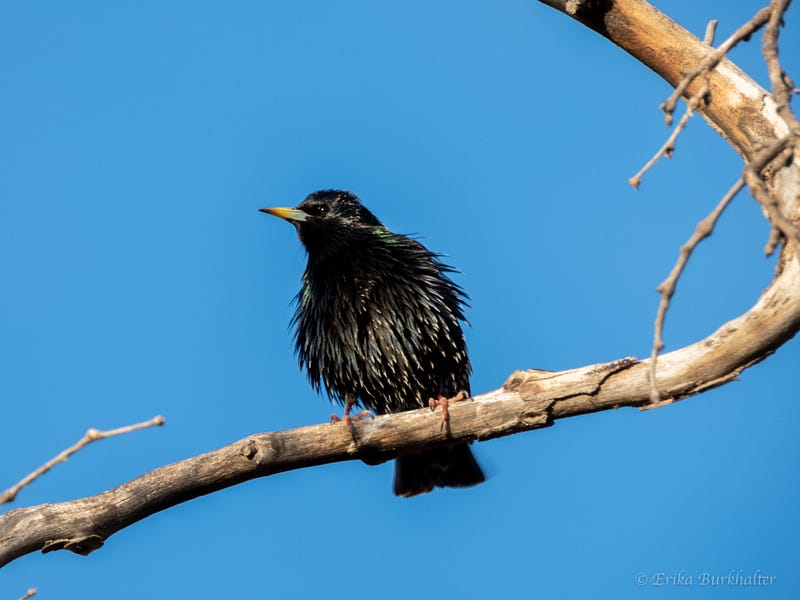
According to the Cornell Lab of Ornithology, all the European Starlings in North America descended from 100 birds set loose in New York’s Central Park in the early 1890s. They were intentionally released by a group who wanted America to have all the birds that Shakespeare ever mentioned. It took several tries, but eventually the population took off. Today, more than 200 million European Starlings range from Alaska to Mexico, and many people consider them pests.
Because they are only recently arrived on North America shores, all of our starlings are very closely related. Genetically, individuals from Virginia are nearly indistinguishable from starlings sampled in California, 3,000 miles away. Although such little genetic variation may be problematic for rare species, it does not seem to have effected the Starlings.
They, like Mockingbirds, are also great vocal mimics.They can learn the songs of up to 20 different species and they often copy the Eastern Wood-Pewee, Killdeer, meadowlarks, Northern Bobwhite, Wood Thrush, Red-tailed Hawk, American Robin, Northern Flicker, and many others.
I found that last tidbit interesting, since this group of starlings lives in such close proximity to several Red-Tailed Hawks.
Starlings have an interesting “wear molt” cycle. They turn from spotted and white to glossy and dark each year without shedding their feathers. The new feathers they grow in fall are tipped in white — that’s what gives them their spots. By spring, these tips have worn away, and the rest of the feather is dark and iridescent brown.
Starlings are also very strong fliers and can fly up to a whopping 48 mph!
I also found it intriguing that starlings can taste salt, sugars, citric acid, and tannins (bitter compounds that occur in many fruits, including acorns and grapes). And they can tell the difference between sucrose (table sugar) and other kinds of sugars, which is helpful since starlings lack the ability to digest sucrose.
I’m so glad to have stumbled across this little haven of Starlings. While I’ve been a bit besotted by the hawks of late, I will now have my eye out for what is happening in the Starling community.
Erika Burkhalter is a yogi, neurophilosopher, cat-mom, photographer, and lover of travel and nature, spreading her love and amazement for Mother Earth’s glories, one photo, poem or story at a time. (MS Neuropsychology, MA Yoga Studies).
As many of you are aware, medium just changed their formatting and there is no option for full-sized photos anymore. But if you click on any of these photos, if you are viewing this on a computer, it will pop up in a full-size format.
I hope you enjoyed my photos and musings. You might also like:
Photos and story ©Erika Burkhalter. All rights reserved.
If you’re interested in keeping up with my poems, photos and stories of the critters in my neighborhood, you might consider subscribing to my stories. You’ll get an alert whenever a story gets published. While I do normally post my stories with free “friends” links on social media, if you enjoy reading on medium, you can help the many talented writers here by joining. It helps to support the arts and to keep us writing!
And, because I’ve had a few people asking lately, if you’re ever interested in purchasing a photo, just leave me a note. I am working on a limited edition series of hawk photos on metallic paper right now. I am quite excited about how they are turning out.