
Nature, Photography
Red-Shouldered Hawks Mating. An Intimate Moment Captured in Photos
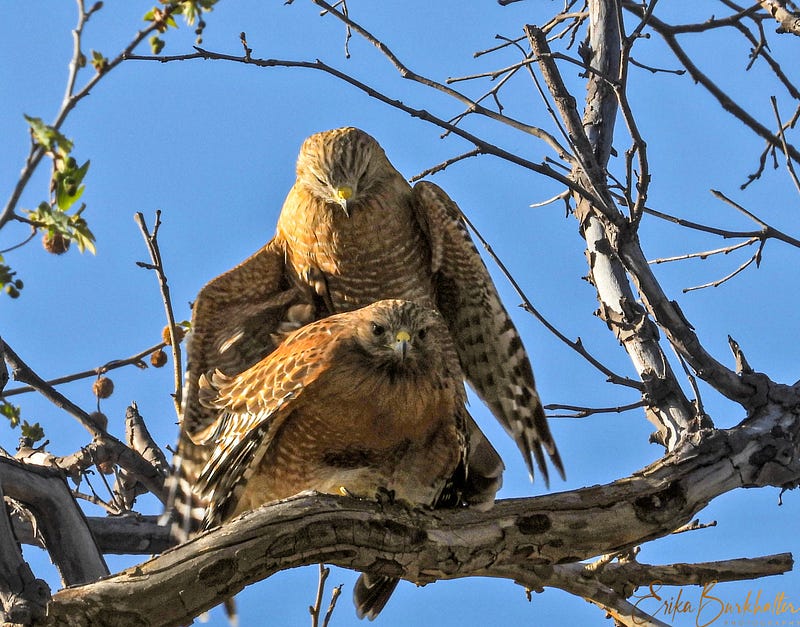
While testing out the new Nikon COOLPIX P1000 ultra-telephoto point and shoot, I inadvertently photographed these two hawks mating. I didn’t realize it until I downloaded the photos.
I hear them all day long. From my desk. From my yoga room. From my kitchen sink. Red-Shouldered Hawks.
It’s a weird keee-yah-type screech. And it’s a different call in California than it is on Florida. For the twenty-or-so years we have lived in this house, we’ve always had at least two or three pairs of Red-Shouldered Hawks in the neighborhood. And they spend most of the day catching the updraft from the hill behind my house, then riding the warm air currents up, up and away into the wild blue yonder, screaming to each other all the way to the rim between sky and earth, “Where are you, where are you?”
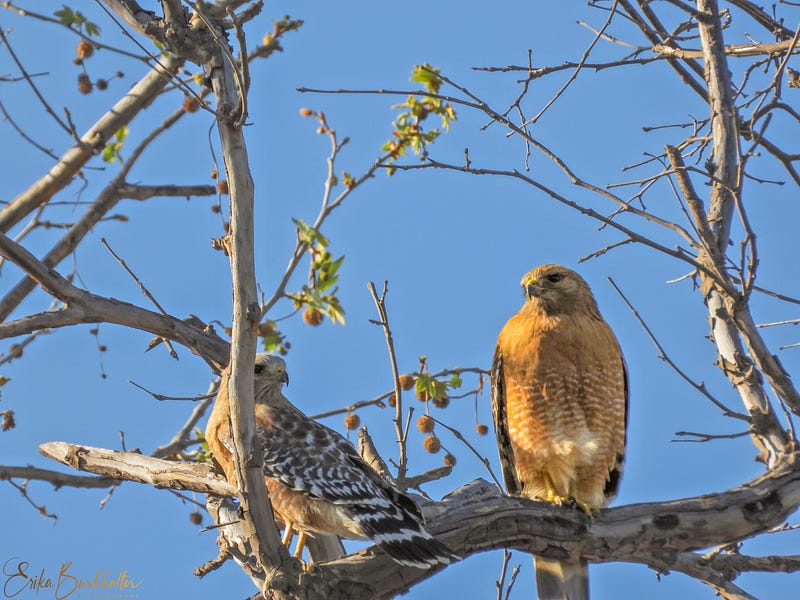
It’s always sounded like a love story to me. And it is. Red-Shouldered Hawks mate for life. Can you tell by this next photo? Look at the eye contact.
I love to take photos. And I love to mountain bike ride. But the two don’t really mix all that well. I suppose it might work out better if you never had a crash. But I do take a tumble here and there, and I just haven’t wanted to risk taking my nice Nikon z7II out on the trail.
So, my iPhone gets tucked away in a pocket and comes along with me. But, as amazing as an iPhone is in so many ways, taking photos of things at a distance is not its strong point. And hawks and crows and woodpeckers, and other critters of that sort, tend to be just a little too far away to be in focus. So, I bought the Nikon COOLPIX P1000 to be my “mountain-biking camera.” It’s not sooooo expensive that if I land on a rock and kill it, I would be crushed. And it has a lot of really cool features. Namely, it can zoom. It has a 125x optical zoom (24–3000mm full-frame equivalent).
My husband and I took it out on a ride the other day, and I told him, “I just want to see a hawk.” There’s a section of the Horseshoe Loop Trail, in Orange County, California, called “Willows,” because it is lined with precisely that, willow trees. Eucalyptus, sycamores live oak trees also reside here. And it is rare to take a late afternoon ride and “not” see a hawk.
But I did not see a hawk on that entire stretch of trail.
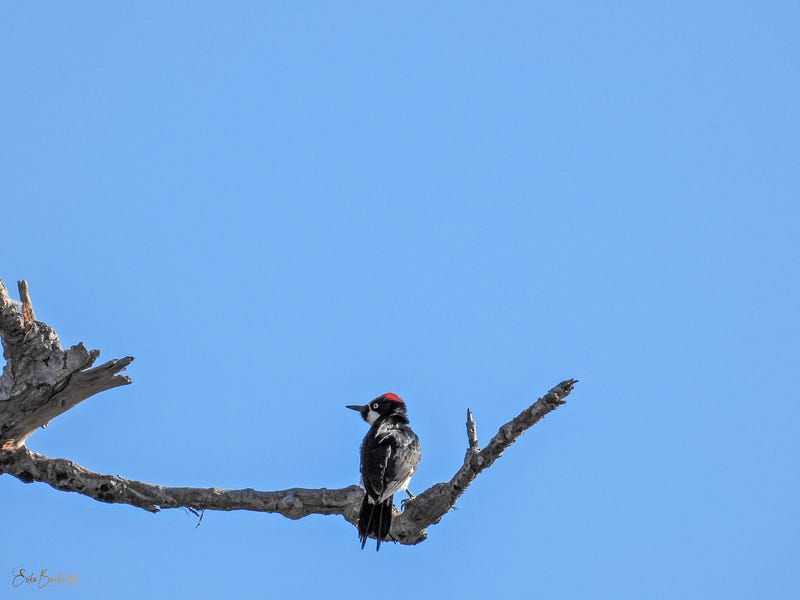
We rode on a little further and, all of a sudden I spotted an “Acorn Woodpecker.” These red-headed little pranksters love to torment the crows, which was exactly what they were doing.
My husband rode on a bit further, scouting things out for me. He didn’t come back, so I hopped back on my bike, rode a little ways up the trail and then skidded to a stop when I almost ran into him around the corner.
He’d spotted a hawk.
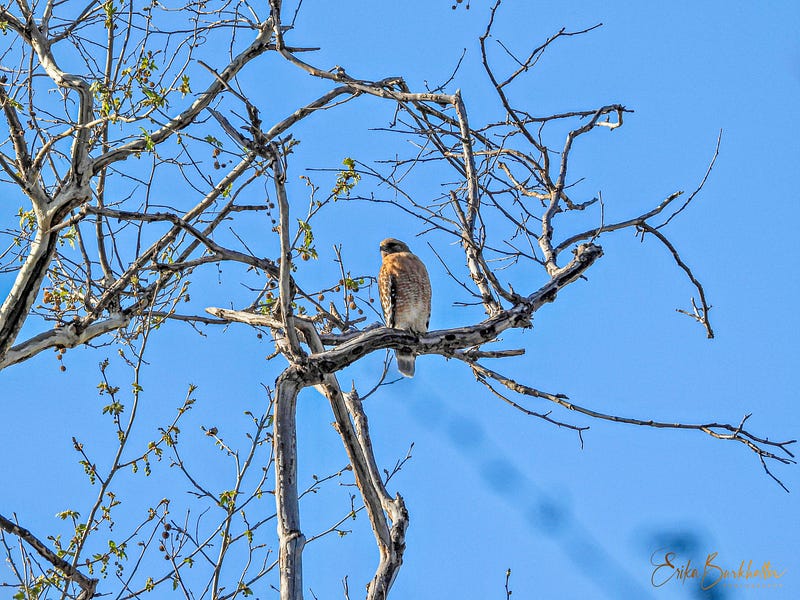
But it was in a really high branch and there was a lot of bramble in the way. So, I ditched my bike for a few minutes and back-tracked, uncertain the whole time if that was a good decision or not. The hawk might just fly away. But it stayed put.
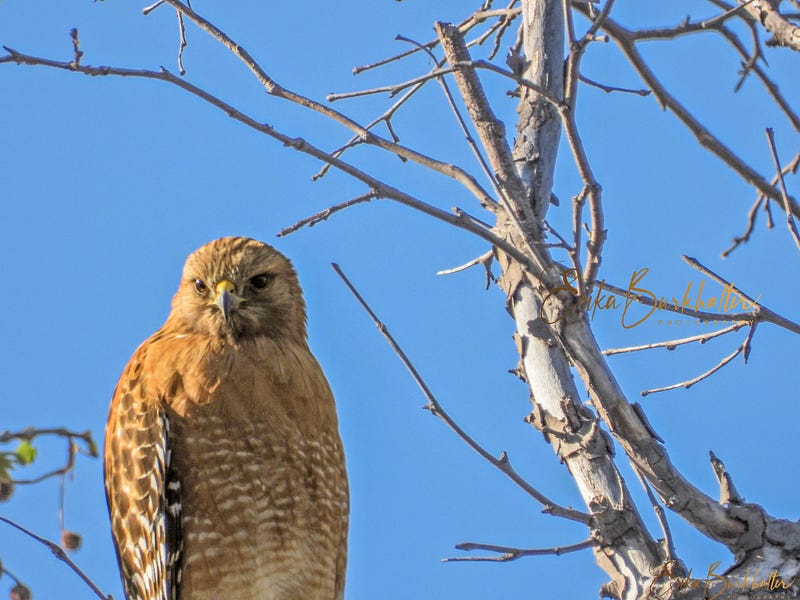
I felt like I was being watched, even though I was the one trying to get a good vantage point. But their eyesight is incredible.
As I was trying to get a clear shot, we both could hear another hawk nearby. They are very vocal. And the males are known to do a “sky dance” for the females — diving low and then circling back up.
In the flash of an eye, another bird landed atop the first one. I thought it was sweet and that they must be mates, but I did not realize what had just happened until I downloaded these photos onto my computer that night. We had just seen two Red-Shouldered Hawks mating.
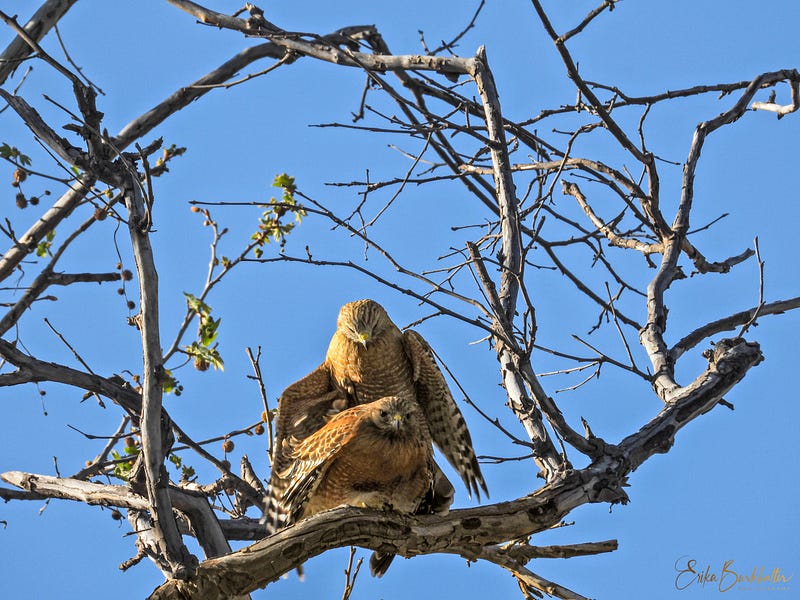
After a second or two, he hopped off and moved over on the branch. The look that they exchanged is priceless.
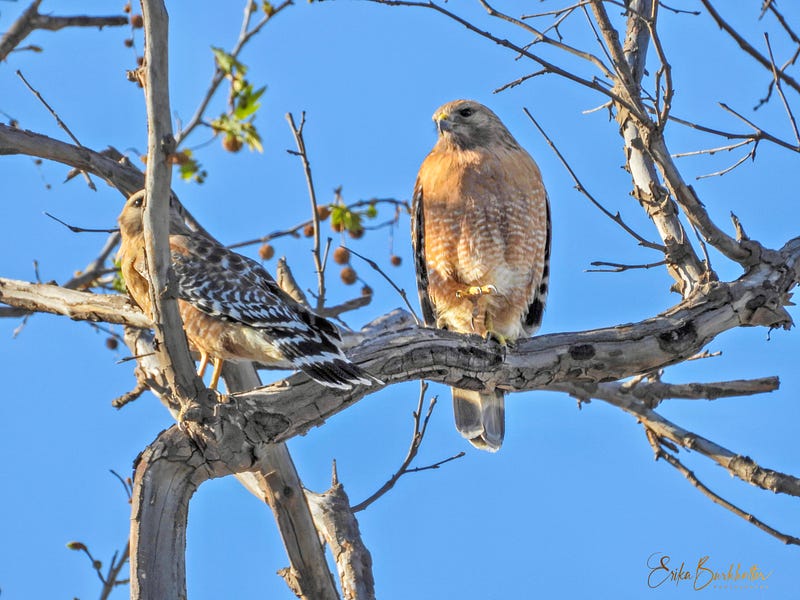
It was so obvious that they were intimate with each other.
What I did not realize until later is that the bird in the tree (the one on the right) was the female. The girls are quite a bit larger than the males.
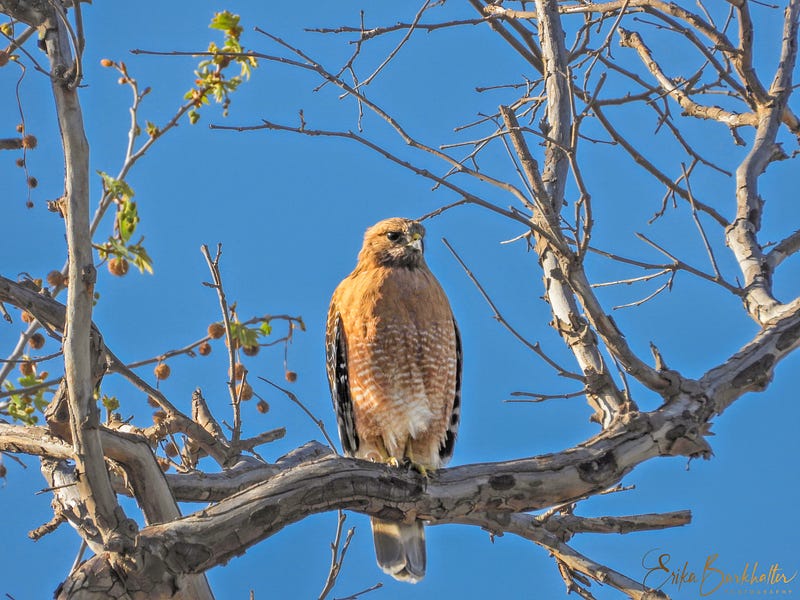
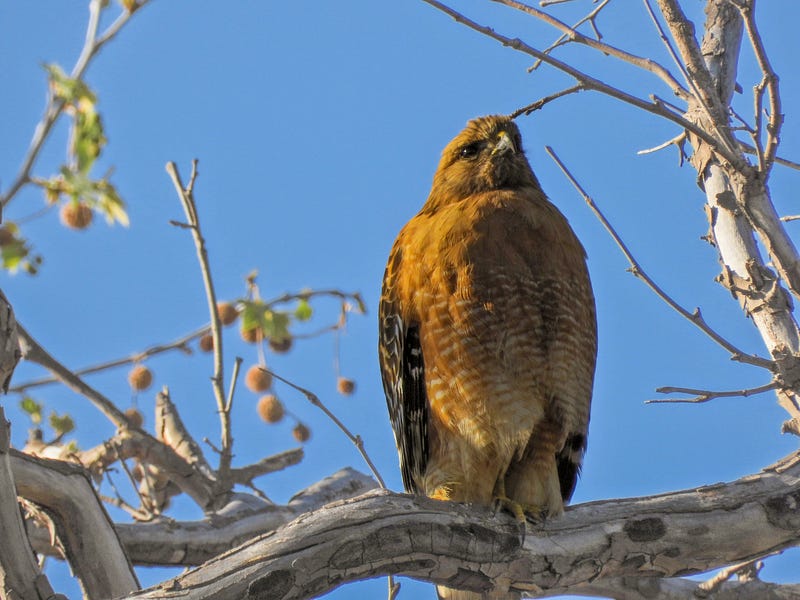
The males and females work together to build a nest. And they often use the same nest year after year, refurnbishing it annually with sticks in the spring. The clutch size is typically three to four eggs and the incubation period can range from twenty-eight to thirty-three days.
The babies do not all hatch at the same time. The first chick can hatch up to a week before the last. The young leave the nest at about six weeks of age, but remain dependent on the parents until they are 17 to 19 weeks old. They may continue to roost near the nest site until the following breeding season. Breeding maturity is usually attained at 1 or 2 years of age.
Who knows if they conceived this time around? But I plan to have my eye out this spring for baby hawklings. I feel like I will already know them before they are even born.
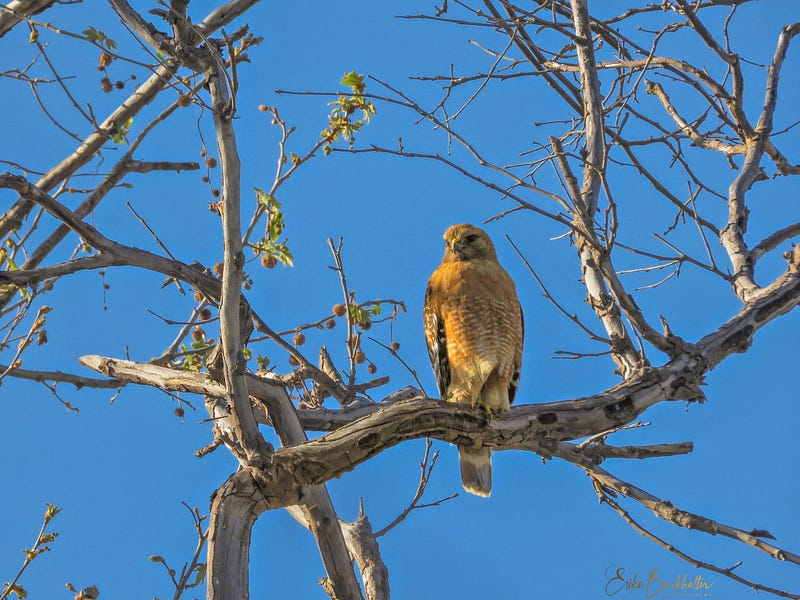
Erika Burkhalter is a yogi, neurophilosopher, cat-mom, photographer, and lover of travel and nature, spreading her love and amazement for Mother Earth’s glories, one photo, poem or story at a time. (MS Neuropsychology, MA Yoga Studies).
As many of you are aware, medium just changed their formatting and there is no option for full-sized photos anymore. But if you click on any of these photos, if you are viewing this on a computer, it will pop up in a full-size format.
I hope you enjoyed my photos and musings. You might also like:
Photos and story ©Erika Burkhalter. All rights reserved.
If you enjoyed this piece, you might consider subscribing to my stories. You’ll get an alert whenever a story gets published. While I do normally post my stories with free “friends” links on social media, if you enjoy reading on medium, you can help the many talented writers here by joining. It helps to support the arts and to keep us writing!
And, because I’ve had a few people asking lately, if you’re ever interested in purchasing a photo, just leave me a note.


