
A Society Based In Partnership Instead of Domination
What would the opposite of a dominance hierarchy look like?
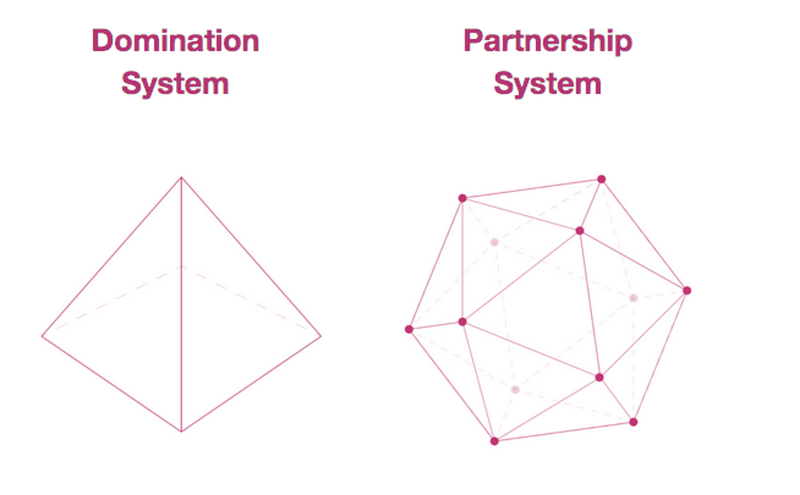
It’s not too much of a stretch for most people to grasp how misogyny, racism, homophobia, classism, and xenophobia take place in a society with a strong system of stratification like the one that we have in the US. Historically, women have been considered inferior to men, blacks inferior to whites, and the poor and uneducated inferior to those with different opportunities. This intrinsic system of many layers of stratification is what patriarchy as a social system truly means. Even though it has eased some in recent years, the desire to endlessly compare ourselves to others for relative power and prestige is still alive and well.
In a pyramid-shaped hierarchy like patriarchy, only a few elites can occupy the apex and everyone else vies for the highest position in the hierarchy that they can attain beneath that. Competence and ability may play some small part in ranking, but in general, these hierarchies are based solidly in traditional power. As recently as 50 years ago, the strata of the hierarchy were pretty well fixed, with white men at the top, white women below them, men of other races, including blacks next, and women of color at the bottom, with homosexuals and other marginalized groups in there somewhere near the bottom also.
It’s not quite that cut and dried anymore because we now have more women, non-whites, and gay people with wealth, education, and positions of power. However, this in itself has created tension because some people are reluctant to give up the old rankings. I personally know several people who were downright incensed when Barack Obama was elected because it was inconsistent with their sense of proper hierarchy to have a black man as the President of The United States.
But even if we can readily see the issues with a dominance-based hierarchy, what are the alternatives? Hierarchies based in domination tend to rely on coercion, violence and the threat of violence, but they also maintain order. It used to be said in Italy that under Mussolini, at least the trains ran on time. Authoritarian structures mean that everyone knows who to look to for leadership and safety, even if it also means that they get stepped on and bullied in the bargain.
Our search for great bosses comes not from a desire to be watched and directed but rather from our belief that clear authority relationships are the antidote to crisis and ultimately the answer to chaos.
Block, Peter. Stewardship: Choosing Service Over Self-Interest (pp. 18–19). Berrett-Koehler Publishers. Kindle Edition.
Most people have probably been in very few structured situations that didn’t involve some type of hierarchy of domination — from the playground bully to the overbearing father to the narcissistic boss. You do what you are told to by the people above you, or you suffer the consequences. But hierarchies of domination aren’t the only kind of hierarchies or the only kind of leadership. Nor are they the only way to be in relationship with others. The establishment of some kind of pecking order is not necessary in order for society to function.
Hierarchies of actualization are employed in partnership-oriented structures to create cohesion and order in a way that is not based in intimidation or for the purposes of maintaining top-down rankings. “Egalitarian and equitable adult relations are the norm. Parenting is not authoritarian but authoritative. Beliefs and stories present empathic, mutually beneficial, nonviolent relations as normal, moral, and desirable.” This is in contrast to the domination stories that “justify and idealize domination and violence, which are deemed inevitable, moral, and desirable.” Such is the case in the state, the family and the workplace, as well as all other aspects of society. The Center for Partnership Studies
Hierarchies of actualization have leaders who empower those closest to the work product or task at hand to make most of the relevant decisions rather than telling them what to do and then sitting back and evaluating them from above. This allows people to emotionally invest in a way that they cannot when they are treated as merely a cog in the wheel or a functionary to be bossed around by someone with more authority.
In my son’s elementary school, the teachers did not mediate disagreements between students. They taught the students how to do it themselves. If there was a fight or other similar situation, they would hold a class meeting in which the other students helped the parties in question to talk about what had happened and work through it. Rather than teaching the kids to defer to authority to solve their problems, it taught them instead how to take greater responsibility for themselves.
Partnership-oriented organizations have trust and reciprocity-based cooperation; achievement-based (rather than conflict-based) competition; and use conflict as a tool to arrive at solutions, rather than a zero-sum win at all costs mentality. “Leadership is based on power to (woman or man who nurtures and supports productivity and creativity) AND/OR power with (encourages and participates in teamwork).” (emphasis mine)
Business is one of the main forefronts for partnership-oriented shifts in our culture today because it leads to greater agility and responsiveness, which in turn, contributes to the bottom line.
In slower moving and less complex business environments the old hierarchical model that depended mostly on only a few people at the top for leadership simply doesn’t work anymore. In today’s more volatile, uncertain and ambiguous business battlefield, decentralized controls and leadership through networks of people at all levels is imperative for success.
Despite the current initiatives in the business world to make things more partnership-oriented for the purposes of adroitness, shifting completely away from social hierarchies based in domination will not be easy. Many people hold on tightly to their perceived status and any perks that go along with it because they are afraid of the alternatives. They believe that in a dog-eat-dog world if they were to let their guard down, they would find themselves the one being eaten or somehow left out in the cold. They are afraid that if anyone else gains, it will have to come at their expense.
None-the-less, visionaries like Dr. Brene Brown are keeping important discussions around this topic in front of the culture. Brown’s TED talks on shame and vulnerability have been watched over 50 million times and her recent Netflix special The Call To Courage has been widely viewed and well received.
One of the reasons for her immense popularity is that Brene Brown brings us concrete ideas and strategies for living in a kinder, more cooperative, and better functioning world and she does it in an engaging, funny, no BS style. Dr. Brown has worked extensively with the US military, Silicon Valley business leaders, and law enforcement agencies to teach tools of leadership based in partnership systems rather than dominance-based ones.
She does not specifically use those terms, but Brown’s ideas about daring to lead with a whole heart are right in line with them. One of the most destructive elements of patriarchal style stratification and dominance-based relationships is that they create social isolation. How can you have real closeness or camaraderie with anyone when you feel you are in constant competition with them, always ascertaining who has a higher rank in the social or power hierarchy? How can you have a real culture of excellence and self-responsibility when everyone, including the leaders, are afraid to admit that they are anything less than perfect because this is what a dominance hierarchy demands of them?
Partnership-based structures (in the family, workplace, or civic arena) don’t have to mean that everyone has equal say, or that there is no hierarchy or leadership at all. The goal is not anarchy. But instead of creating an in-group and an out-group, or having some people with vastly more power than those around them, the goal is to have real cooperative relationships that yield the best results for everyone.
Demands for subordination and obedience are replaced with mutual respect and collaboration. Stratification based on arbitrary elements like gender, race, or class are unnecessary and serve no purpose. Achievement based solely on merit is fully possible. Quality-of-life, human development, and environmental sustainability become more important than the interests of a few elites.
Are we likely to fully realize this kind of society in the immediate future? Probably not, but some meaningful moves in that direction are already underway, and there is no reason for them not to continue, despite the current pushbacks from many of those at the apex of the pyramid. The more we recognize and discuss the differences between hierarchies that are based in domination and the possibilities for a more partnership-oriented culture, the more likely we are to be able to embrace them.
Books Incorporating Partnership Concepts
- The Responsibility Revolution: How the Next Generation of Businesses Will Win by Jeffrey Hollender and Bill Breen with Foreword by Peter Senge (Jossey Bass, 2010)
- Mind in the Making: The Seven Essential Life Skills Every Child Needs by Ellen Galinsky (Harper, 2010)
- Visionary Business: An Entrepreneur’s Guide to Success by Marc Allen (New World Library, 2009)
- Beyond: Business and Society in Transformation by Mario Raich and Simon Dolan (Palgrave Macmillan, 2008)
- Transformative Learning by Edmund O’Sullivan (Zed Books, 1999)
- Gender Roles by Linda L. Lindsey (Prentice Hall, 1997)
- A Dream Deferred by Philip Slater (Beacon Press, 1991)
- Creative Work by Willis Harman and John Hormann (Knowledge Systems, 1990) Gaia: The Human Journey: From Chaos to Cosmos by Elisabet Sahtouris (Pocket Books, 1989)
- Dare to Lead by Brene Brown (Random House, 2018)
- Stewardship by Peter Block (Berrett-Koehler Publishers, Inc. 2013)
- The Chalice and the Blade by Riane Eisler (Harper Collins, 1987)


