
MONTHLY CHALLENGE: RUINS OF THE WORLD
A Snippet of Roman and Irish Ruins
Unfortunately, this is more of a sad tale of travel photography gone wrong.
When I first read about Anne Bonfert’s Ruins Of the World prompt for May, I knew what I wanted to write about, but it posed two challenges; I didn’t have digital copies of my European photos — and I didn’t want to take pictures of pictures — and I knew that most of my Irish photos from 2017 are blurred.
What better incentive to deal with the two shoeboxes of negatives tucked away in a safe for years? I did some research and purchased a small negative converter from Amazon. Two days later, I was slip-sliding negatives through this portable device and incredulous at the results — and have been furiously sliding negatives through the machine ever since!
As for my Irish ruins, they’re mostly ruined — and I don’t know why. I have a vague recollection of doing something drastically wrong the day we were at the Skellig Islands, as a ton of those photos are missing. A travelling photographer’s worst nightmare is to delete instead of save — and, sadly, it’s not the first time I've done it.
Is it ironic that thereafter, all my pics are a disaster? I suspect I screwed up the settings on three of the days we were there — or was shooting blindly, thinking that things were in focus. I’m pretty annoyed with myself as I love looking back on my travels through pictures.
So, instead of two stories, I have such few photos I can only muster up one.
A little background first
My first overseas trip was in 1992 when I was 26. I did not have the travel bug, but my fiancé insisted I travel before settling down and having kids. Am I ever glad he did!
Thirty-odd years ago, cameras were not like they are today. I can’t even recall the model of the one I had, but I know we came home with a few rolls of 35mm that then had to be taken to the photo lab for processing.
Can you imagine waiting months to see your pictures? These days, we get to see them instantaneously and can dispose of or keep them just as quickly. Then again, the anticipation — and disappointment when there are many duds — is not the same as in the good ol’ days!
I also remember trying not to take photos just of the scenery as I was of the mind they were boring and meaningless unless someone was in them. That notion came from the cost of development. Now, it means I only have three photos to share of the Roman ruins. My ex is in the other pictures, and we don’t have a great relationship, so asking his permission to use them is out of the question.
We were away for ten weeks, spending time in Paris before driving around France and Germany for a month, and then we meandered through Italy, Greece, The Netherlands and England by train. It truly was a trip of a lifetime.
Roman ruins
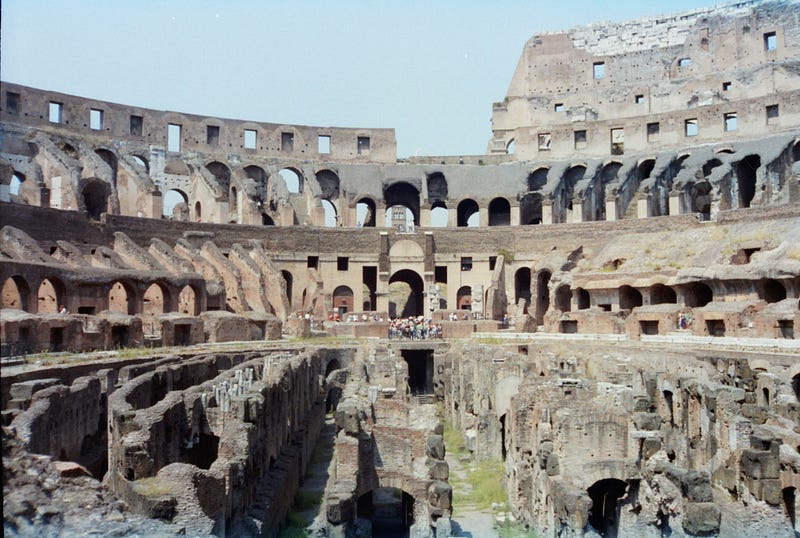
The most meaningful was a visit to the Colosseum and Forum in Rome. I had studied Latin in high school — and my Dad was a Latin teacher — so I had heard all about the shenanigans that used to go on in the massive outdoor theatre that was built back in 80 AD. It’s incredible to think that part of the structure still stands despite its age and exposure to natural elements.
To stand in the same place as Emperors and gladiators once did was surreal. I was transported back to my high school lessons through the Ecce Romani books with Cornelia and Flavia, and their bleached stories of life in Rome. Although they conveniently avoided too much detail about the bloodshed in the arena, it is well-known that the Romans had an appetite for open displays of execution, whether being mauled to pieces by an animal or slaughtered by a gladiator.
Hundreds of years later, you can still see the tiered seating and underground passageways that were built later to allow the emperor to come and go without the bother of crowds and to schlep animals and gladiators from nearby stables and barracks.
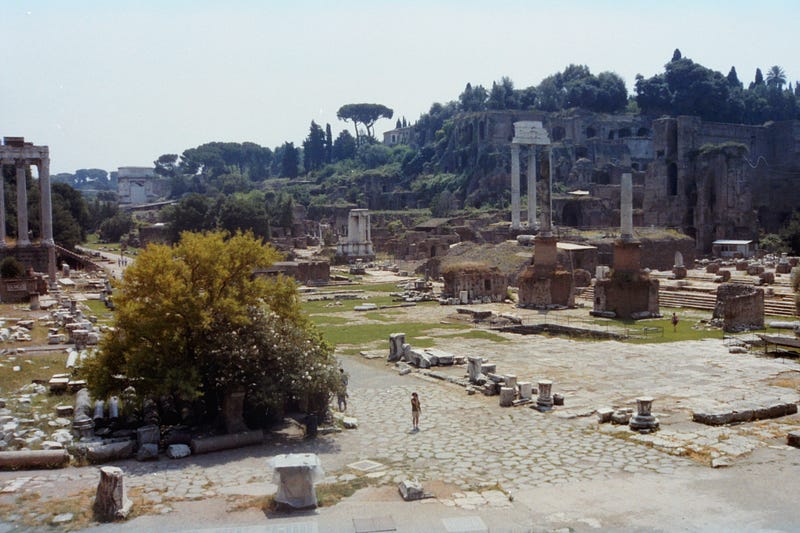
The Forum is adjacent to the Colosseum and was the commercial hub of ancient Rome. From a marketplace to governmental buildings, processions and shrines for the famous, the site is littered with ruins.
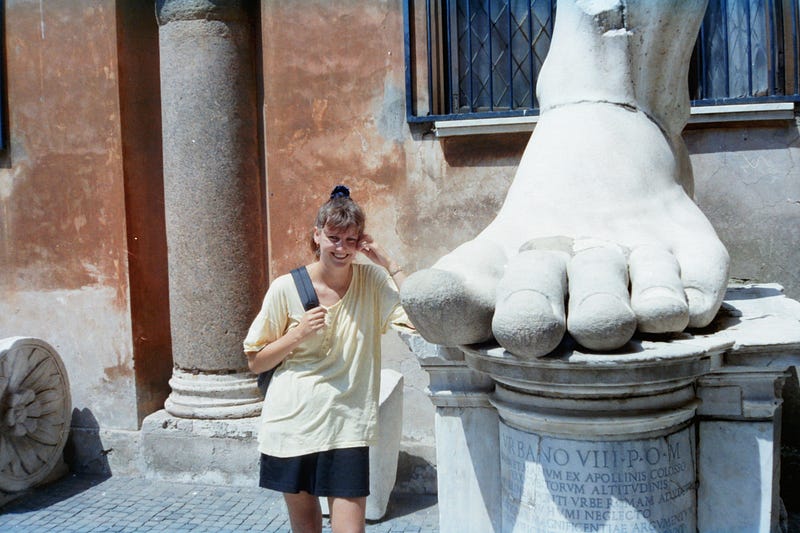
At one end are the remains of the Colossus of Constantine, a huge sculpture that Emperor Constantine commissioned of himself. With a young me standing beside one of his feet, you can get an idea of how massive the sculpture must have been. Reportedly, the foot is two metres long, and the whole figure would have stood around 12 metres high.
That’s one big ego, Emperor Constantine!
Naturally, as time marches on, the acute details of a trip fade. That’s why we write travel diaries! Reading through to support this piece, I recalled three moments that are worth mentioning.
- It can be brutally hot in a busy city like Rome at the height of summer. Wear sunblock, take water and seek shade where possible.
- There are a lot of pickpockets about, especially at the train stations. Stand back against a wall until the train has arrived at the station — you can even see them in action — and wear your backpack in front of your body. I had mine slashed without even realizing it, but thankfully I had just dumped a bag full of dirty laundry at the laundromat, so they got nothing!
- We decided to take the #64 bus back from the ruins and noticed some seedy behaviour on that bus too. Later as we waited for our train to Brindisi we got talking to a Canadian guy who was robbed on that same bus. Trip Advisor has a few entries from some pi$$ed-off travellers too. It has a bad reputation.
Irish ruins
I’ve only four ruin-worthy photos to share of my wonderful week in Ireland in 2017.
One of the best days was a trip to the Aran Island, Inis Oirr, where we rented bikes and explored its entirety. I fell in love with this place, and if I could, I’d move there in a heartbeat to write, stitch, read, take photographs and travel more.
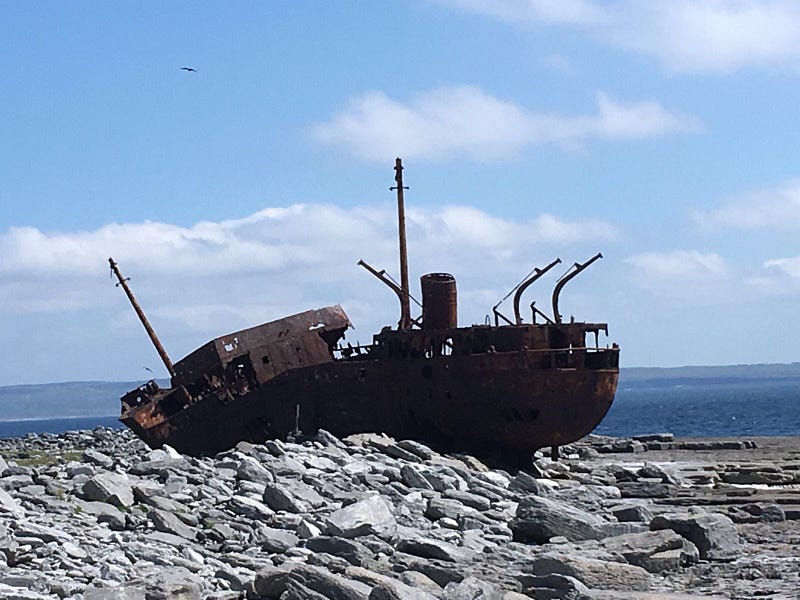
It was a strange sight to see a real-life shipwreck. The Plassey freighter hit the rocks in bad weather in 1960 and has been aground ever since. You may have seen on the tele, as the wreck features in the TV comedy show Father Ted.
This stone shell of a church was taken in the Cahersiveen area. Ireland was dotted with similar ruins and ancient graveyards.
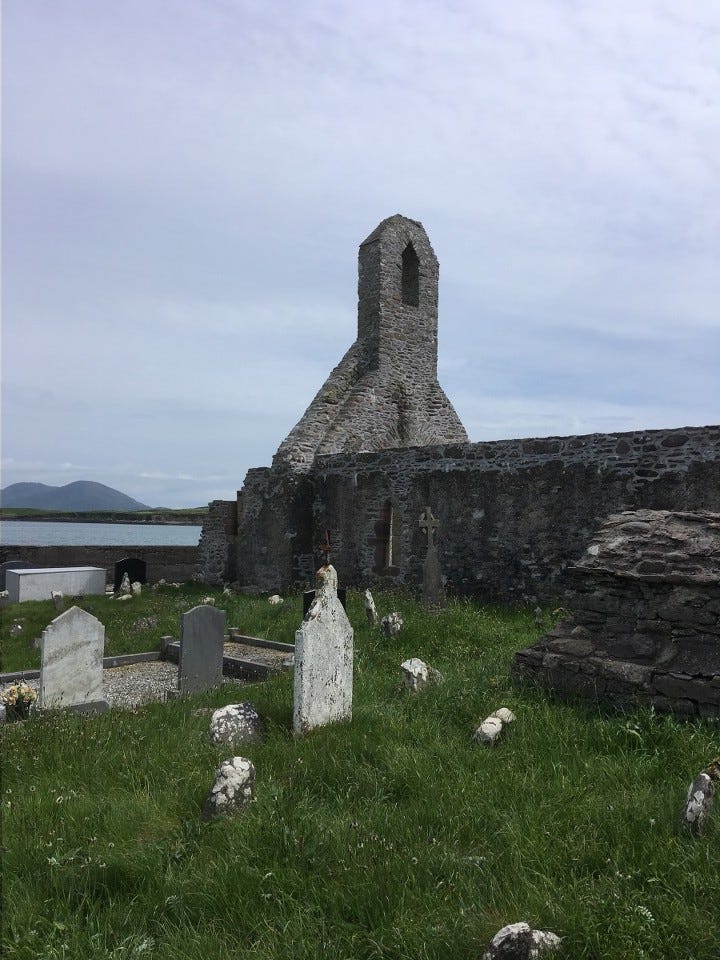
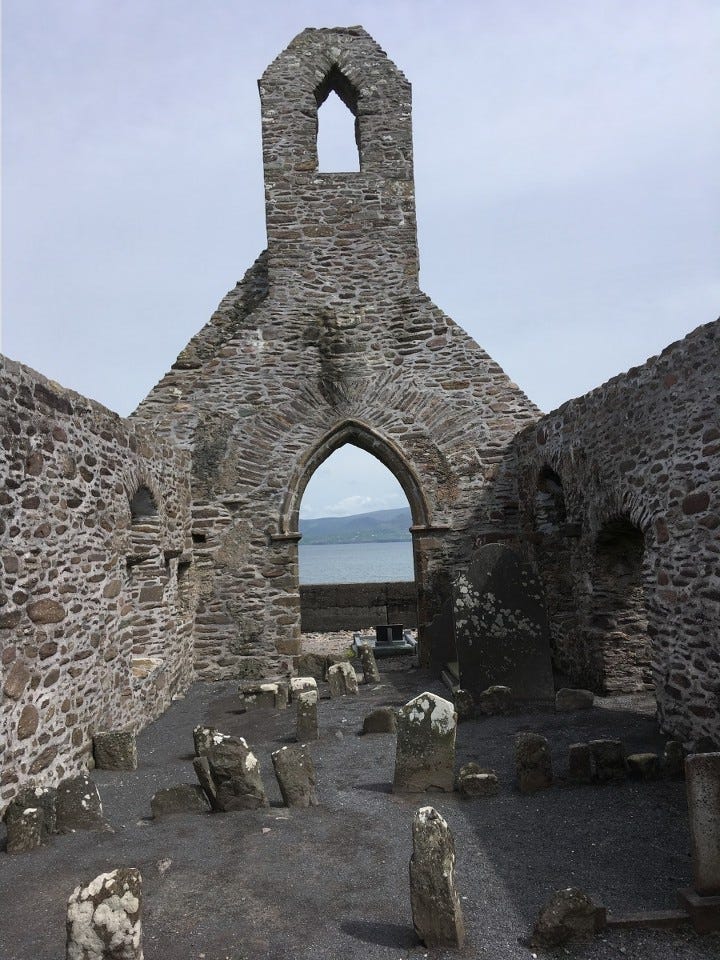
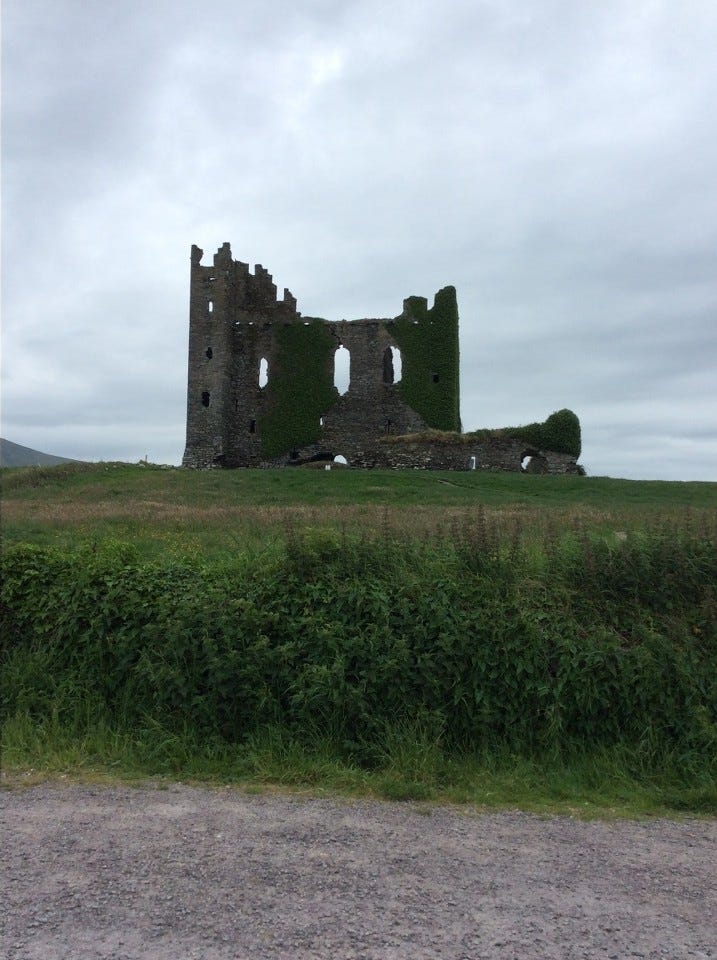
The only other decent shot I had was this castle ruin that was also in the same area. I loved how there was some resident greenery on the old structure.
Honestly, there were so many castles in Ireland it got to the point where we would just say ABC — another bloody castle! Many of them were in pretty good shape, often now used as museums or restaurants.
And, sadly, that is it from me regarding ruins. But — thank you, Anne Bonfert, for kick-starting my negative digital rebirth!
I’d love to shout out to two Globetrotter writers who inspired me this week — and I must also thank Adrienne Beaumont for making my reading easier with her weekly roundup!
Of course, I was interested in anyone who wrote about the Roman ruins too. I enjoyed Ronald Smit’s account of his trip to the ancient Italian city — and his sense of humour!
Erie Astin’s account of the Roman ruins is both factual and delightful. If Medium was around 31 years ago, I could maybe have given her a run for her money — lol — but my brain is too old for that! Read Erie’s story for a wonderful account of her 20-year-old trip to the ruins.
Thanks, Globetrotters!


