A Real Reason Why the Internet Shortens Our Attention Spans
How the growing need to compress information on a screen, led to a drastic change to the way we appreciate content.

This is part 2 of a Wonk Bridge series on Internet Culture and it’s impact on society. Yuji Develle is an MSc Management student at the London School of Economics interested in Digital Humanities, Cybersecurity and Sociology.
In part 1 of this series we discussed how the way humans see (on a psychological and sociological level) affects how they appreciate visual media on the Internet. Winding the clock back to René Magritte’s The Treachery of Images, we briefly investigated how visual content can be manipulated to produce a certain response from target audiences. This article examine how the Internet’s technological limitations, influences society’s expectations and appreciation of visual content.
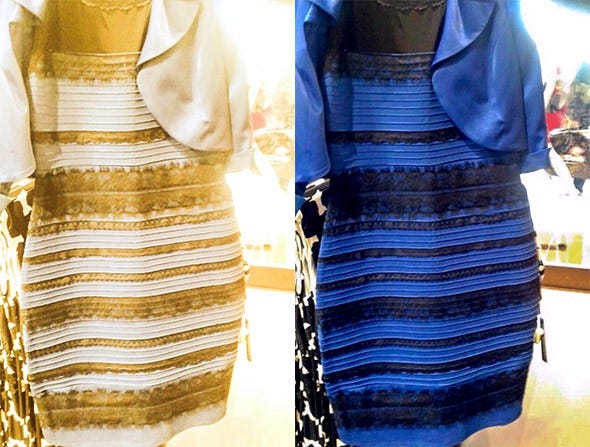
“The Dress”
Millions of pieces of Internet cultural iconography (or “memes”) could have been chosen to represent our fascination for the medium. However, nothing gives me more pleasure than to use “the Dress” as an example — a debate about the colour of a dress had, at the time, more virality than the war in Syria…
But we aren’t surprised by this; We know — from the unwarranted success of gutter-press & Snapchat stories — that trivial matters seem to capture the public interest. “The Dress” is different, however. After much trial and tribulation, we found out that the reasons behind the divergeant opinions on the colour of the dress (Blue & Black vs. White & Gold) had something to do with the way it was presented on screens:
- The camera used for the picture distorted the rendering of the dress, due to a lens flare on the top-right corner;
- This image was re-uploaded multiple times in varying degrees of pixel rendering quality;
- The different images were then found in their different forms on search engines (like Google Images). Individual computers also have diverging image-rendering qualities.
The combination of several technical limitations associated with image rendering led to an amusingly public debate on whether “people” saw the colours blue/black or white/gold. Here the common mind was fascinated with by interpretative differences of visual content due to the limitations of technology.
The Internet, like any medium, is subject to intellectual design.
For a quick timeline of the creation of the Internet, this is not the article. There are far better sources for such a question:
This paper is interested in how the unprecedented explosion of content on the Internet affected the nature of Internet content today.
By simply examining the changing layout of content in websites throughout the past 25 years, we begin to notice a trend towards shorter text and the increasing use of visuals/categorisation. Of course, the Internet in the 1990s was seen as a way to mainly deliver written content to the greatest possible audience for close to no-cost.
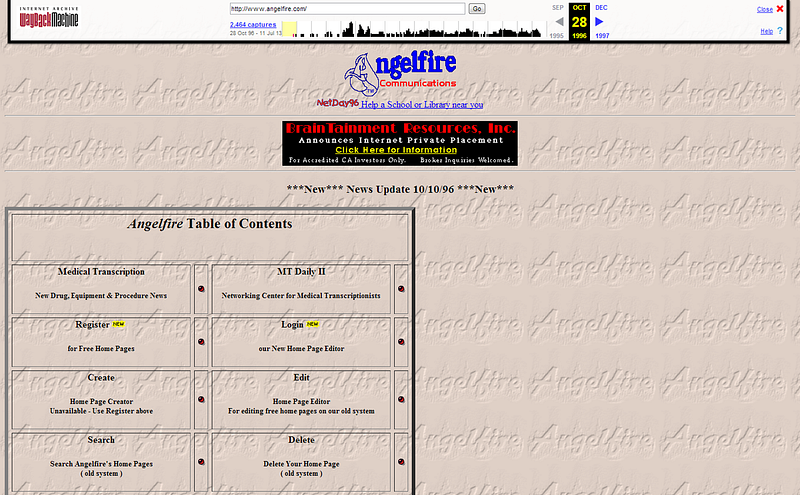
Due to this belief, many websites in the 1990s could be see today as e-magazines or e-books. The Angelfire website above is very much a catalogue of webpages indexed by a table of contents. Not much thought is placed on the appearance of the website; It features a trademark 1990s-ugly wallpaper with its name on it. By today’s standards, this is toilet graffiti.
Near the end of the 1990s and the beginning of the Naughties, a change happened in time for the emergeance of social media: Friendster (social gaming, 2002), MySpace (social networking, 2003), YouTube (initially social video, 2005). Growing internet use associated with social media meant that there was a growing need to present unprecedentedly large swathes of content on computer screens. The early 2000s brought about new and innovative design and layout practices that still exist today.
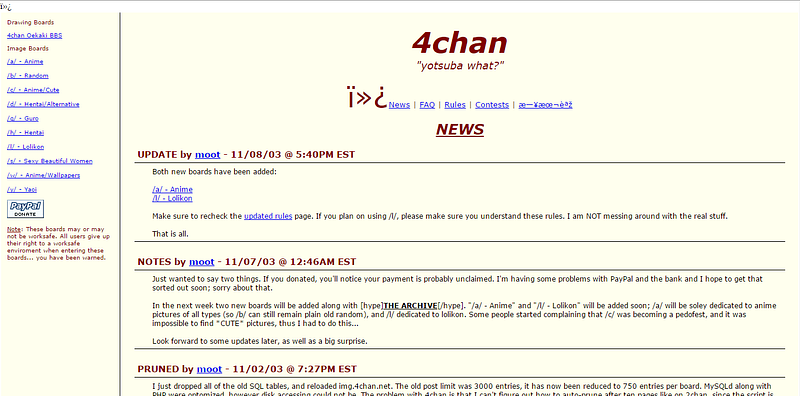
4Chan and Reddit were trailblazers in the triage and categorisation of data. They figured out that a good way to help users sort through content was to create categories (threads) and subcategories (sub-threads) assisted via prefixes (/a/ Anime, for instance). This categorisation principle would be combined with an open-source rewarding mechanism to sort out the good from the bad content. Reddit went on to embrace this principle, and made it their central business model.
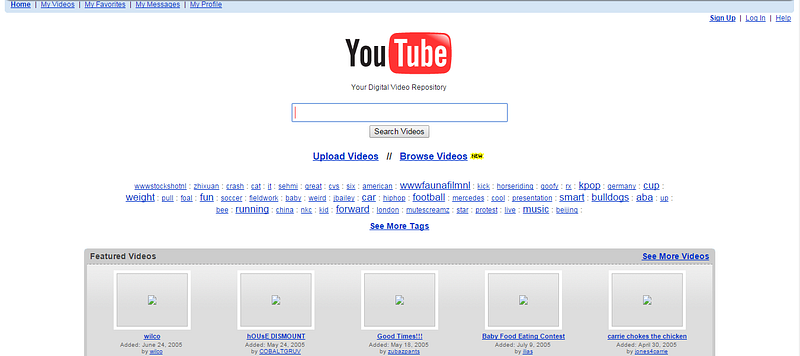
By examining YouTube’s evolution in UI design and layout, the consequences of such innovation become clear. At first, YouTube acted very much like a search engine, where users would look for what they wanted to see and had a relatively easy time finding a video on each desired topic.
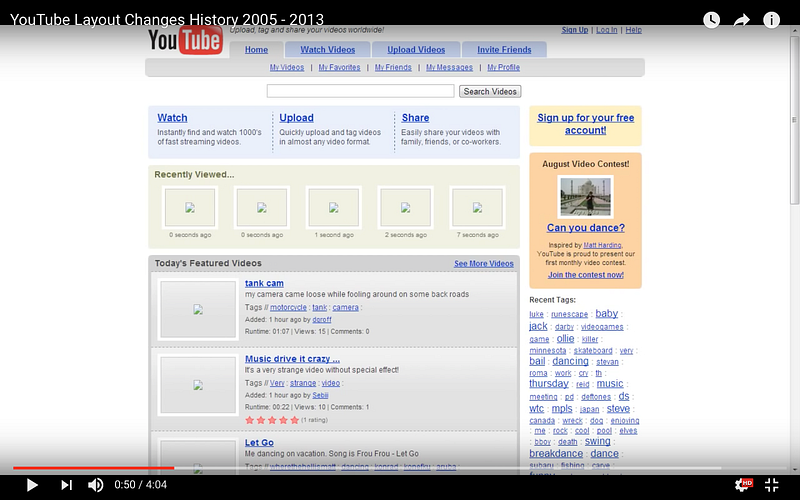
Towards 2008 and 2009 however, the amount of videos uploaded to YouTube were beginning to overwhelm this simple search-engine-like UI. YouTube adopted a new layout which placed a greater emphasis on “Featured Videos”, “Tags” and “Recent Viewability”. Hints of personalisation were just appearing, but the service was geared towards creating user loyalty and a deep community affiliation to YouTube. Tags encouraged content creators to become experts in their genres. Feature videos gave YouTube the ability to select content that it believed exemplary.
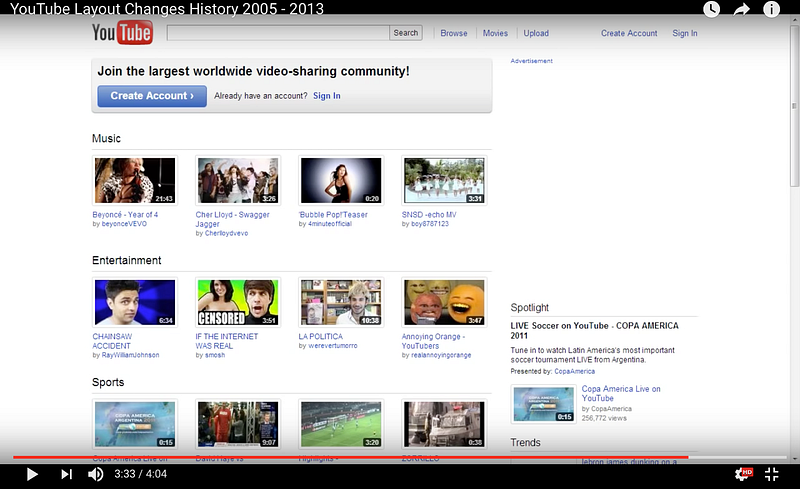
In 2013, YouTube once again introduced a set of changes to its UI and shifted its attention. This shift, intensified with every change since, was in line with Google’s algorithm policy: Videos were to be personalised in such a way that the individual user is directed towards seeing videos similar to those he/she has liked and/or seen. In every video panel, a right column appears suggesting previously watched videos as well as “Videos You May Also Like”. In this new paradigm, the number of views (or the number of video clicks) primes over the relevance and/or authenticity of the content.
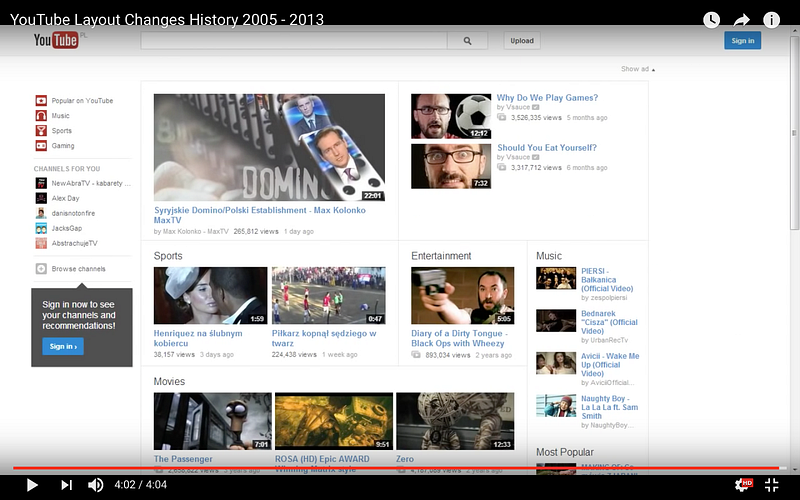
Giving up lists and adopting the tiles format, YouTube placed more emphasis on images and provided less space for text. This means content creators were tasked with creating titles and images interesting enough, to guarantee viewership (at the expense of providing an authentic summary of the video content). Amusingly enough, pop-culture responded to this new paradigm with the all familiar “Rick-Roll Prank”.
Written & Visual content aimed at higher viewership now trend towards:
- Punchy and/or provocative titles/images
- Trendy topics and/or relatable issues
When compiled with many other thumbnails on a web layout, this looks like a dizzying gallery of content that provokes saccading.
What is this word, saccading? A concept elaborated by the visual activist, Nicholas Mirzoeff, saccading ‘is an action taken by both eyes between two or more phases of fixation in the same direction.’ (Cassin & Solomon, 1990).
Saccading: the causal link?
By tracking the origins of today’s website layout paradigm, we drew a link between, the need to contain and process unprecedented amounts of content on a single-page, and the physical phenomenon of saccading. However, there is a missing link.
We are the missing link. Having created an environment of brevity and virality, content creators have been played at their own game. While providers seek to present as much content to users as possible, so as to maintain and increase daily active usage, content creators have engaged in a content arms race of proportions never previously witnessed.
The Arms Race: Look at YouTube
Did you know that ‘more video is uploaded on YouTube every month than the 3 major US TV networks created in 60 years’? (See more mind-blowing YouTube facts here).
While it is certainly true that the ‘featured video’ + ‘videos you may like’ system favours the more established content creators, YouTube’s model presents a great freedom of opportunity to those creators willing to put in the time & effort. The speed of information and frivolity of fashions mean that statistically it is possible for you or me to equal Casey Neistat’s subscription count in three to four years.
In fact, due to the nature of UI/UX on YouTube, it is much easier for a popular YouTuber to lose a massive following after a series of missteps or a dry spell. The fact of the matter is that content consumers expect creators to generate regular content on a weekly (if not daily) basis. This content must stay relevant to current events and faithful to the channel’s underlying themes/motifs.
Apple and Casey Neistat are two creators that have not only understood this key issue, but also sought to bring saccading right into their video content.
Keeping my opinions about the new iPhone to myself, Apple’s promotional video for this year’s Apple Keynote was impressive. In a video that should’ve been accompanied by an epilepsy warning, Apple’s “Don’t Blink” captured the attention of millions because it played straight into our now acquired taste for brief saccading snapshot content. The video brought something fresh to a Tech-Ad Genre that has, until now, stagnated to either boring stock footage of people laughing at salad bowls or Wes Anderson style phone-table presentation.
Casey Neistat, a YouTube personality with 1 billion total views (mainly from his daily VLOGs), also gets it. Among many filmography innovations, the “Neistat Cut-Off”, as Film Scholar This Guy Edits calls it, is Casey’s way of tailouring his content to our decreasing attention spans.
Casey Neistat understands how demanding YouTube consumers can be, especially whilst YouTube presents dozens of alternative videos they can watch in the right column (beside the video). The cut-offs are designed to keep the attentions of the consumer on the video at the centre of the screen.
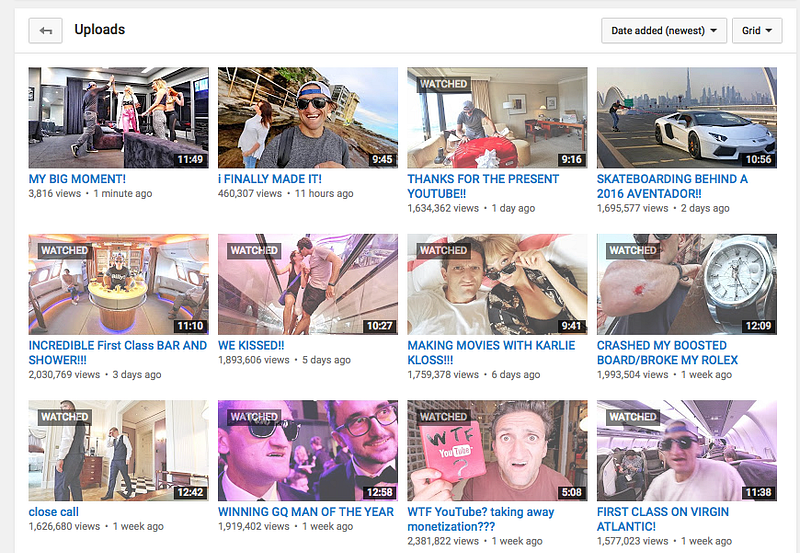
We know Casey Neistat is aware of our short attention-spans as he regularly uses “click-bait” titles + thumbnails to attract new consumers to his channel. Just take a look at the screenshot of his last twelve VLOGs above:
- 10/12 are completely capitalised
- 9/12 feature exclamation points and/or the extensive use of question marks
- an average of 4.33 words per title
Of course, these practices are by no means unique to YouTube; they are basic media marketing practices from book covers to movie titles.
Casey’s content behaviour on YouTube didactically speaks to the role of saccading on the Internet.
Lower Attention Spans are an emergent property of a complex interplay of marketing practices and consumer behaviours.
Technological limitations posed by UI/UX (for instance) have the power to determine the nature of this interplay.
We hope you enjoyed reading Part 2 of our Wonk Bridge series on Internet Culture & Society. See Part 1 if you haven’t already, and CLICK FOLLOW for Part 3 COMING SOON!!