Seeing is not Believing
We still have trouble understanding 21st century communication. Taking a page out of Mirzoeff’s book, let’s see how we understand visual media differently. Why this is important in an increasingly polarised society.

Eric Garner’s death by NYPD chokehold, went viral and spawned some of the largest #BlackLivesMatter and #ICantBreathe protests in the past years. However, along with several other high-profile police-linked murders in the USA, the same videos were fuelling white-supremacist and NRA membership.
How can a video spawn such contrasting views?
The answer lies in the way people interpret information in the digital age.
Nicholas Mirzoeff’s How to See the World sheds a crucial light on the physiological and sociological reasons that drive today’s communication paradigm.
Seeing is not only about the eyes
Before the momentous coming of the Information Age, images held a special and rare place in political culture. They were valued as important sources of evidence, even proof. The effect of IMINT (Images Intelligence) during the Cold War was crucial.
Our growing visual conscience
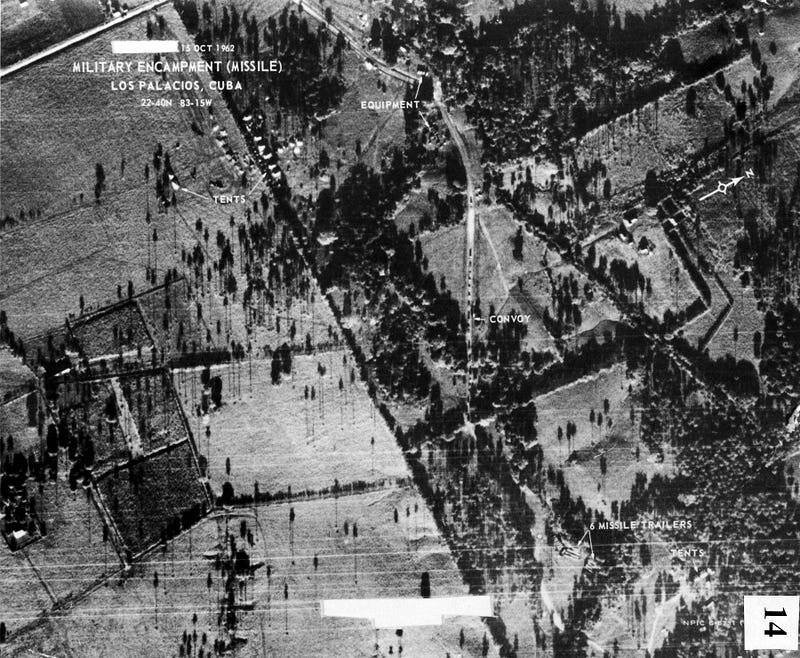
IMINT was central to the USA exposing the Soviet Union for its activity during the Cuban Missile Crisis (1962). On the flipside, the 1960 Gary Powers incident, when a U-2 surveillance fighter was shot down by the USSR, marked one of America’s low points.
Forty years later, in 2003, Colin Powell used IMINT to (intentionally or unintentionally) mislead the UN Security Council into invading Iraq.

The images were labelled and commented on, professionally and under-oath. At this point, we can already notice that it was slightly more difficult for Powell than it was for Kennedy’s team. Not because the IMINT was fake, but because society’s relationship to visual data was beginning to change. Check out his historical speech here.
Contrary to 1962, Powell’s use of visual data was received with scorn and skepticism abroad. Dominique de Villepin’s speech in response de Powell and against the invasion of Iraq is still hailed as a high-point of French diplomacy. As Mirzoeff puts it, in the first possible political use of Microsoft Powerpoint, the highly annotated slide shows how annotation can actually can actually raise more eyebrows.
As we’ve exposed ourselves to more visual data, we’ve come to expect so much more from images; heavily annotated black/white IMINT just doesn’t cut it.

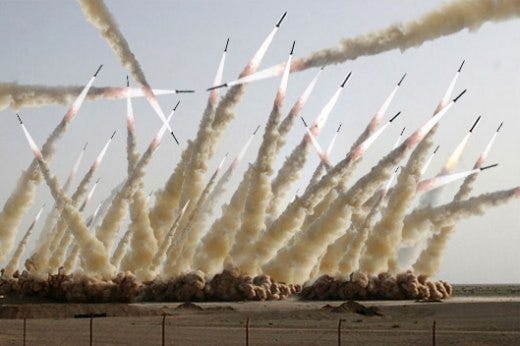
In fact, in the years following, the satirical use of political images and the development of text-image combinations (memes) became one of the most impactful displays of socio-political protest. My favorite is when Iran, to mask a technical failure, doctored an extra missile into their strategic missile-test images.
We See With More Than Just Our Eyes
In 2009, Nassi and Callaway discovered that among primates visual processing occurs on two ‘streams’ of brain activity. As Mirzoeff alludes, vision is a plural noun: perception and action. ‘One aspect identifies a friend, and the other reaches for his/her hand to shake it.’
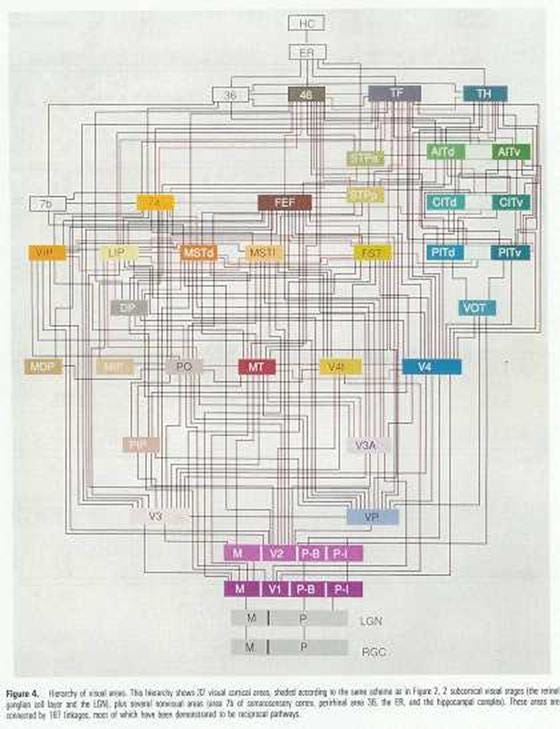
In fact, there are over 80 (and counting) different areas of the brain associated with processing vision. Felleman & Van Essen’s “Hierarchy of Visual Areas” effectively map out this neurological complexity.
On a sensory level, vision is already a collaborative effort. While looks can be deceiving, your five other senses + a plethora of other visual sensors associated to the brain can aid you in identifying and associating what you see with your lived experience.
Yet, seeing is as much based on mindset as it is on sensory experience. Daniel Kahneman’s best-seller Thinking Fast and Slow explains how we “think”. Kahneman points at how judgement can be determined by an interaction between one’s System 1 (intuitive/emotional) and System 2 (analytical/rational) cognitions.
‘During the talk Kahneman offered his take on how the mind processes information in two distinct ways. “System 1,” he explained, is the brain’s fast, automatic, intuitive approach. “System 2,” he said, refers to the mind’s slower, analytical mode, where reason dominates. But the first often dictates the second.’ — Koleen Walsh, Harvard Staff Writer
Simply put. People “see” what they are used to seeing. Our tendancy towards associating what we perceive visually with predetermined ideas, is a way of creating an understanding of the world around us. This understanding is what provides us with the cognitive stability to feel safe in the world. It is thus difficult to shake off.
Simon & Chabris’ “Can You See the Gorilla?” is a selective attention test from 1999 that exposes how our two systems can lead to cognitive dissonance. The experiment was uploaded on YouTube in 2010 and immediately went viral; society is fascinated with these amusing occurrences.
While the experiment is rather simple and amusing, these neurological traits have grave consequences socially and politically. Over the years, we all develop cognitive biases or pre-supposed judgements that are filed into our System 1 brains. They lead us to living in a prison of the mind, a cortexual isolation. Many Americans can develop a hostile attitude towards muslims due to a cognitive association of terrorism with the Muslim demographic. It is no coincidence that xenophobia towards Muslims is found most often in communities with the lowest amount of Muslims or minority populations.
Along with a swathe of other factors (of course), the media’s constant discussion of muslims in the context of war and/or terrorism has cemented this perception among those who can’t counter-balance this view with other experiences. In this lens, Donald Trump’s hate speech towards hispanics, muslims and pretty much every other minority (+ women), can’t be defeated with raw logic and clear explanation. Instead, it may be more useful to help the American public shift its mindset in a way so that it can “see” the gorilla. Should you have an idea on this, please shoot me a message ASAP!
We are being told how to think
Today, our constant connection to the Internet and social media has put our critical thinking at risk. My favourite YouTuber, Evan Puschak, made a video about “The Treachery of Images”. Watch it now, and then I guarantee that you will spend the rest of your day watching all of his other videos.
You knew it was coming. It’s the artpiece everyone starts piping about (the pun is always intended) as soon as the conversation on communication goes cognitive.
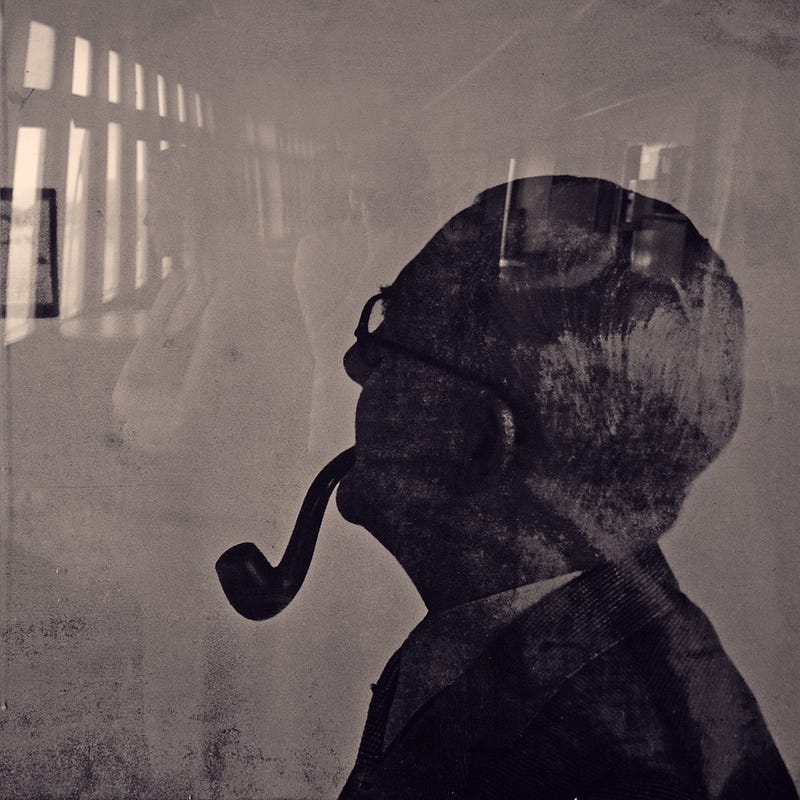
René Magritte’s “La Trahison des Images” (or “The Treachery of Images”) is a simplistic painting of a pipe with “this is not a pipe” transcribed underneath it. It comments on how we often take images for granted. René reminds us that just because we think we know what the drawing (or data) is about, does not mean we are right.
That the mental association we make (this drawing looks like a pipe and therefore is a pipe), is fundamentally incorrect.
Yet, at the same time, it is a commentary on commentary itself. Why should anyone trust the text underneath (this is not a pipe)? What authority does the painting have in dictating the way I think/feel about it?
The text traps you into a certain interpretation. It reduces your options. As is often the case for the most important events covered by the media, primary sources are rare and shallow at best. Terrorist attacks, mass shootings and images from the Middle East are rare to come by and heavily annotated.
Of course, it is important to analyse and explain events to audiences. But being unable to provide recourse to critical thinking and/or to opposing schools of thought can lead to ignorance.
For instance, Vox has become a one-stop resource on YouTube for visual explanations on current events (particularly for American liberals). This video seeks to use data representations to highlight certain topics of the Gun Debate in America.
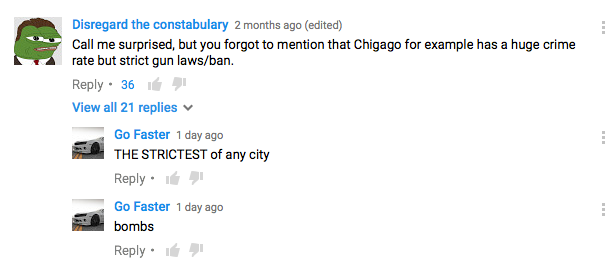
YouTube is a great medium when it comes to annotating data as it ensures artists get a monopoly on the creative process. Nevertheless, the comments section still allows for conversation/cynicism:
The Washington Post’s use of the Federal Bank of St.Louis’ gun violence infographic leads to a more “balanced” annotation of the data.
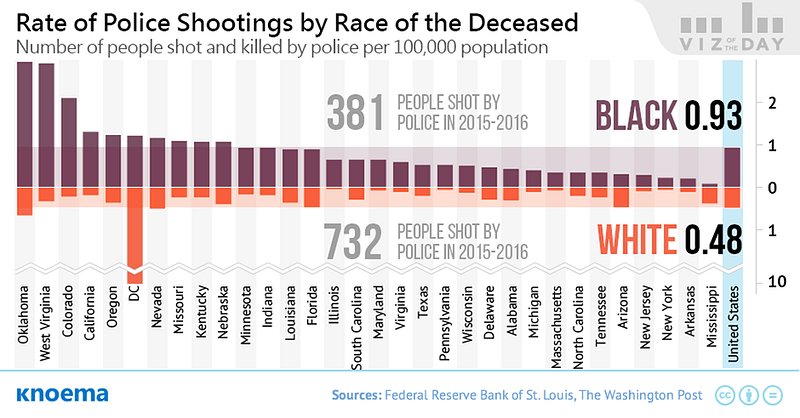
It can be interpreted in two different ways. There are six key pieces of data on this infographic:
- Total Number of Casualties in 2015–2016 for Whites
- Total Number of Casualties in 2015–2016 for Blacks
- Number of casualties per 100,000 people for Whites
- Number of casualties per 100,000 people for Blacks
- Oklahoma figures
- Washington D.C. figures
A person interested in linking the gun violence issue with race inequality and police brutality would more likely use the per 100,000 people casualty figure and discuss the Oklahoma figures. A person who thinks that gun violence has little to do with race and/or the police would likely look at total casualties and D.C. figures.
Concluding Part One.
I am dividing this thought-piece into two parts. This piece treated how our obsession with cognitive association leads us to losing our ability to think critically. The next section will look at how we can change the way we communicate to better fit this new reality.
Let us not forget René Magritte’s lessons. Humans are especially vulnerable to generalisation. 21st century media is particularly guilty of simplifying events and experiences to mere intuition and/or ‘feelings’. In the context of rising extremism and radicalisation, we should be mindful of who’s in charge: the subject or the object?