
A Pre-Antibiotic World Is Not an Option: Why We Should Know Better
Antibiotic-resistant strains continue to emerge and proliferate.
The World Health Organization predicts that ‘superbugs’ could result in up to 10 million deaths annually by 2050. What path are we currently on to prevent this crisis?
When the Covid-19 pandemic hit, a wave of biological information ran over television and newspapers. Doctors, biologists, and scientific communicators were explaining how epidemics and pandemics can arise, and how it’s essential to work in advance to prevent their catastrophic effects.
Possible future landscapes, well-adapted to the gloomy times of the lockdown, included unknown pathogens resurfacing after thousands of years from melting permafrost (something like this one) and the return to a pre-antibiotic era following the rise of resistant bacteria.
The latter is perhaps closer than we can perceive.
On Molds and Random Discoveries: the First Antibiotic
‘One sometimes finds what one is not looking for. When I woke up just after dawn on that September day, 1928, I certainly didn’t plan to revolutionize all medicine by discovering the world’s first antibiotic, or bacteria killer. But I suppose that was exactly what I did.’
Alexander Fleming on the discovery of penicillin
On September 1928, microbiologist Alexandre Fleming returned to his lab in London to find what no scientist likes to find on their bacterial cultures: mold.
A contaminated experiment is a lost experiment. Fleming could have simply trashed the dishes, but he noticed instead that bacteria consistently did not appear to grow in close proximity to the mold, as if the latter were producing something to which the bacteria were sensitive. It was the discovery of penicillin, which would then become the first antibiotic.
While Fleming immediately understood the potential of what he had discovered, his findings received little to no attention in the scientific community. It was only in the late ’30s, when a team from Oxford finally managed to produce an efficient purification protocol for penicillin, that his discovery received the interest it deserved.
It was the beginning of the antibiotic era.

Antibiotics and Resistance
Unfortunately, an antibiotic is not meant to last forever. As bacteria co-evolve with us, they eventually become able to cope with the drugs we use to fight them, developing resistance.
What does that mean? Unlike viruses — which consist of a capsule, some DNA — or RNA, like the coronavirus — and a couple of proteins, bacteria are full-cell organisms.
A bacterial cell (prokaryotic group) presents similarities and differences from an animal cell (eukaryotic group). This means that, when a bacterium infects an organism, we can safely fight it by using compounds that target structures specific to bacterial cells: antibiotics.
The short-term side effects that we experience when taking antibiotics are not due to damage to our cells, but rather to the “good” bacteria that live in symbiosis with our organism and that are essential for the correct functioning of our body.
Now, bacterial proliferation consists of DNA replication, followed by the cell splitting to give birth to two cells. In optimal conditions, bacteria can proliferate rapidly, doubling on the scale of minutes. While proliferating, random DNA mutations can arise and be carried by the new bacteria.
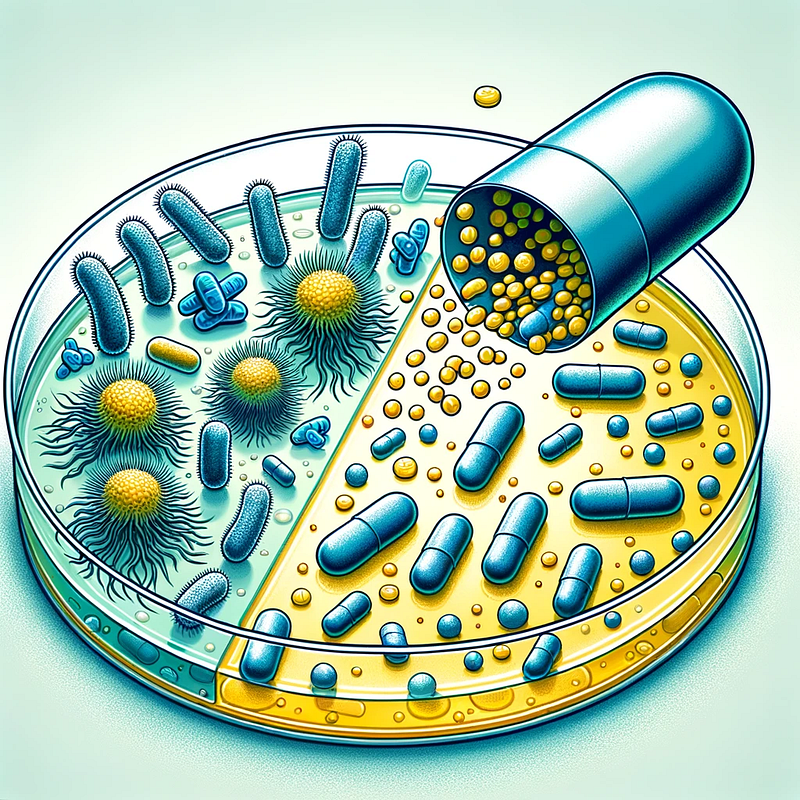
If these mutations have a negative effect, the bacteria will likely not survive and therefore not pass the mutation on to the next generation. If the mutation has a positive effect, the bacteria will likely survive and continue proliferating. A positive effect depends on the condition, which in this context is referred to as selective pressure. If a mutation that confers immunity to a certain antibiotic arises, the use of the antibiotic itself will select for this mutation by killing all the bacteria that do not carry it. The small resistant population will go on proliferating.
The Possibility of a Pre-Antibiotic World
Antibiotic resistance is very much a present situation, and not only that; resistance to antifungal agents is increasing as well. Multi-drug resistant strains (or ‘superbugs’) are already out there, including very common opportunistic pathogens like Staphylococcus aureus.
The emergence of resistant strains has become more and more frequent in the last decades: in 2010, the antibiotic ceftaroline was introduced, and just one year later, a strain of resistant Staphylococcus was already identified.
Reports from the World Health Organization (WHO) predict that at the current rate, antibiotic resistance may cause up to around 10 million deaths yearly by 2050 (as a comparison, estimates from WHO report that Covid-19 caused 3 million deaths in 2020).
While it’s true that bacteria spread slower than viruses, current hospital organization is probably not adapted to fight a potential outbreak of resistant bacteria. Returning to a pre-antibiotic world would make curing even common infections very difficult, and would render what is now considered routine practices, such as surgery, definitely less safe.
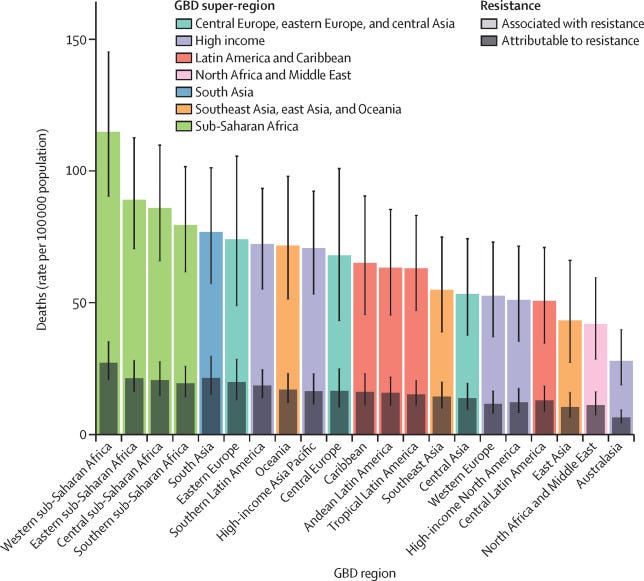
While the acquisition of resistance is inevitably linked to drug exposure, the overuse of antibiotics (through wrong prescriptions and extensive agricultural use) undoubtedly accelerates the selection of resistant strains. What can we do to combat this?
On New Antibiotics…
At this point, it may be surprising to hear that the introduction of new antibiotics has decreased compared to the ’90s. This is mostly because our system relies on private companies for drug development and production, and antibiotics are not profitable drugs. They are used for short-term treatment and often work quickly, therefore not being as profitable as drugs for chronic disorders, such as psychiatric conditions or diabetes.
In 2013, a cost–benefit analysis by the Office of Health Economics in London calculated that the net present value of a new antibiotic is only about $50 million, compared to approximately $1 billion for a drug used to treat neuromuscular disease.
An additional problem with tackling antibiotic resistance through the introduction of new antibiotics is that a new resistance will eventually arise. However, the prudent use of antibiotics can definitely slow down the rate at which this occurs, buying time to develop new antibiotics.
… and Fighting Bacteria Using a ‘Collateral’ Weapon
In a recent study published in ‘Nature Communications’, a Spanish team suggested exploiting a biological phenomenon called collateral sensitivity (CS) to combat bacteria without using new antibiotics.
CS is the phenomenon by which strains resistant to a certain antibiotic show increased susceptibility to another one. Now, the first thought might be: if we simply exploit CS to treat bacteria with the second antibiotic, won’t we simply select a new resistant strain?
Here’s the point. We now understand the molecular mechanisms behind certain antibiotic resistances. Scientists have suggested using our molecular knowledge to transiently induce the resistance, and therefore the CS that accompanies it, to treat bacteria with the second antibiotic without selecting resistant strains. They used as a case study the multi-resistant bacterium Pseudomonas aeruginosa, an opportunistic pathogen (which means that it is normally present in our body but can become pathogenic if conditions alter, as happens during another infection or surgery, for instance).
P. aeruginosa strains resistant to ciprofloxacin (which for simplicity we’ll call antibiotic A) present collateral sensitivity to tobramycin (antibiotic B). Resistance to A is caused by a DNA mutation leading to the overproduction of a membrane channel that literally pumps A out of the bacterium.
The researchers hypothesized that by artificially and transiently (so, without DNA modifications) inducing the overproduction of such a pump in a bacterium, they could induce resistance to A, and therefore increased susceptibility to B.
Through a series of elegantly combined experiments, the scientists demonstrated that 1) CS can be artificially and transiently induced; 2) it is effective at eradicating a wide range of strains under lab conditions; and 3) in large populations, the surviving bacteria, once the artificially induced CS is reversed, do not present increased resistance to A, B, or other antibiotics.
While these results have yet to be applied in clinical settings, they present a promising additional tool in the fight against bacterial resistance.
We Should Know Better
Scientific and technological advances have brought our society a level of comfort that we wrongly normalize. Just as socio-political systems should never be taken for granted and must be closely and actively monitored, so too should natural world-related pillars, such as interactions with other organisms (including microbes) and climate stability.
Taking most of the population by surprise, the 2020 pandemic showed us how fragile the equilibrium on which our systems rely truly is. Dynamics can change quickly, and it is our responsibility to think long-term and plan in advance to prevent foreseeable crises from occurring.
Antimicrobial resistance, like climate change, has been discussed for a long time. Yet, the production of new antibiotics — and more generally, antimicrobials — appears to be slowing, and the market for them is defined as “broken” and not profitable. Such a trend raises the question of whether the response to a healthcare emergency should rely on a public long-term plan and funding rather than solely on private companies.
Our common sense does not immediately perceive the danger behind non-linear phenomena (such as disease outbreaks and climate change), often realizing it only when it is quite late to act. But Covid-19 and climate change are teaching us a lesson: let’s apply it.


