avatarJanice Harayda

Free AI web copilot to create summaries, insights and extended knowledge, download it at here

2537

Abstract

r put it, founded on “the theological truths of the Faith, but particularly on three of them which are basic — the Fall, the Redemption, and the Judgment.” But she transcends the label “Catholic writer.”</p><p id="9434">Porter conveys “her Franciscan joy in created things” and “reminds us that the idea of the holy is still possible for us,” the poet David Shapiro note in his foreword to <i>Living Things</i>. At the same time, her poems spring from everyday life, particularly her role as the mother of five children by her late husband, the artist Fairfield Porter.</p><p id="5773">Many of her rhymed and unrhymed poems are meditations on saints, holy days, or Bible verses. Others are hymns or prayers, steeped in a sense of wonder and gratitude reminiscent of that of Gerard Manley Hopkins, the Jesuit poet who wrote: “Glory be to God for dappled things.”</p><p id="6265">One of the most memorable poems in <i>Living Things</i> is “A Short Prayer,” an interpretation — you might even call it a brief modern translation — of the Hail Mary. In “An Easter Lily” Porter considers the gift of a lily:</p><p id="5ece"><i>Whose whiteness Is past belief</i></p><p id="cb74"><i>Its blossoms The shape of trumpets Are mute as swans </i> <i>But deep and strong as sweat Is their feral perfume.</i></p><p id="32d2">In seven short iambic lines, Porter links the Easter lily to glory (“trumpets”), martyrdom (“swans”), and purity (the whiteness of the lily and swans). And she does more.</p><p id="3b23">The best-known Bible verse about lilies, Matthew 6:28, says they “toil not” — they <i>don’t</i> sweat. Porter’s simile — “strong as sweat” — encourages you to consider the strength of the lily as well as its grace. It also connects flower implicitly to the sweat of Christ carrying the cross. Could anyone look at a lily the same way after reading this poem?</p><h2 id="ca4a">Honoring a son believed to have autism or schizophrenia</h2><p id="d0de">Several other poems also relate to Easter, including “In Holy Week,” “Cradle Song II” and “Four Seasons Carol.” Anyone who likes strong rhymes may also enjoy the more secular “House Lots,” a meditation on the arrival of bulldozers: “Good-bye sweet whistling quail/ Milkweed and Queen Anne’s lace/ Good-bye shy cottomtail/ Quit your secret room …”</p><p id="4873">Perhaps the most poignant poem in <i>Living Things</i> is the loving reminiscence, “For My Son Johnny.” Porter told the <i>Wall Street Journal</i> that she believes her late son suffered from either schizophrenia or autism.

Options

In the poem she recalls, among other things, his kindness:</p><p id="c0d3"><i>Though your shoelaces were hardly ever tied And you seldom wore matching socks You tried to behave with dignity in the village “So as not to embarrass my little sisters.”</i></p><p id="c329">Porter’s natural tone and diction, in that poem and others, are part of the charm of her book. The work of religious poets can imitate, consciously or unconsciously, the language of Scripture or the great metaphysicists. Porter has a voice all her own that you can hear in her <a href="https://www.poetryfoundation.org/poets/anne-porter">poems posted</a> by the Poetry Foundation. How lovely that, however belatedly, people discovered it.</p><p id="30dc"><i>@<a href="https://janiceharayda.medium.com/about">Jan</a> is an award-winning critic and journalist who has been the book columnist for </i>Glamour<i> and the book editor of a large newspaper. She has also been a vice president of the National Book Critics Circle, a role that included serving as a judge for its annual award for poetry.</i></p><p id="8f6e"><b><i>You might like two of my other stories for Medium on poetry:</i></b></p><div id="dd29" class="link-block"> <a href="https://janiceharayda.medium.com/how-to-be-absurdly-well-versed-in-poetry-c979ff6be9de"> <div> <div> <h2>How to Be Absurdly Well-Versed in Poetry</h2> <div><h3>A fast and easy way to learn about many types of poems</h3></div> <div><p>janiceharayda.medium.com</p></div> </div> <div> <div style="background-image: url(https://miro.readmedium.com/v2/resize:fit:320/1*Uh-QnTnGDYNelqGBzBjdaA.jpeg)"></div> </div> </div> </a> </div><div id="75a0" class="link-block"> <a href="https://readmedium.com/ukraines-heroism-through-the-eyes-of-its-most-popular-poet-bfcce76716c0"> <div> <div> <h2>Ukraine’s Heroism Through The Eyes Of Its Most Popular Poet</h2> <div><h3>An activist writer tells why he began taking bulletproof vests to the front in his new book, ‘Sky Above Kharkiv’</h3></div> <div><p>medium.com</p></div> </div> <div> <div style="background-image: url(https://miro.readmedium.com/v2/resize:fit:320/1*tsehXBFSyGDEQCv-vDoTCQ.jpeg)"></div> </div> </div> </a> </div></article></body>

MAKING HEADLINES AT 95

A Poet Who Proves It’s Never Too Late To Succeed As a Writer

She published her first collection at age 83 — and became a National Book Award finalist
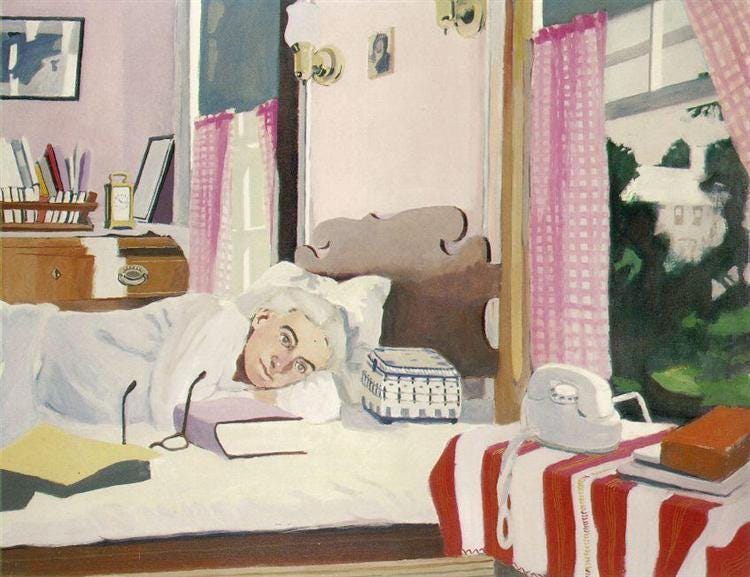
Anne Porter painted by her husband Fairfield Porter in “July Interior” / Smithsonian Institution

You could easily get the impression from the media that all successful authors start writing when they’re wearing footed pajamas.

Take Amanda Gorman. At the age of 22, she read one of her poems to the world at Joe Biden’s inauguration. She became the first poet to perform at the Super Bowl and appeared on the cover of Time. She’s published seven books and has others in the works.

Gorman is 26 years old.

Her superstardom is exceptional, but literary history abounds with writers who struck gold early. S.E. Hinton’s The Outsiders came out when she was 18, F. Scott Fitzgerald This Side of Paradise he was 23. Philip Roth was 27 when he won a National Book Award for Goodbye, Columbus.

Late-blooming authors get less attention, but writers can leave their mark at any age. In recent years no one has made that clearer than the poet Anne Porter, who died in 2011 a few weeks before her 100th birthday.

Porter won acclaim when, at the age of 83, she published her first book of poetry, An Altogether Different Language, which became a finalist for a 1994 National Book Award.

Her second collection, Living Things, came out in 2006 and brought more recognition. A Wall Street Journal article about her ran under the headline: “A 95-Year-Old Poet Finds Her Muse and Literary Praise.”

Living Things has all the poems from An Altogether Different Language and 39 new ones, and if you’re unfamiliar with her elegant work, the Easter season is an ideal time to discover it.

Poetry rooted in her faith

Porter is a Catholic poet in the same way that Flannery O’Connor was a Catholic novelist. She describes a world that is, as O’Connor put it, founded on “the theological truths of the Faith, but particularly on three of them which are basic — the Fall, the Redemption, and the Judgment.” But she transcends the label “Catholic writer.”

Porter conveys “her Franciscan joy in created things” and “reminds us that the idea of the holy is still possible for us,” the poet David Shapiro note in his foreword to Living Things. At the same time, her poems spring from everyday life, particularly her role as the mother of five children by her late husband, the artist Fairfield Porter.

Many of her rhymed and unrhymed poems are meditations on saints, holy days, or Bible verses. Others are hymns or prayers, steeped in a sense of wonder and gratitude reminiscent of that of Gerard Manley Hopkins, the Jesuit poet who wrote: “Glory be to God for dappled things.”

One of the most memorable poems in Living Things is “A Short Prayer,” an interpretation — you might even call it a brief modern translation — of the Hail Mary. In “An Easter Lily” Porter considers the gift of a lily:

Whose whiteness Is past belief

Its blossoms The shape of trumpets Are mute as swans But deep and strong as sweat Is their feral perfume.

In seven short iambic lines, Porter links the Easter lily to glory (“trumpets”), martyrdom (“swans”), and purity (the whiteness of the lily and swans). And she does more.

The best-known Bible verse about lilies, Matthew 6:28, says they “toil not” — they don’t sweat. Porter’s simile — “strong as sweat” — encourages you to consider the strength of the lily as well as its grace. It also connects flower implicitly to the sweat of Christ carrying the cross. Could anyone look at a lily the same way after reading this poem?

Honoring a son believed to have autism or schizophrenia

Several other poems also relate to Easter, including “In Holy Week,” “Cradle Song II” and “Four Seasons Carol.” Anyone who likes strong rhymes may also enjoy the more secular “House Lots,” a meditation on the arrival of bulldozers: “Good-bye sweet whistling quail/ Milkweed and Queen Anne’s lace/ Good-bye shy cottomtail/ Quit your secret room …”

Perhaps the most poignant poem in Living Things is the loving reminiscence, “For My Son Johnny.” Porter told the Wall Street Journal that she believes her late son suffered from either schizophrenia or autism. In the poem she recalls, among other things, his kindness:

Though your shoelaces were hardly ever tied And you seldom wore matching socks You tried to behave with dignity in the village “So as not to embarrass my little sisters.”

Porter’s natural tone and diction, in that poem and others, are part of the charm of her book. The work of religious poets can imitate, consciously or unconsciously, the language of Scripture or the great metaphysicists. Porter has a voice all her own that you can hear in her poems posted by the Poetry Foundation. How lovely that, however belatedly, people discovered it.

@Jan is an award-winning critic and journalist who has been the book columnist for Glamour and the book editor of a large newspaper. She has also been a vice president of the National Book Critics Circle, a role that included serving as a judge for its annual award for poetry.

You might like two of my other stories for Medium on poetry:

Poetry
Easter
Aging
Books
Writing
Recommended from ReadMedium
avatarMathyn Ressang
I wrote my first screenplay!

7 min read