
A Mother’s Heart Ripped Out
A death that should not have happened from a routine traffic stop.
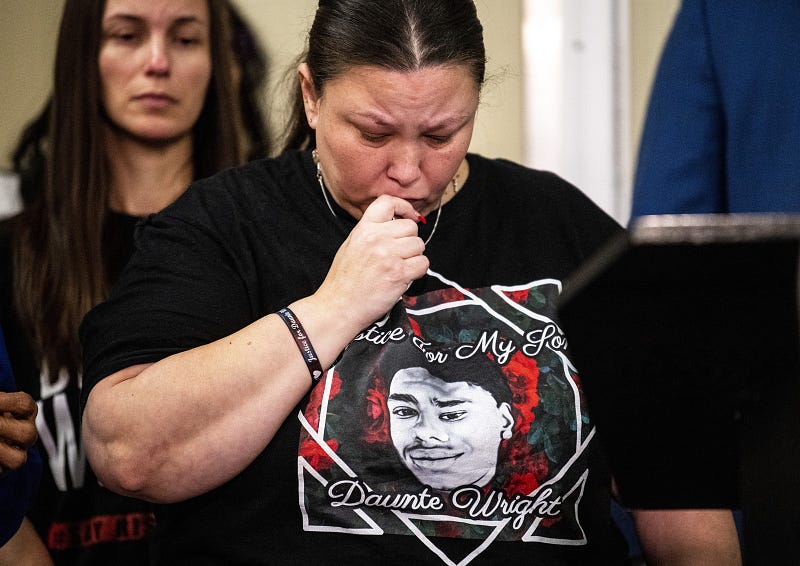
To lose a child in this manner, young or old, no words can begin to describe the anguish and agony that haunts a mother’s heart. Every day and every night the words haunt her, “What could have I done more to protect my child from a system designed to take his or her life, due to skin color.
The memory of that awful day, when your child drives down the street minding his or her own business and gets stopped by three police officers because of an air freshener hanging in the rearview mirror of the car. This was the beginning of an ugly situation and the end of a young man’s life.
While it all sounds unreal, it is true. Daunte Wright lies in his grave and his mother’s heart is broken into a million pieces and can never be put back together. What does she tell Daunte’s child, her grandchild who will never see his father again, or touch him or feel his touch, his arms around him or his laughter? Nothing can replace his life, not even a guilty verdict. Daunte Wright is gone forever
What happens as this child grows up and comprehends the true reality of his dad’s life and how he was shot in his own car trying to do the right thing and a policewoman with two other officers pulled her gun and shot his dad at close range, who then claimed she mistook her gun for her taser? This explanation does not hold water.
Kim Potter was an experienced officer who had been on the force way over 15 years and had trained other officers. How is this type of mistake possible?According to the media, her life was not even in danger. Now, here is food for thought. Why shoot then? Three officers against one unarmed small frame Black man.
This policewoman, Kim Potter, took one life off this earth but in the meantime, she has wounded his family and friends and these wounds will last a lifetime and perhaps even generations to come learning what happed to their loved one.
According to the news media, the jurors are currently being selected for Potter’s trial who claimed she make a mistake pulling out her firearm for her Taser and fired at Daunte Wright, 20, killing him as a result of a routine traffic stop in Minneapolis, Minnesota.
Jury selection is very interesting as the goal of the defense attorney is to prove innocence not whether he believes innocence but to prove it as such, and the prosecutor to prove guilt regardless of what he or she thinks. Potter is being charged with manslaughter.
There is an estimate of 200 potential jurors that are being questioned extensively regarding any information, what they how about the case, if they participated in the demonstrations or marches related to policing that took place in the Twin Cities area in the last two years, if they carried signs, do they know anyone who suffered injury or property damage during those demonstrations, to explain their feelings regarding the protests impact on the community, negatively or positively, have they ever helped or supported or advocated in favor or against police reform, if they support defunding the police, and their positive or negative impression about the officer shooting of Daunte Wright on April 11.
Shockingly but not totally surprised, that the Potter’s defense team is allowed to dismiss up to five jurors without an explanation while the prosecution can only dismiss three, this is a standard in Minnesota courts. This practice seem swayed in my opinion toward the defense team, why not make it equal in the eyes of the court.
America’s court system is rigged and riddled with so much injustice from the Supreme Court all the way down to the local court systems. Even in the Derek Chavin guilty verdict, the defense was allowed 15 strikes compared to nine for the prosecution, as neither had to justify using a so-called peremptory strike unless the other side argued it was because of a juror’s race, ethnicity, or gender. At the scene of Daunte Wright’s murder, there were three officers including Kim Potter when she shot him. Being pulled over for a routine stop and they discovered that Wright had a warrant out for him on a gross misdemeanor charge.
Three police officers could not handle one Black twenty-year-old medium build man who was unarmed? Perhaps, these officers need to rethink their profession. If this is the best they can do, then this is not enough, and all need to pay for taking a life that didn’t warrant the crime. Potter pulled her gun and yelled ‘taser taser taser” as she shot Wright. These two objects, a taser gun, and a firearm are grossly different in weight, size, and design. How could this happen? Prosecutors are charging her with first-and second-degree manslaughter due to her experience and long tenure as an officer and should know the difference between a taser and a gun.
Minnesota’s sentencing guidelines call for a sentence of just over seven years on the first-degree manslaughter count, and four years for second-degree, but the prosecutor is seeking a longer sentence.
In conclusion, Kim Potter took a life. Why? No one will ever know for sure. The only thing that one can be certain of is that she shot an unarmed Black man, while her life was not in imminent danger. As the saying goes, “If you do the crime, you need to do the time.”
For additional reads:


