
A Modern Development In Brain-Wave Mapping Plus Some Future Scenarios
A recent breakthrough from the field, plus personal ideas of mine for applications down the line.

The field of Neurotechnology is one of the most exciting, as it connects the organic matter of the brain (long a source of inspiration for technology and from technology), with the computing we’ve become so behaviorally merged with in recent years.
I’ll briefly talk about an update from the field, and use that as a jumping-off point for my own analysis of where we might be headed. I have some rough ideas that I suspect we’ll eventually see developed, through further advancements of technology we’ve already seen.
Speech Mapping
Last week, the first device was invented that allows a paralyzed man to communicate his speech via his thoughts. A computer mapped the brain waves of his usual method of communication, via eye tracking on a computer screen where he spells out words.
A monitor was then hooked up to his brain waves, to later show that he could think of what he wanted to say, and have it translated for him directly. I won’t bother going into too much detail here, because the article linked above does a great job of explaining it.
The big Picture
I think many would agree that this is an amazing accomplishment. It essentially uses a computer to do what they were invented for — to make humanity’s work easier. A paralyzed person can be trained to spell words out on a screen, and a computer can also be trained to do it for him.
So the question going forward is: what else can we get a computer to do for us? Brain wave mapping is the operative concept here. In theory, just about anything a brain can tell a body, a brain can also tell a computer.
So if we can get a computer to connect to something that can do a body’s job, we’ve taken out the middle-man (the body — which might be conditionally faulty, or otherwise inefficient).
Needless to say, this has tremendous future application. Science fiction is filled with stories of robots and interfaces controlled from a human brain. One popular example of this is the cyborg.
Applications in Music
If you study some of the great composers from history, for example Mozart or Beethoven, both were famous for being able to hear their musical ideas, and compose them in their minds, before laying pen to paper.
You can probably see where I’m going with this. Writing out sheet music long-hand is already a thing of the past, given modern software. The simple first-step from here using brain-wave mapping, would be to map sheet music composition.
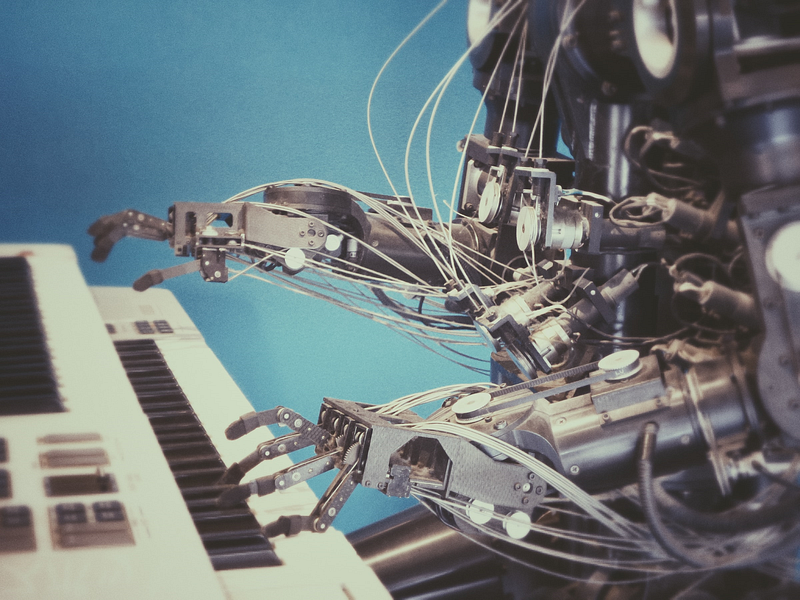
However, I’d like to take the idea a step further. Given how advanced computers are at synthesizing music, I’m going to suggest that composers could create and play music in real time, by using only their thoughts.
One possibility would be to have a robot controlled by the brain, playing an instrument (like in the below photograph). Another would be an interface where a synthesizer constructs music on the spot, from the composer’s mental ear.
The Soul of a new Artist
Tracy Kidder wrote a book in 1981 that was called The Soul of a New Machine, about the development of the modern computer, and the industry that ran in parallel. Nearly a half century later, we’re looking at the soul of a new user — a new artist.
Musicians could use future brain-wave mapped interfaces and devices to make music, directly from their minds. Who else could use it? Visual artists, graphic designers, movie directors, architects, the list goes on.
I suspect that this basic idea of mapping brain waves will be reiterated in more and more advanced ways as we move forward in time. If you can imagine it, it’s possible.
VR and AI that Respond to your Thoughts
An inevitable result will be VR that receives feedback from the mind. Consider an entire virtual world that responds to your thoughts.
Some examples of this: AI in a personal, computer-rendered world, that are programmed to offer just the right level of challenge and excitement. If you’re feeling bored, the AI might cook up a high-speed chase or epic street fight on the spot.
They might also conform to your more conscious wishes or preferences. Let’s say you’re one who thinks a great deal about symphonic music as your favorite genre. In your recreational VR world, you might soon find an opera house opening just down the block.
What can you think of that you’d like to see in these kinds of technological applications? The possibilities seem almost endless.
If you enjoyed this article, you might also like to read: