
The Gift of Time
A Journal of the Plague Year: Day 4
And on the fourth day the world stilled and slowed on its axis. The roads emptied, the shutters along the high streets remained down. The people breathed out, quietened, and maybe began to listen.
At the same time, here in the world’s North at least, nature is stirring as humanity settles. New shoots are pressing up from the earth after the respite of winter, the birds and squirrels in the garden are singing and springing in search of mates, the pond is lumpy with frogspawn. The planet is breathing also.
Today is Mother’s day, yet we are urged to stay home to protect our mothers. Alarming graphs scatter the internet showing that the spread of Coronavirus in the UK is now following, with two weeks’ delay, the exact trajectory of the disease in poor Italy. And so we rest.
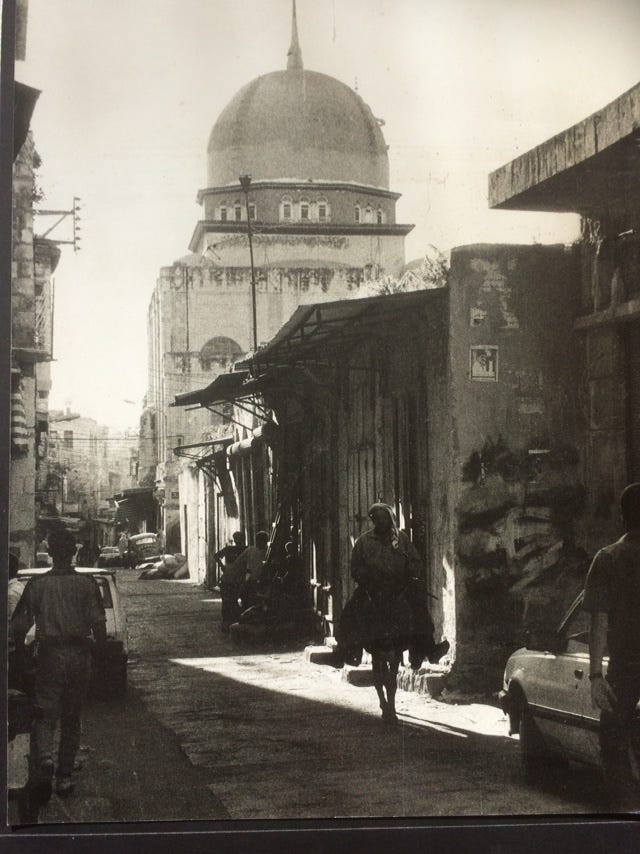
I have been here before, under very different circumstances. For my undergraduate degree I studied the improbable combination of Russian and Arabic. The third year was spent abroad, immersed in the language and culture of one’s choice. I did not want to attend a language school overseas where I would be surrounded by other English speakers. I sought full immersion. And so I passed a year, in 1993–4, in Nablus, the largest city in the north of the Israeli Occupied West Bank, helping to set up and manage an outpost of the British Council. The Intifada — the Palestinian uprising striving to throw off the oppression of Israeli occupation — was at full roar. Hamas was just beginning to emerge as a movement. There were Israeli army checkpoints on all of the routes out of town, Uzi-touting soldiers patrolling the markets and winding alleys of the ancient town, the aerials from their radio backpacks swaying above the crowds. Green-uniformed lookouts were stationed across the roof tops, ready to pick off Palestinian shabaab when they reached for the rocks of rebellion. The acrid tang of tear gas regularly floated across the barrows loaded with courgettes, aubergines and warm flatbreads beneath the windows of our office. I learnt a lot about post traumatic stress that year, but more on that anon.
The British Council took over the fourth floor of a six storey office building in the down town business district. It created classrooms, and a library of books and videos — this in the days before the internet or mobile phones. There was a basic kitchen, with two gas burners and an electric tea urn, for students to brew cardamom scented coffee and tooth jangling sweet tea. And — incongruously — a bedroom and bathroom, directly off the library, where I, as an unpaid student, lived.
On the 24 February 1994 an Israeli settler opened fire on Palestinians praying in a mosque in Hebron, exterminating 29 people. Occupation is humiliation, powerlessness, despair. Lifetimes with no hope or opportunity. The Hebron massacre shook up this cocktail of despair into a fury. Raging protests filled the streets of Gaza and the West Bank. After a few days attempting to dampen this fury with a mix of tear gas, rubber bullets, and live ammunition, the army enforced a curfew. Everyone had to remain in their homes, 24 hours a day, until further notice. They commandeered the loud speakers of the mosques in order to convey this order. It rang out across the bowl of Nablus, echoing back from the surrounding mountains where the very last of the Samaritans still reside.
The people of Nablus, the staff and students of the British Council, withdrew to their homes and families in the foothills. I was left alone, the sole occupant of a six storey building save for the soldiers who occasionally tramped up the stairs to their lookout on the roof. And any contact with them was out of the question. The curfew was lifted once a week for a couple of hours, to enable citizens to venture out to buy food and essentials. Only as time went by these became ever harder to find as nobody could get to the fields or warehouses to restock. And whenever it was lifted, rioting again filled the streets. And so we were forced back indoors, not even allowed to put heads out of windows.
We were under curfew, on that occasion, for three full weeks. Most of that time has faded to a blur in my memory, with only a few crisp moments standing out. I remember making origami mobiles using paper and wooden kebab sticks. I tried making glue out of flour and water, but it stuck nothing. I didn’t run out of food — I had tins, and dried food, and some scant fresh produce. But I did run out of bottled gas to cook my food on. I recall trying to boil a sweetcorn in the electric tea urn. And I was lucky, I had a whole library to distract me. I read. And, when the power was on, I watched a large back catalogue of the peculiarly British videos that the British Council saw fit to export to the world in the service of cultural diplomacy. Nature documentaries, Doctor Who, and the entire canon of Red Dwarf. We had one of those school assembly TVs on a wheeled stand. The windows all started about two feet above the floor. And so I lay, flat on my stomach on the carpet tiles, hopefully below the range of any stray bullets, binge watching Red Dwarf long before the advent of Netflix. A surreal show featuring a talking cat, a hologram and Craig Charles, all stranded together in space, perfectly echoing my surreal existence.
I wonder if I can find Red Dwarf online now, to enliven this new period of isolation. I wonder if I can convince my daughter to watch it with me. This Corona curfew is sheer indulgence compared to the Israeli version. I have family, pets, chickens and a large garden. Phones, computers, radio, TV and the internet. For now, I’m allowed out on long walks and bike rides to enjoy the quickening of spring. I couldn’t care less if I have loo roll or not. And, most joyously, I have the prospect of time.
Last week, as the reality of the global shut down began to sink in, I was quite giddy with excitement at the promise of having more time. Life has become so frenetic. My life is a list of to do lists. I have lists for home, and lists for work. Lists for holidays and days out. I even have lists of things that I hope to do if ever I have more time — music, singing, woodwork, pottery, painting and, of course, writing. I have wonderful, meaningful work that I love. But in the search for financial diversification and therefore security I have become the victim of my own success with, now, three clients across three epic projects, a directorship, a rental property and an investment portfolio that has just tanked. My life is timetabled to the extreme, dashing between jobs, ferrying my daughter to a range of enriching activities, trying to support my husband, step daughter and parents, coping with all the tedious life admin, and still trying to find time for homemade bread and home grown produce. The sacrifices to this constant striving and self-sufficiency have been sleep, and time for friends, for creativity, and for myself.
Last week, confronted with the promise of liberation from this timetable, I of course started writing a new list — of all the things we can do, at home as a family, to fill the vacuum left by the cancellation of school, clubs, and a whole lot of meetings. Finish the tree house. Get fit. Teach my daughter Portuguese and Piano. I will still have to juggle this with work — there is very little of my work that I cannot do from home for now. And I am not eligible for any of the UK government’s Corona bail outs (so far). But even so, yesterday I took part in my first online Zumba class. I’ve yearned for ages to attend the actual class but never found time. I have five, brilliant cousins, scattered across four continents. We have been in touch with each other more in the last fortnight than in the last decade. And by virtue of capturing and sharing these memories, I have reconnected with many far flung friends from earlier phases of my life.
And so, the only gift I need this Mother’s day, is the time to be more present as a Mother.
For the next instalment, click here:


