
A Journal of the Plague Year, Day 22: The Gift of my Husband
Or how COVID-19 may have saved my marriage
April 13 2020
Four weeks ago, when I started writing these posts, we were still at liberty to move and mingle. Football, festivals and every kind of fun had begun to be cancelled. Lockdown loomed but had yet to be imposed. I listed a number of positives that I could foresee about the time that was to come. The gifts of time, perspective, solidarity. And the gift of my husband. I wrote then, “anything that we are about to live through is as nothing compared to everything that he has already survived. I cannot imagine anyone better equipped to have by my side at this time. Our British society has never valued him, has never had the imagination or empathy to understand his achievements. With terrible consequences for him and us. Maybe now is his time.”
I have expanded upon each of my other perceived gifts in turn. I have left this one until last, because it is by far the hardest to write, the most raw. But now, at this time of Easter, Passover and spring, the time of new beginnings and rebirth, seems the right moment to find my courage. Why? I am prompted by two developments in this last week. The first is the death of nineteen NHS staff — and counting — from Covid 19. The parade of their faces greets us from the newspapers. And what is most striking? Almost all of them — doctors, nurses, hospital porters — are people of colour and, from what I can discern, first generation immigrants to this country. They are our new front line, striving and now dying for their adoptive country. The second is that, at precisely this time our Home Secretary, herself a child of immigrants, saw fit to publish an update to her post Brexit points based immigration system. In it she reiterates that she continues to view the majority of those classed as “keyworkers” during this current crisis as unskilled and, therefore, unwelcome in our country. They will be told to leave once the Corona crisis passes and they are deemed dispensable. I cannot be alone in being struck by the screaming injustice and hypocrisy in this juxtaposition.
This mechanistic box ticking approach to valuing people, fuelled by a strong dose of xenophobia, is not new in this country, and is not confined only to the Home Office. I have spent much time and energy trying to understand and circumvent it. To no avail. Over the last 15 years it has reduced my husband from a resilient, ingenious, creative survivor, to an angry bitter man with a self-destructive drinking habit. With painful consequences for me and our children. It results in such waste.
Angelo has told me that I am not to write his story, that he needs to do that. I agree, and he writes beautifully when he can summon the peace of mind for creativity. But I will recount a little of it here, to make the point. In truth I cannot write his story because, even after 18 years together I only have snapshots of it. He has been schooled by a decades long fight for survival to hide his truth. His greatest achievement in life is to still be alive. Most of us, in his shoes, would be dead many times over. But how do you score that, in a points based recruitment or immigration system?
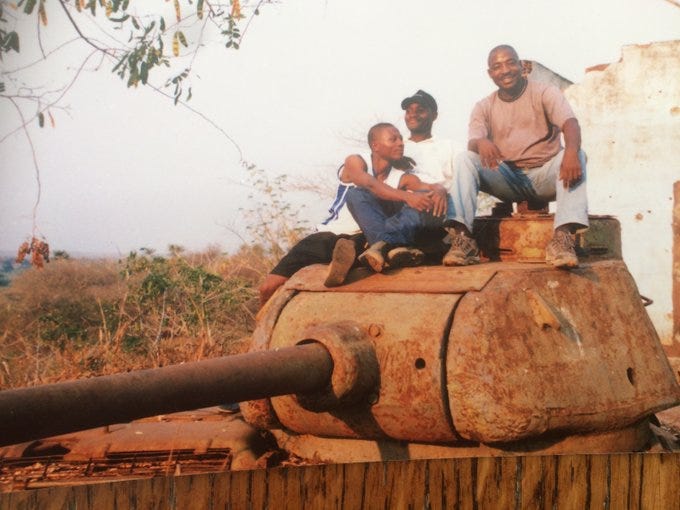
We met in his country, Angola, in 2002 immediately after the end of the 40 year civil war which ripped that country apart, and provided the backdrop to Angelo’s entire life. We were both working for Medecins sans Frontieres (MSF), and were sent on a madcap mission to try to deliver a Toyota Hilux 300 miles inland, across territory that had been lethally inaccessible for decades. Angelo was MSF’s most senior Angolan logistician. His role, among other things, was to distribute emergency food and medical supplies to the starving. Mine was to document and bear witness to the enduring injustices of victor to vanquished.
At the time of our journey, hundreds of thousands of shattered UNITA rebels and their families were finally stumbling out of the bush after terrorised lifetimes driven back and forth across that vast country by the violence. The government forces had finally won by starving the rebels out into the open. Many of them were dressed only in bark that they’d managed to peel from the trees. Our task was to try to find a route into the heart of the country, across roads peppered with landmines, where all the bridges had been blown up, to deliver emergency supplies to these demobilised rebels.
Angelo was the perfect travelling companion for this insane voyage. Last week, as we queued to get into our local Morrison’s, I asked him how this Covid situation compares to his other experiences. “This is nothing. When the war flared up in the 70’s I was five. I was stuck at school, amidst the fighting. There was no one to come and get me.” He wouldn’t say more than that. He doesn’t like to remember. A few days later I asked if he’d ever been under lockdown before. “Oh yes, pretty much every night of my childhood we had a curfew.” Five years I lived in Angola, 18 years together, and I never knew that. As a teenager, after a couple of years of hiding in his parents’ attic from press gangs, Angelo was forced into the Angolan government’s special forces and served for several years. He still has regular nightmares about the trauma of what he was forced to do and see. Other than a few mildly comic episodes, I know nothing of those times. He’s talked of sleeping on an inflatable mattress in a bombed out building somewhere in the interior and waking up floating on flood waters from a tropical downpour. Of being forced to do scores of somersaults as a punishment by army instructors. Nothing about the actual fighting. Eventually he escaped by walking 400 miles, across enemy lines, to neighbouring Congo. Try to imagine a situation where taking refuge in the DRC is preferable to staying at home. That’s how heinous Angola’s war was. He was then captured by UNITA and interrogated for 6 months, on suspicion of being a government spy. I cannot imagine what they subjected him to. When he was finally released he made his way to Zambia where he lived for 12 years in refugee camps, with no contact at all with any of his family inside Angola. From this desolate period I have more comic cameos. Of sleeping on the dirt floor of a shack with other refugees from Rwanda and DRC and waking up to find a massive snake curled up enjoying their body heat. Of breaking down, at dusk, in a national park full of carnivores, and being forced to fashion a fan belt out of a sock. During this time he worked his way up from UN driver, to Deputy Country Director of the NGO Norwegian People’s Aid. He also lost a baby daughter, and — unbeknownst to him, back home in Angola — two sisters, and countless friends. I am still never allowed to cook with sweet potato; there was a period of many months when all he had to eat was dried beans and sweet potato. When everyone else was panic buying toilet paper three weeks ago, he went out a bought a couple of kilos of Cassava to sustain us if everything else ran out. At one point, while working for NPA, he recklessly risked his life to drive into eastern Angola to rescue two of his staff who had been captured by UNITA while clearing landmines and accused of spying. He found then tied to a tree, about to be executed. For this rescue he was “rewarded” by his employers by being sent to Sarajevo for six months to train as a de-miner. Defusing booby trapped sofas and fridge freezers left by the Serbs for the Bosnians. So you see, the perfect chaperone for a journey through battle fields and mine fields, crossing from government to rebel territory.
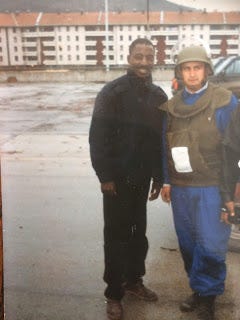
Angelo returned home to Angola for the first time in 1997 during a brief lull in the fighting. When the war flared up again he fled once more, this time to Cuba and Haiti. He returned home for good in 2000 and worked for Oxfam and Save the Children before joining MSF.
We fell in love during the three days that it took us deliver our 4 x 4. It was a delirious adventure. After years of being hemmed into the city by the rebels, we were able to drive across Angola’s vast, deserted and breath taking landscape. We had no map. There were no maps for roads untraveled for 30 years. At one point we took a wrong turn and drove for about 10 miles before realising our error. Angelo had to reverse the whole 10 miles back, rather than run the very real risk of triggering a land mine by veering off the tarmac to turn around. A year later we decided to get married. But then I got very sick and had to come back to the UK to access medical care. (The NHS saved my life, and has kept me alive ever since.) Angelo applied for jobs in the UK but ended up being offered one in Liberia, as Logistics Coordinator for medical emergency charity Merlin. He was the perfect man for the job — Liberia too was just emerging from its own vicious civil war. While he was there he managed a team of 60 and a budget of £2m and oversaw the reconstruction of a bombed out hospital.
He stayed in Liberia for 12 months. Merlin wanted him to stay on longer. Stupidly, newly wed and confident that he would be able to find rewarding work closer to home, I asked him to come back to the UK. So he did. And I could not regret that decision more.
Since that time — in 2006 — he’s never had decent work other than one brief six month contract. He’s desperate to work. Not so much for the money as for the self-respect and sense of purpose. We all define ourselves by what we “do”. He’s tried endlessly to find work in the UK, sending off hundreds of job applications that have never even been acknowledged. He has never been entitled to benefits, as a result of my income. And it turns out that if you’re not on benefits then the Job Centre has no interest in helping you find work as their targets are all about getting people off benefits. More dehumanising box ticking. Frustrated, he’s returned to Angola to find work there instead, but struggled there too as he’s been away too long and is viewed with suspicion. And so he has bounced, back and forth, on a relentless downwards spiral ever since. The only work he’s now able to get in this country is the kind of minimum wage, zero hours menial labour which has abruptly, ironically, been recategorised as “essential” in the last few weeks. He has worked in countless warehouses, picking and packing; in meat factories and glasshouses growing tomatoes; in the kitchens of schools and hotels and even at the Tory Party Conference at Manchester Central which has now become the North West’s “Nightingale Hospital”. He has toured the underbelly of the UK economy, part of the invisible army of devalued migrant labour that sustain our greedy lifestyles. In most of these workplaces the mindless menial work is done by a flotsam of folk swept in from the world’s trouble spots — Guinea Bissau, Afghanistan, Somalia. I am sure they have stories, and skills, that echo Angelo’s. The supervisors tend to be Eastern European. I wonder if Priti Patel has ever visited one of these workplaces? I’m certain she’s bought a lot of stuff made in, or shipped from, them. Angelo’s frustration, desperation and humiliation have been the backdrop to our entire marriage; to our daughter’s entire life. He survived the hell of civil war for 40 years, but being treated as worthless by our society has been his undoing. Depressed and angry, conditioned by enduring war trauma, a lot of the time he has behaved horribly.
I feel to blame, responsible as I am for bringing him here. I have invested so much thought and energy in trying to help him to get the opportunities he deserves. Filling in application forms and redrafting CVs. Paying for courses and writing to MPs. No, he doesn’t have Maths and English GCSE, but he has managed million pound budgets and can speak 10 languages. He can fix pretty much anything and has helped save thousands of lives. Writes beautiful poetry and dances like a dream. But none of this counts in our society. He would be deemed to be an unskilled migrant under Ms Patel’s system. Angelo decided long ago that the problem is ingrained, institutional racism. From my cosy position of white privilege I didn’t want to agree with him but have, reluctantly, had to conclude that he is right. And he has had so many despicable experiences which affirm this.
Here’s just one. We live in a leafy, middle class corner of Greater Manchester. One day in 2018 Angelo was walking down the hill past our local pub. A couple of guys were standing outside drinking pints. As Angelo walked past one of them decided to throw the dregs of his pint at him, while muttering something about “going back to where you came from”. They picked on the wrong guy. His reflexes kicked in and he flattened them both. The police were called. I actually expected Angelo to be the one charged. But no, the police believed him, maybe they already knew the other pair. They urged him to press charges. He didn’t have the heart, couldn’t see the point. But he did end up involved in some kind of “restorative justice” initiative where he went to his abusers’ house to try to get them to appreciate the person behind the brown face. They seemed astonished that he could speak English. That he had a British wife and child and passport. They claimed “We thought you was one of them people we see coming across on the boats from Africa all of the time.” Dear God.
I doubt either of them have ever heard of Angola. Or Niger or Eritrea or Somalia. I’m sure they have no concept of the lives lived in those places, of the desperation that drives people to leave their loved ones and traverse the Sahara and the Mediterranean and the Channel. Of the sheer determination and ingenuity it takes to reach our shores. I’d hazard a guess that they can’t speak any foreign language. That they have never lived or worked anywhere that they are the visible minority. That they probably voted for Brexit. They are a testament to the failure of our education system. But they are quite possibly the people ticking the boxes in offices across this land, consigning talented people to the scrap heap.
There are a couple of mantras that I live by. One of them is that people, the world over, are the same; what differentiates us is our opportunities. From Syria to Sudan, Salford to Somalia, I have spent my working life trying to create opportunities for deserving people. This philosophy is rooted, in large part, in my own education. I had the privilege to attend an extraordinary school — Christ’s Hospital. A 470 year old private school for people who could never normally afford a private education. A mixing pot which forces everyone to dress in a bizarre interpretation of Tudor costume, eradicating their visible differences and backgrounds, judging them instead on their intrinsic character and merits. At the leaving ceremony you are charged never to forget the benefits that you have received at the school, and in time, to do everything in your power to extend those benefits to others. I have done my best. But in my own home, where I am the visible minority, I have failed.
I wrote, a month ago, that this Corona crisis could finally be Angelo’s moment. When the value of a person with 20 years’ experience of life saving humanitarian logistics might finally be recognised. In the last month he has applied to work for all of our local supermarkets. To the Kelloggs factory across the Ship Canal. To Amazon and UPS. All of these places are apparently in urgent need of staff. He’s not heard from any of them. Even my stubborn optimism may have to admit defeat. I am so tired of hoping. But maybe, instead, it’s our moment, as a couple and family. Over the years, as Angelo has become more depressed and directionless, I have in turn become more stressed and overstretched as I try to compensate. We have drifted apart. I too, have become frustrated and resentful. Have lost sight of the man that I met on that trip to Mussende. His calm good humour, wry resourcefulness, dazzling smile. We have spent less and less time together. Have stopped creating memories together. But now we have time. Thanks to this cruel virus we are forced to stay home. To reconnect and remember what we saw in each other. Maybe time to plot a way back to who we were. To plot a different way forward. Perhaps, for us, the ultimate gift of this virus will be a chance to bring the gifts of time, solidarity and perspective to bear on our own story.
For the next instalment, click here:


